
Before attempting to propagate a ficus, carefully familiarize yourself with all the methods available. Learn which method is best for each type of houseplant. Otherwise, the process will not yield the desired results.
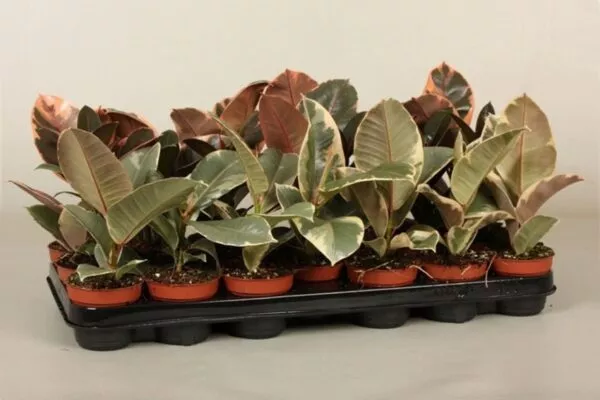
Features of reproduction depending on the flower type
| Name | Type of reproduction | Rooting period | Recommended substrate |
|---|---|---|---|
| Ficus Benjamina | Cuttings | 4-6 weeks | Peat with sand |
| Rubber plant | Air layering | 3-4 weeks | Sphagnum moss |
| Ficus lyrata | Sheet method | 2-3 weeks | Water |
There are over 840 species and varieties of ficus, but in indoor conditions are grown Not many. Each flower has its own characteristics, which determine its propagation method.
Features for the most popular types:
Semi-woody branches are used for cuttings; rooting in a nutrient-rich medium is essential. Only after roots have formed can they be potted.
Please note that the sap of ficus trees causes severe burns to the skin, so work only with rubber gloves.
Preparing for the procedure
Preparatory work helps create a comfortable working environment. It's convenient when everything is prepared in advance and always within reach. To propagate a ficus, first choose a location; it's best to do this on a large table covered with plastic wrap or paper. Lay out your tools, containers, gloves, growing medium, etc. on the table.
Necessary tools
In the process of flower propagation, you may need the following tools and materials:
- pruning shears, scissors and a knife – these are used to separate the seedling from the mother bush;
- brush - used to powder the cut areas;
- crushed wood ash or activated carbon - for treating cut areas;
- antiseptic (for example, alcohol) – to disinfect instruments;
- Rubber gloves – this will not only keep your hands clean, but will also protect you from the toxic sap of the ficus.
Choosing a location
The surface on which the procedure will be performed should be as hard as possible. Water should be readily available. Keep in mind that the table should be clear of any unnecessary items, as ficus parts (leaves, bark, roots) or substrate may fall onto the floor. Therefore, cover the floor as well as the table. Alternatively, remove the rug to avoid staining it. Work in a well-lit area.
Preparing the pot and soil
Ceramic, clay, and high-quality, thick plastic are ideal for ficus plants. The top should be wide, and the container type should be chosen based on the plant's species and variety.
Features and preparation:
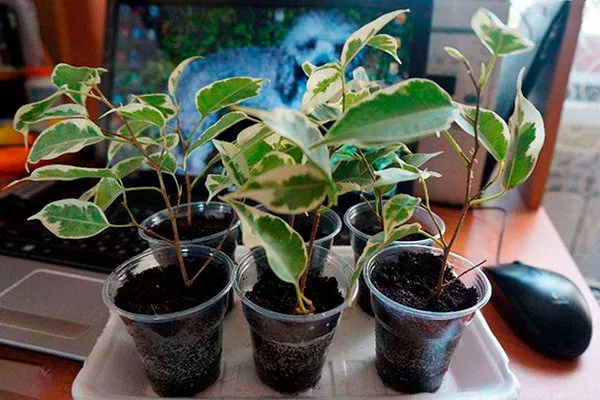
- Depending on the propagation method, you may need plastic cups - they should not be transparent, but matte;
- The containers must have holes to drain excess water;
- the diameter of the pot should be slightly larger than the root system (take this into account when transplanting a rooted seedling to a permanent location);
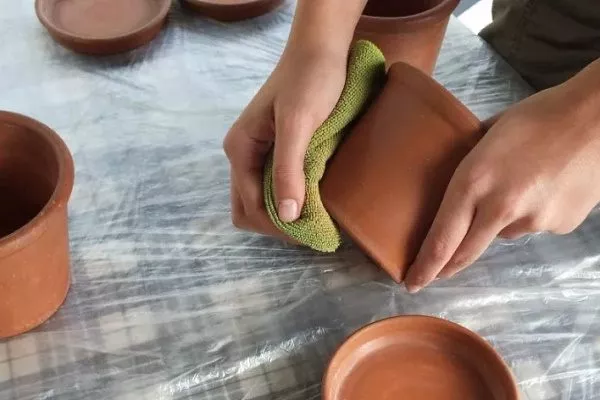
- Disinfect the containers - scald them with boiling water, pour in a pink solution of potassium permanganate.
The soil for seedlings needs to be permeable and loose, but not too loose. Therefore, the optimal option is considered to be a composition of:
- leafy and soddy soil - 3-4 parts each;
- peat and river sand - 1 part each.
To prevent infection of the seedling, which still has a weak immune system, be sure to disinfect the soil as well. This can be done in the following ways:
- With manganese solution. Dissolve potassium permanganate in water to create a pink (or lighter) solution. Pour the soil over it and let it dry thoroughly before using.
- In the oven. Preheat the oven to 200 degrees Celsius (400 degrees Fahrenheit) and roast the earth for 20-30 minutes. If you set the oven temperature to 100 degrees Celsius (212 degrees Fahrenheit), the roasting time will increase to 4-5 hours.
- With boiling water. Pour boiling water over the soil and let it dry.
- Freezing. Place the soil in a plastic bag and place it in the freezer for 10-12 hours. Defrost, then refreeze. The temperature should be at least -10 degrees Celsius.
Rooting methods
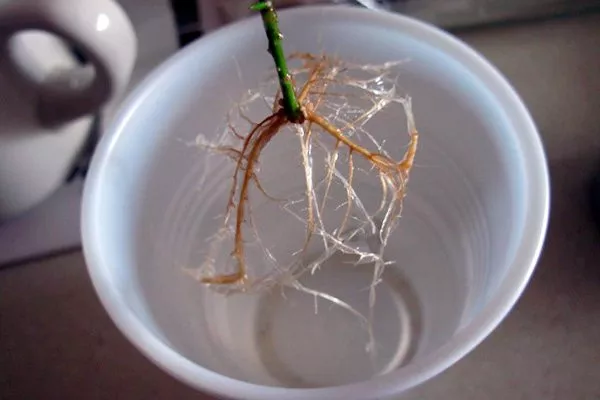
Regardless of the propagation method (except seed), cuttings must be rooted. Only after the root system has formed can the plant be transplanted into a permanent pot. This can be done in three ways: in water, in a substrate, or in a peat pellet.
In the water
Rooting from layers, cuttings, and leaf shoots grows well in an aquatic environment. Water rooting offers the following advantages:
- You can always see the condition of the Koreans - how ready they are for permanent transplantation;
- the roots grow much faster than in the soil;
- no need to prepare the substrate;
- It is enough to use simple plastic cups instead of buying small pots.
- ✓ The water temperature for rooting should be no lower than 22°C and no higher than 26°C.
- ✓ Use only settled water for rooting to avoid leaf chlorosis.
There's one drawback: constant soaking in water can cause the stem to rot, so it's important to change the water every three days and keep the glass in a warm room. You should also monitor the condition of the cutting.
How to root in water:
- Pour boiled water into a glass.
- Place a branch or leaf (sprout) in it.
Be sure to shade the glass—wrap it in dark paper, etc.—as light promotes algae growth in the water. Keep in mind that the stem should be positioned so that the bottom growing point is underwater. You can repot it when the roots have grown 3 cm.
In the ground
Rooting in substrate is more difficult than in water, so this method is more often used by experienced ficus growers. Another drawback is the inability to control the rate of growth and root formation. This method is not suitable for leaves and aerial roots.
However, this method is renowned for its high level of effectiveness, as the root shoots will be very strong (not watery), which will make adaptation to the permanent pot quicker and easier.
How to do it:
- Place a layer of pebbles (expanded clay, perlite) on the bottom of a glass or small pot.
- Add the substrate on top. Ideally, it should consist of equal parts soil, peat, and sand. To promote rooting, the soil mixture should be looser than that in the pot if planting for permanent cultivation.
- Insert the cutting.
- Cover with cut plastic wrap.
After the green buds have formed, remove the covering. water daily.
In a peat tablet
It's best to sow ficus seeds in peat pellets, but you can also use twigs. This method is advantageous because the pellets already contain all the necessary nutrients.
How to root:
- Soak peat tablets in water for 24 hours.
- When they swell, make a hole in the center to fit the seed or cutting.
- Insert the planting material.
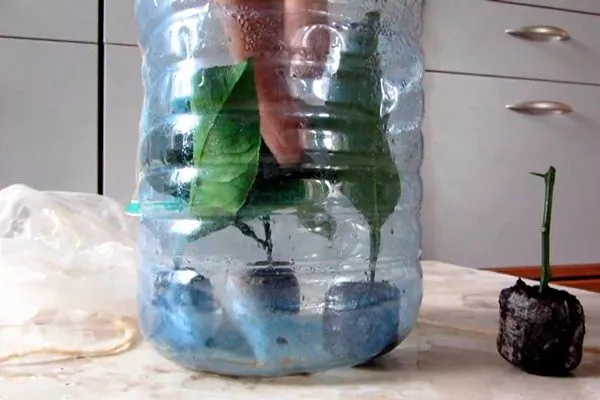
- Transfer the tablets to a container with 1-2 cm of water at the bottom. This ensures that the tablets remain moist.
- Cover with plastic.
Water frequently and thoroughly, without letting the peat dry out.
Methods of propagating ficus
After preparing the substrate and containers, you can begin the propagation process. But first, decide which method is most appropriate. This depends on the ficus variety and the grower's personal preferences. To make your choice, carefully study each technique.
Sheet method
This propagation technique is considered the simplest and most common, as an accidentally broken leaf can be repurposed rather than thrown away. A mandatory requirement is that the leaf must have a shoot at least 5 cm long.
Step-by-step instructions:
- Cut the bottom of the shoot at a 45 degree angle.
- Treat the cut areas on the bush and leaf with activated carbon.
- Leave the planting material on the table to allow the milky sap to dry. This process takes about an hour, depending on the ficus variety.
- Prepare a solution from any rooting agent (Kornevin, Epin, Heteroauxin, etc.), according to the instructions.
- Place the bottom portion in it. Keep it there for as long as indicated in the instructions for the medication.
- Take a sharp knife and make scratches just under the leaf.
- Put it to root.
- When roots of 3-4 cm appear, prepare the substrate and prepare the pot.
- Place drainage material on the bottom and soil mixture on top.
- Make a hole in the center and insert the sprout so that the base of the leaf blade is at soil level.
- Moisturize, but not too much.
- Lightly compact the soil.
- Insert a wooden stick next to the shoot to serve as a support.
- Since the leaf is large, roll it into a tube and tie it with thin thread. This will simplify the covering process and reduce the loss of moisture, as it's through the leaf blades that the plant releases moisture.
- Cover with plastic wrap/jar/plastic bottle.
For more information on how to grow a ficus from a leaf, watch the following video:
Propagation by cuttings
Another very common method. However, for successful propagation, it's important to follow several basic requirements:
- The length of the cutting should vary from 10 to 15 cm. Always make the lower cut at an angle and the upper cut straight.
- Each section must have at least one eye that is not damaged.
- The cutting should be fully or partially woody. Keep in mind that very young cuttings will not root fully. Furthermore, they rot quickly, regardless of the rooting method (water or substrate).
- The mother plant experiences stress when separating the cutting, so try to use one long shoot rather than several short ones.
- If the ficus is tree-like, then cut off the upper fragments on the trunk or stem, but be sure to include the bud.
The process of reproduction is as follows:
- Cut off the whip.
- Use pruning shears to divide it into several pieces so that each has 1-2 buds and a leaf.
- Treat the cut areas. You can use not only charcoal or activated charcoal, but also a pink solution of potassium permanganate.
- Remove all the leaves. The shoot should remain bare.
- If desired or necessary, root the cuttings. Otherwise, proceed with planting immediately. To do this, use a sharp knife to make a vertical cut on the underside of the cutting. However, if the bark is already very woody, make two cross-shaped cuts.
- Place the cuttings in a rooting stimulator.
- Prepare the pot and substrate. Place expanded clay or other drainage material on the bottom, filling up 1/3 of the container's volume. Place enough substrate on top to leave 5 to 10 mm of space above the pot's rim.
- Make a depression in the center.
- Insert the cutting into it.
- Cover with film or a jar.
- Place it in a warm place. This is usually the kitchen.
Propagation by cuttings without rooting has several advantages, including eliminating the need to repot the young plant twice, which reduces the risk of problems. However, it's important to moisten the substrate more generously during the first couple of months, unlike with rooting in a glass. However, this should be done carefully to prevent root rot.
Also watch a video on how to propagate cuttings:
Air layering
This method is considered the most reliable, with roots growing in a maximum of 20 days. A disadvantage is that it cannot be used for many ficus species—only for arborescent epiphytes. Layering can be either aerial or horizontal.
Air layering propagation procedure:
- Select a healthy, strong branch from the bush. This could also be a section of the trunk. Keep in mind that this section should be 50-60 cm from the pot surface. The presence of a living bud is essential.
- Trim the selected section, removing all leaves and other branches. The length of the section should be approximately 15 cm.
- Under the bud, mark a strip of bark, 1 to 3 cm wide, depending on the plant's size. Now, using a very sharp knife, carefully trim the bark along this strip.
Process:- you need to make two cuts in a circle;
- after one across these two;
- then you need to bend back the bark and carefully remove it around the entire circumference of the trunk.
- Sprinkle the area left without bark with a rooting agent, which is sold in powder form.
- Wrap the area with sphagnum moss, pre-moistened with a spray bottle. The moss should be 2-3 cm wider on each side than the exposed area.
- Wrap the moss with cling film or plastic wrap and secure with rope (tape, thread, soft wire)
Wait a few months for the root shoots to form. Then, cut the branch below the clamp, remove the film, and transplant the shoot into the substrate.
Horizontal layering is propagated as follows:
- Select a long, flexible shoot with aerial roots.
- Remove all leaves.
- Press the cutting into the soil and sprinkle with substrate.
- Secure the escape.
Once the cutting has taken root, transplant it into a pot in the standard way.
To see how gardeners do it, watch the video below:
Seeds
This method is used extremely rarely. There are many reasons for this: it's difficult to find and collect seeds, the process is too long and labor-intensive, and it's impossible to accurately replicate the parent's characteristics.
To put it briefly, the procedure looks like this:
- Soak the seeds in a weak solution of manganese, then in a humid environment for germination.
- Mix peat with sphagnum moss and place in a container with a lid.
- Place the seeds in the mixture. Water with warm water.
- Close the container.
- After the first leaves appear on the seedlings, pick them out and, after rooting, transplant them into a permanent pot.
To learn how to properly propagate ficus from seeds, watch the video below:
Part of the root
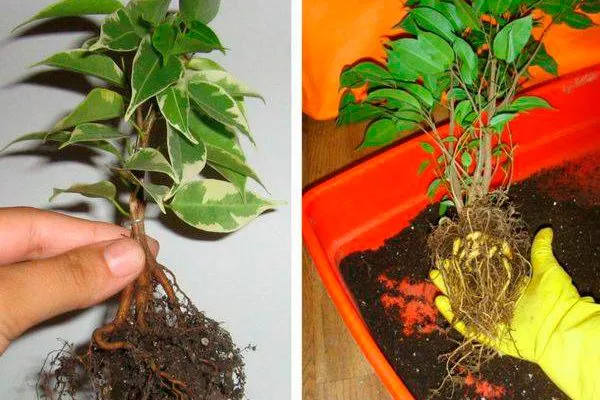
Another name for this method is bush division. This method is useful when replanting a plant, so as not to disturb the bush otherwise.
How to do it right:
- Water the substrate the day before planting, which will make it easier to remove the bush from the pot.
- Remove the plant using the transshipment method.
- Remove any soil and rinse under water. Boiled water is best.
- Using a sharp knife, divide the bush into two or more parts. Make sure each part has healthy root shoots, leaves, and buds.
- Plant in the standard way.
With the help of shoots
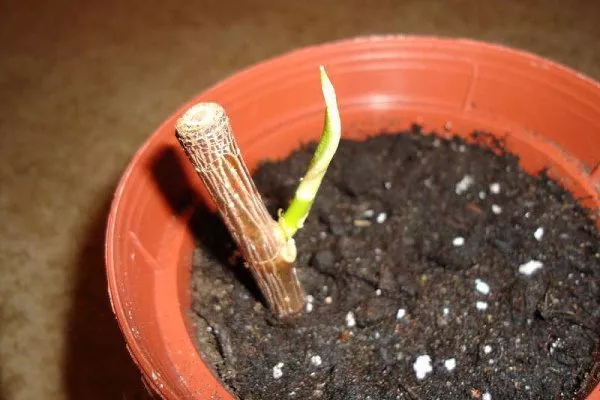
This method is also known as stem cuttings. It's most often used for large-leaved ficus trees. A stem with a leaf and bud is required. If the stem is too long, it is cut into pieces, each about 20 cm long.
This method simultaneously rejuvenates the plant, so it's most often used for older bushes. You can use the same method to replant a accidentally broken shoot. The trick is to plant the stems directly in the potting mix. Then, proceed as with cuttings.
Questions and Answers
When propagating a ficus, unexpected questions arise, the answers to which are difficult to find right away. Here are some of the most common:
Tips from florists
To achieve positive results when propagating ficus, pay attention to some recommendations from more experienced ficus growers:
- When the seedling is under a film cover, be sure to ventilate the sprouts daily, otherwise they will rot;
- It is forbidden to remove the film immediately - you must first leave the flowers without cover for an hour, then for two, etc.;
- After planting, the soil should always be kept moderately moist - not only drying out, but also over-watering is harmful;
- pay attention to the lighting – do not place it in direct sunlight, but it is better to make the light diffused;
- average air temperature – +24 degrees;
- The best time for breeding is from April to September, but keep in mind that there should be no sudden changes in temperature, so do not allow drafts;
- you can plant it in a permanent pot only when 4-5 new leaves have formed;
- Be sure to treat all instruments with alcohol or another antiseptic;
- Pour boiling water over the pots.
Before you begin propagating a ficus plant indoors, familiarize yourself with all the methods, find out if a particular method is suitable for your plant species, and be sure to have everything you need ready. Remember that many ficus plants have a milky sap that contains toxic substances, so be sure to wear rubber gloves.