
Today, there are a large number of violet varieties. However, plant breeders continue to surprise us with new varieties. We invite you to explore unique violet varieties with shades of green.
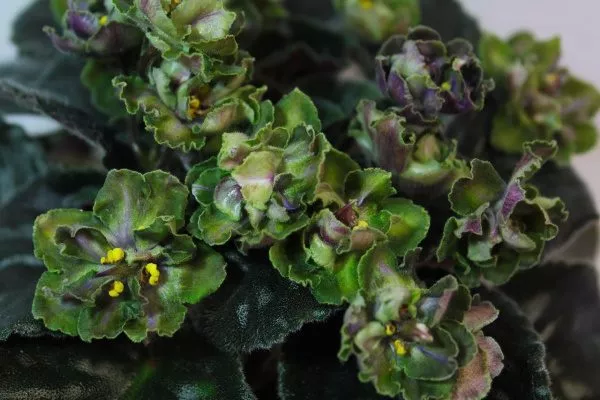
Violet AV-Kuporos
Where does the green color of violets come from?
In these violets, the green pigment appears due to excessive chlorophyll production. For this reason, these varieties are particularly prized by gardeners for their long flowering period. However, among green-flowered violets, there are no pure green specimens—the petal edges are colored in a unique border.
The border can be emerald, light green, turquoise or yellow-green, making each plant original and unique in its own way.
Varieties with green petals
When choosing green violet varieties, it's recommended to familiarize yourself with their characteristics and features. Explore violet varieties with green petals.
| Name | Petal color | Flower shape | Flowering period |
|---|---|---|---|
| LE-Master Yoda | white and green | terry with corrugated edges | long-term |
| LE-Kupava | white with green edges | stars | long |
| LE-Kalina Color | white with green trim | semi-double | long-term |
| LE-Mojito | white with green border | stars | incessant |
| LE-Tamara | white and green | semi-double with corrugated edges | long-term |
| AV-Kiwi | deep green with a white/light green eye | bells | long-term |
| AV-Kishmish | dark green with a light eye | semi-double | long-term |
| N-Frog | white and green | bouquet | abundant and prolonged |
| N-Snow Dahlia | white with green backing | dahlia | abundant long-lasting |
| EK-Green Cockatoo | white and light green with a lilac mesh | pansies | long-term |
| EK-Emerald Roses | white and cream with green fringe | pansies | long-term |
| Grinya | white with green trim | semi-double and double | long-term |
| AN-White Fillings | green, then turn white | pansies | long-term |
| BO-Green Turtle | white with green border | miniature | long |
| Irish Glen | white and green | stars | abundant and long-lasting |
| Emerald Love | white and cream with green trim | stars | long-term |
| Emerald Bell | light green | bells | abundant without interruption |
| Silverglade Apples | white with green edge | semi-double and double | up to 3 months |
| Rose Spring | white with a greenish border | average | long-term |
| Green Horizon | white with green edges | stars | abundant and prolonged |
| Paul Green | snow-white with green fringe | compact | long-term |
LE-Master Yoda (E. Lebetskaya, 2017)
The Master Yoda violet was bred by Elena Lebetskaya. It has a compact, even rosette topped with bright green leaves. The double flowers, with ruffled edges, are white and green. This violet has an unusual and unique appearance.
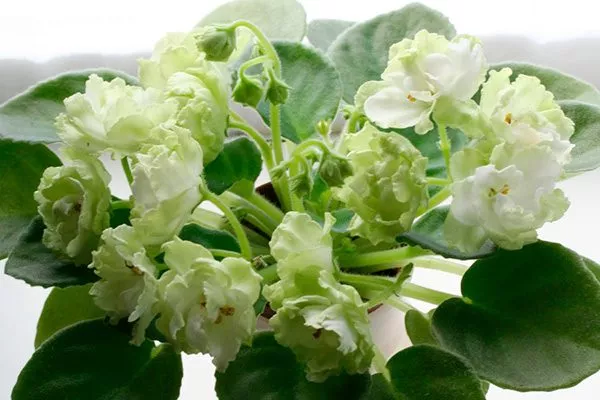
LE-Kupava (E. Lebetskaya)
Breeder Elena Lebetskaya developed the Kupava variety. The medium-sized, star-shaped flowers resemble a river lily. The petals have wide, vibrant green edges. The semi-double white flowers darken in the center over time.
The rosette is neat, covered with rounded, wavy leaves that seem to "hug" the planter. The violet grows quickly, profusely, and blooms for a long time.
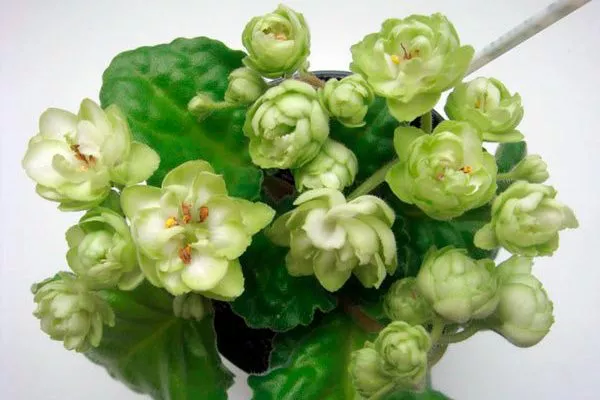
LE-Kalina Flower (E. Lebetskaya)
Violet "Kalina Tsvet" (Viburnum Color), bred by Elena Lebetskaya, features semi-double white flowers. The petals have a wide, corrugated green border.
The rosette is even, neat, and covered with rich green foliage. Long flowering is the main advantage of the Viburnum Violet.
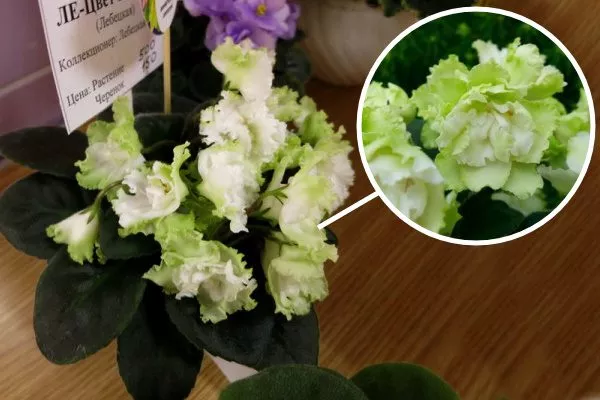
LE-Mojito (E. Lebetskaya)
Breeder Elena Lebetskaya developed the Mojito variety. This violet is renowned for its white, semi-double and double star-shaped flowers with a bright green edge. Several inflorescences appear on tall stems.
The emerald-green, smooth rosette is covered with neat leaves. The violet is renowned for its incessant flowering.
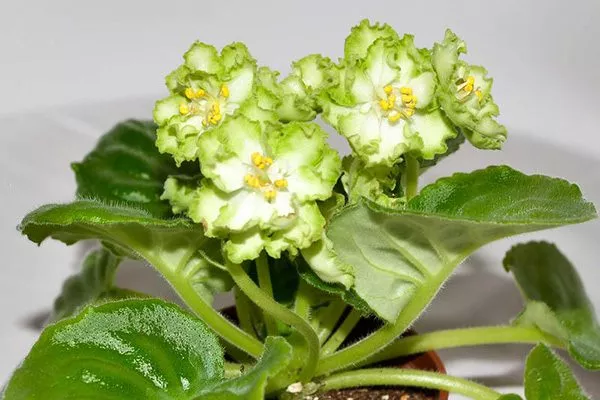
LE-Tamara (E. Lebetskaya)
Tamara is an interesting variety of white and green violet. It features semi-double flowers with ruffled petal edges. The plant has a smooth rosette with beautiful emerald leaves.
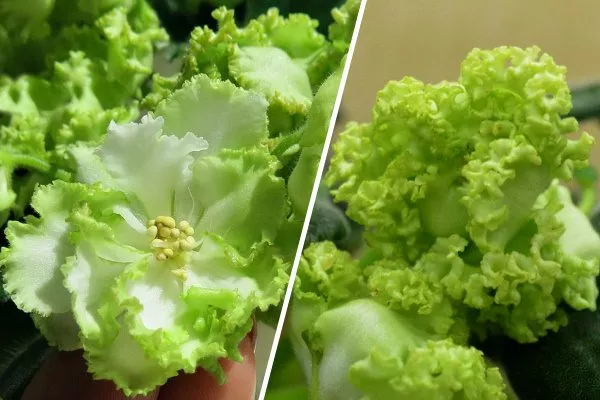
AV-Kiwi (A.P. Tarasov)
The violet grower who developed the AV-Kiwi variety ensured the plant had an interesting coloring. The bell-shaped flowers are a rich green with a white/light green eye. The smooth rosette is studded with quilted, rounded leaves.
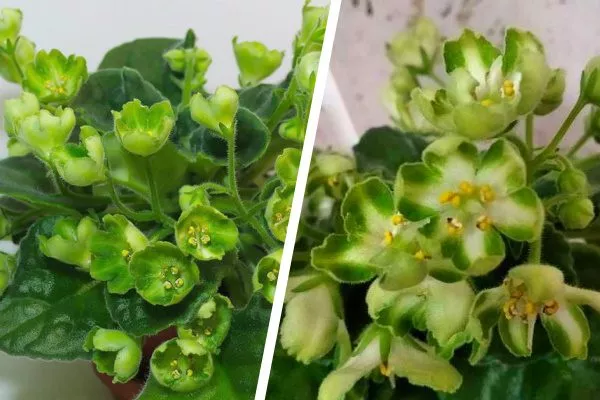
AV-Kishmish (A.P. Tarasov)
The AV-Kishmish violet is renowned for its small, semi-double flowers, reminiscent of miniature water lilies. The petals are dark green, and the eye is light green.
The compact rosette is covered with medium-green, slightly wavy leaves. This variety is renowned for its long flowering period.
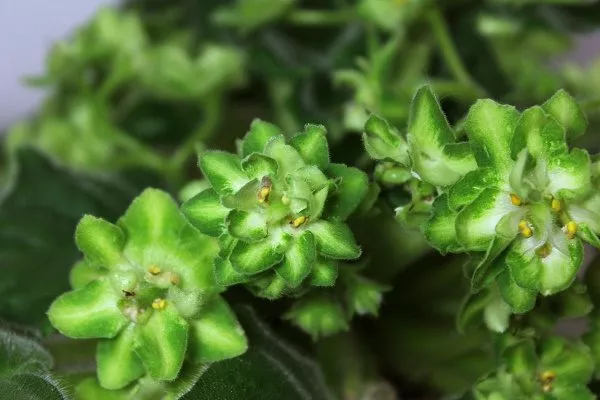
N-Frog (N. Berdnikova)
Breeder Natalia Berdnikova developed the Lyagushonok variety. This violet boasts a bouquet of white and green flowers. The flowers are held on sturdy stems, with 5-7 on each.
The rosette is smooth, medium-sized, and consists of light green leaves with a silvery underside. The quilted leaves have a serrated edge. This variety is popular for its abundant and long-lasting blooms.
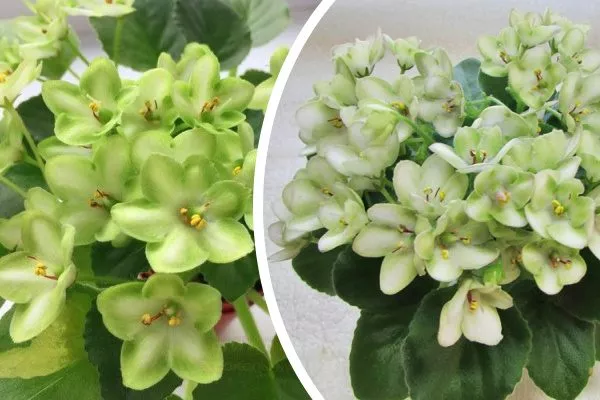
N-Snowy Dahlia (N. Berdnikova)
The Snow Dahlia violet by Natalia Berdnikova is renowned for its white flowers with a green underside that extends to the outer edge of the petals. The separate petals give the flower a dahlia-like appearance.
The miniature rosette is covered with medium-green, serrated foliage. The Snow Dahlia variety is renowned for its abundant, long-lasting blooms.
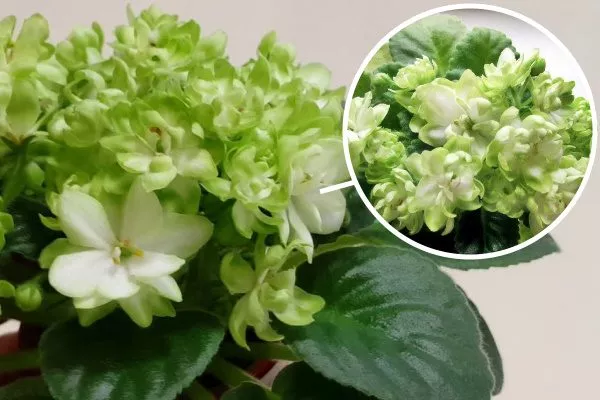
EK-Green Cockatoo (E. V. Korshunova)
When developing this variety, the breeder ensured that the flowers were large and double. These neat pansies are characterized by a white-green color with a lilac mesh, and the fringed edges of the petals have a bright cucumber color.
The variety gets its name from its resemblance to a flock of green parrots frolicking against the dark, glossy foliage. The rosette is even.
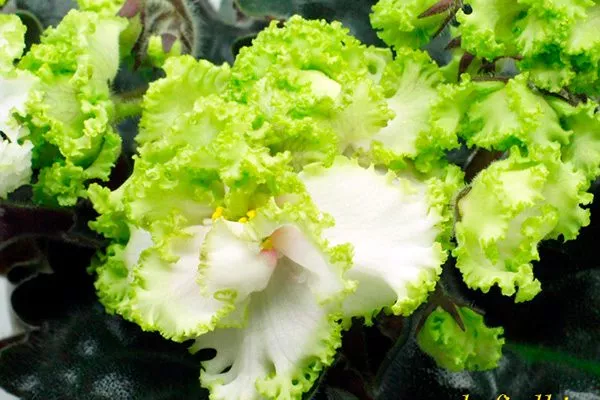
EK-Emerald Roses (E. V. Korshunova)
Emerald Roses is a variety developed by E. V. Korshunova. It is characterized by interesting inflorescences, with large, densely double flowers. The petals are a creamy white hue, with a green fringe around the perimeter. The flowers resemble pansies in appearance.
The rosette is normal, standard. The leaves have wavy edges and rounded teeth. The leaf blades are colored green.
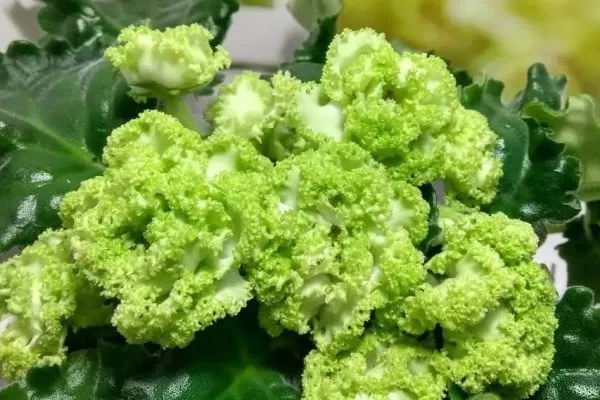
Grinya (T. Dadoyan)
Breeder Tatyana Dadoyan developed the violet 'Grinya.' The plant is covered in large, fluffy, semi-double and double flowers. The petals are white, edged with green.
The smooth rosette is covered with wavy leaves that have an attractive bright green hue, making the plant look even more appealing.
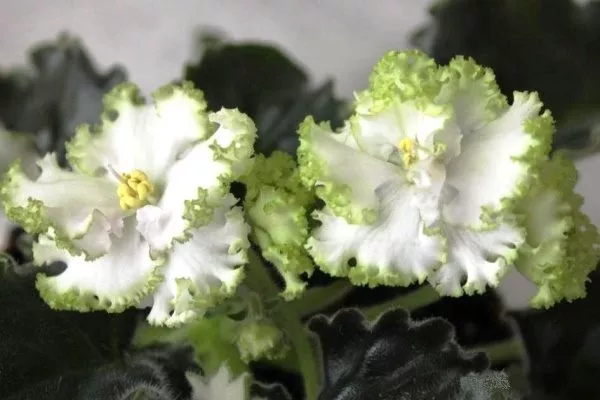
AN-White Fillings (N. Andreeva)
The White Nalivy violet, bred by Natalia Andreeva, is characterized by small, pansy-like flowers. The buds open gradually, initially green, then turning white. The petals are edged in a green apple hue, hence the variety's name.
The rosette has a nice, even shape, with densely arranged, wavy leaves of a bright green hue. The rosette height does not exceed 30 cm.
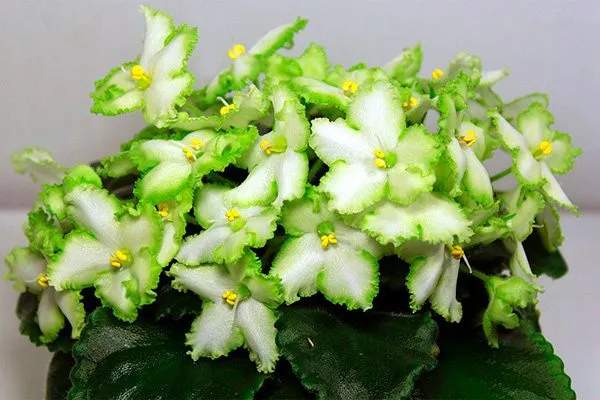
BO-Green Turtle (B. Kosceviat)
Breeder Bohdana Koscewiat developed the Green Turtle variety. She created a compact plant with miniature white flowers, the petals of which have a green border and a neat yellowish center.
The smooth, miniature rosette is covered with emerald leaves of a classic shape. This variety is renowned for its low maintenance and long flowering period.
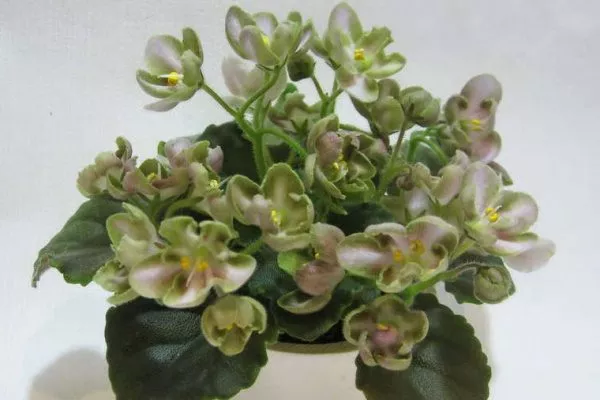
Irish Glen (D. DiCamillo/LLG)
The Irish Glen violet, bred by D. DiCamillo, is considered an unusual variety. Its distinctive feature is its abundant and long-lasting blooms.
The rosette is studded with numerous star-shaped flowers, which, when not fully open, resemble hop cones. The petals are white and green.
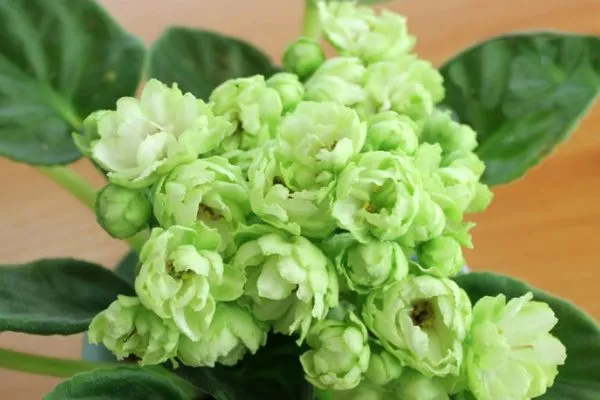
Emerald Love (E. Kolb)
The Emerald Love violet was bred by E. Kolb. The plant is renowned for its simple, star-shaped flowers, a creamy white hue. The petal edges are edged with a wide green border.
The flowers resemble snowdrops more than violets. The smooth rosette is covered with wavy, dark green foliage, the undersides of which are tinted red.
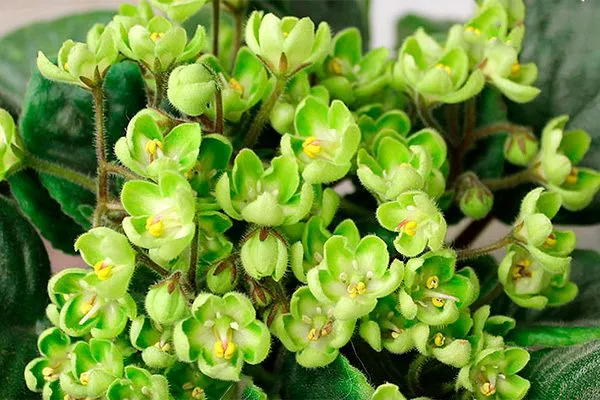
Emerald Bell (O. Barysheva, 2016)
The Emerald Bell variety, bred by Olga Barysheva, translates as "emerald bell." It features simple, bell-shaped flowers. The rosette is covered with light green foliage.
The advantage of the Emerald Bell violet is its ability to bloom abundantly without interruption for months.
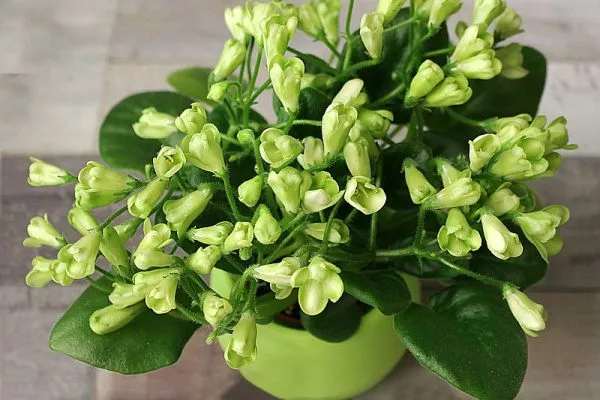
Silverglade Apples (S. Harrison)
Silverglade Apples is a violet characterized by semi-double and double flowers. The petals are edged with green. The smooth rosette is studded with medium-green, quilted, slightly serrated, and wavy foliage. The long, bumpy leaves reach up to 17 cm.
The white, rounded flowers have a wide, bright green, heavily ruffled border. The buds open very slowly, as the excessively dense fringe on the flowers hinders their development. Blooming can last up to three months.
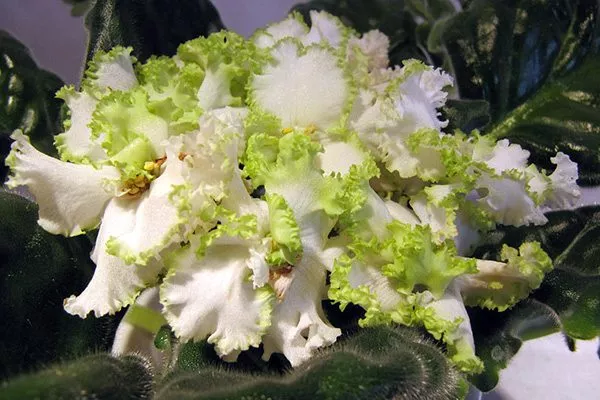
Rose Spring (P. Sorano/LLG)
The Rose Spring violet is renowned for its neat rosette, whose medium-sized leaves have a smooth, textured finish and a glossy, shiny surface. The leaves are heart-shaped and have slightly wavy edges.
The violet is characterized by a calm green color palette. The flowers are medium-sized, white, and have a neat greenish edge.
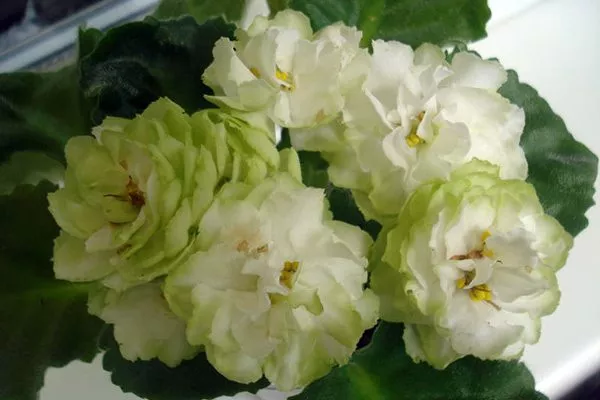
Green Horizon (P. Sorano/LLG)
White, double, star-shaped flowers are framed by wide green edges. In rare cases, gray-blue specks may appear along the petal edges. The flowers reach 4.5-5 cm in diameter. The violet's thick, dense petals ensure a long bloom.
The neat, even, large rosette bears medium-green foliage. This variety is characterized by abundant and long-lasting flowering.
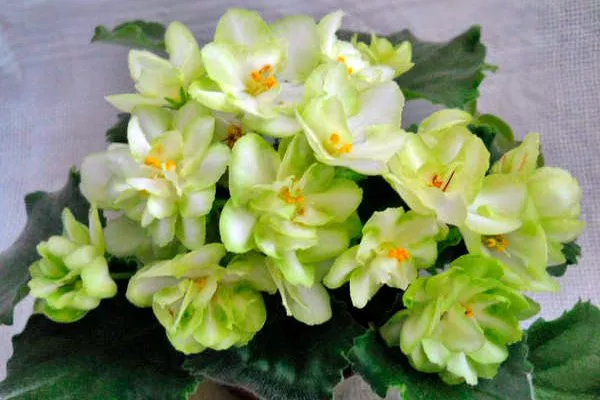
Paul Green (Paul Bunyan)
Saintpaulia 'Paul Green' is a popular variety with an interesting coloring. Its petals are a snow-white shade, while the fringed edge is green. The bushes are compact, reaching 20-24 cm in diameter.
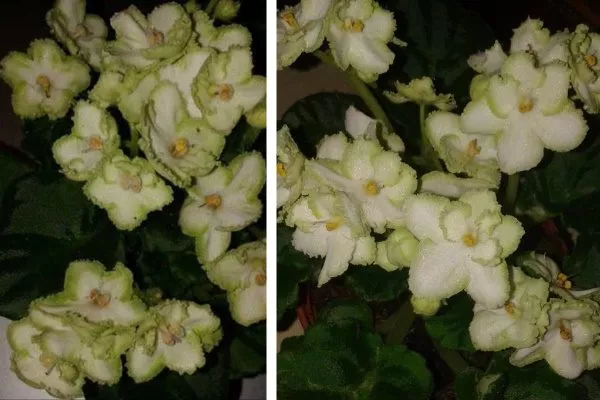
The rosette is compact, even, and neat. The leaves are medium green and have a classic shape.
Saintpaulias with green-pink petals
There are many varieties of violets with greenish-pink petals. We suggest you read the descriptions of these varieties.
EK-Lotus Lake (E. V. Korshunova)
Breeder Elena Korshunova developed the "Ozero Lotosov" variety. She created a violet with large, double white lotus-like flowers with green outer petals and a pink center.
The rosette is smooth, compact, and covered with serrated, quilted leaves. This variety is renowned for its abundant blooms in large clusters.
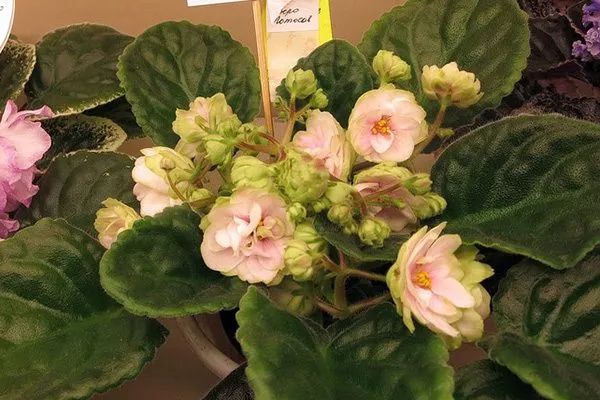
EK-Lovebirds
A violet with large, double flowers, dark green in color, and petals with lilac-pink centers. The petals are edged in green. Its name derives from the visual resemblance to a flock of bright, rosy-cheeked lovebirds perched atop the lush foliage.
The plant has a good rosette, consisting of rich green, slightly wavy leaves with rounded teeth.
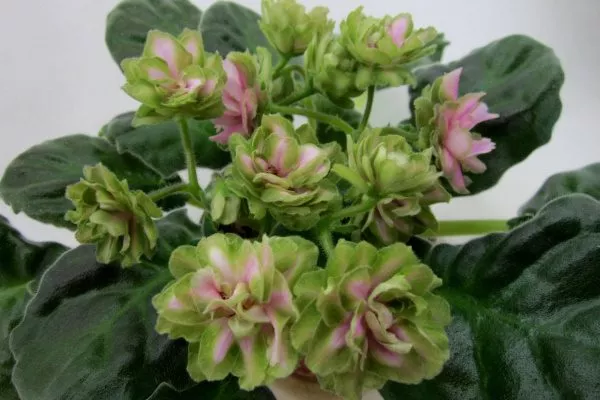
EK-Green Chrysanthemums (E. V. Korshunova)
The Green Chrysanthemum violet gets its name from its resemblance to these popular flowers. The large, double flowers with white petals have wide, rich green edges. Pink markings are sometimes visible in the center.
The rosette is even and neat, dotted with slightly quilted, green, serrated leaves. A very beautiful and popular variety.
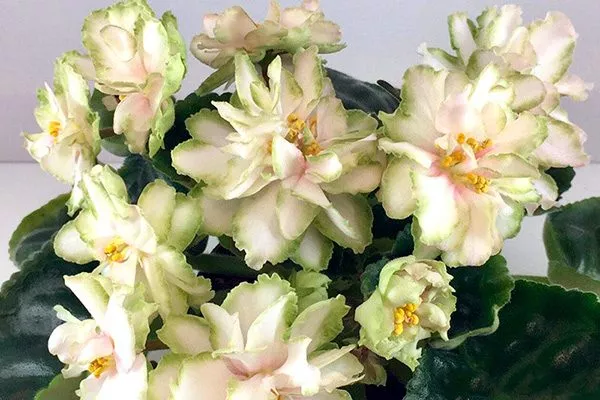
EK-Dance of the Water Lilies (E. V. Korshunova)
Breeder E. V. Korshunova developed the "Dance of Water Lilies" variety. This violet is renowned for its large, double white flowers with a pink glow at the center. The petals also have a green edge, giving the plant a unique appearance.
The smooth rosette is covered with green, serrated leaves. This variety is characterized by a long flowering period. The flower cap is lush and eye-catching.
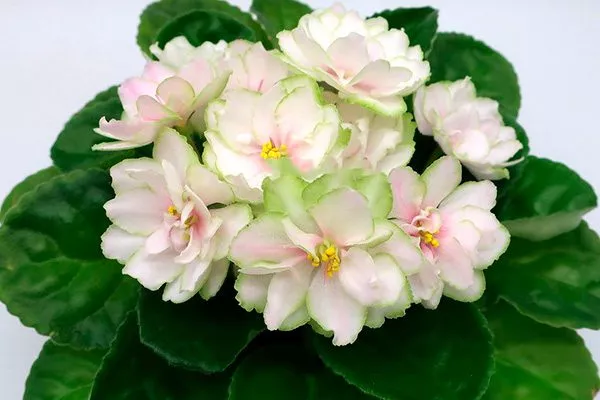
N-Green Tea (N. Berdnikova)
The Green Tea violet was developed by breeder Natalia Berdnikova. The semi-double flowers are white and green, with occasional hints of pink along the petal edges.
The rosette is compact, with medium-green leaves. This miniature variety is renowned for its long flowering period.
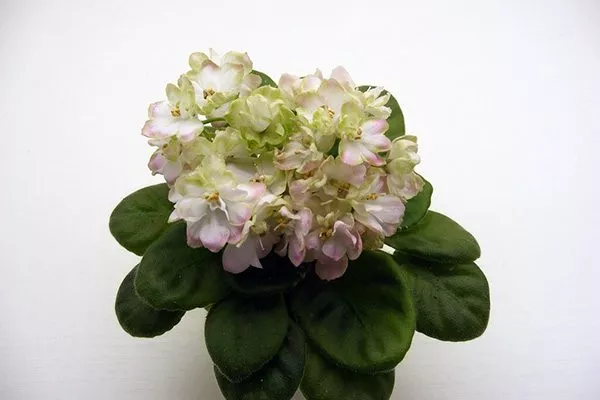
TV-Paradise Apples
The Paradise Apple violet features double, semi-open flowers with cupped petals. The beautiful blooms range in color from light green to soft pink with a green edge.
The rosette is neat, covered with light green, heart-shaped leaves. The violet blooms for a long time, up to 9 months.
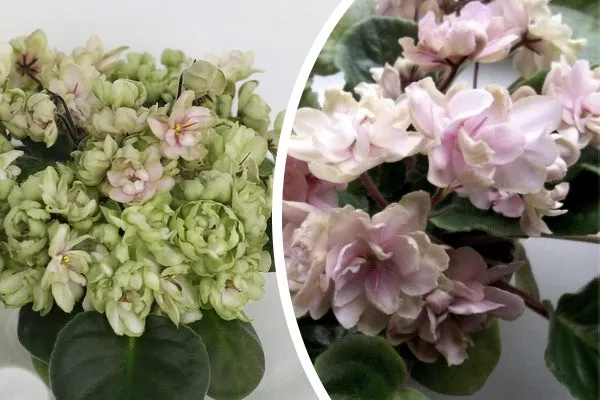
Colored varieties with green fringe
Violets with green fringes are also common, and they are very popular among violet growers. These varieties are very eye-catching and easy to care for.
RS-Green Corals (S. N. Repkina)
The Green Corals violet, bred by S. N. Repkina, is characterized by simple blue-white star-shaped flowers framed by a bluish edging and bright green fringe.
The plant has a compact, neat rosette, dotted with corrugated foliage, colored in a medium green shade.
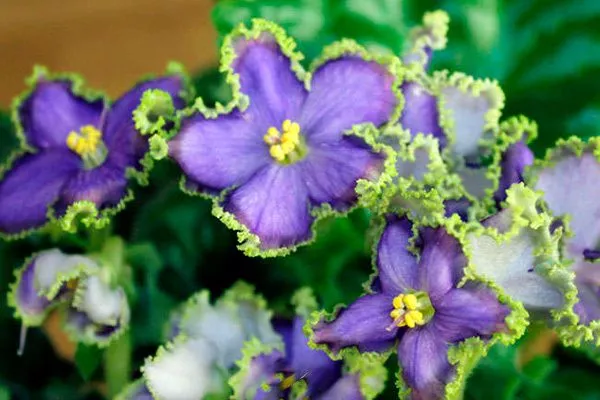
RS-Green Moss (S. N. Repkina)
The Green Moss violet features unique, semi-double, ruffled flowers that, when half-open, are adorned with purple streaks. The picture is completed by elegant green fringing.
The compact, neat rosette is covered with corrugated foliage, which is colored in a medium green shade.
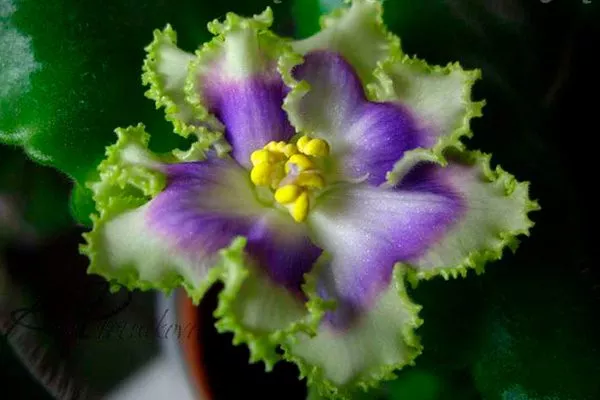
RS-Green Lagoon (S. N. Repkina)
Breeder S. N. Repkina developed a stunningly beautiful violet variety, Green Lagoon. This plant boasts large, double, fringed white flowers with blue streaks. The outer petals have a greenish tint.
The smooth rosette is covered with light green, wavy leaves. This variety is renowned for its abundant and long-lasting flowering.
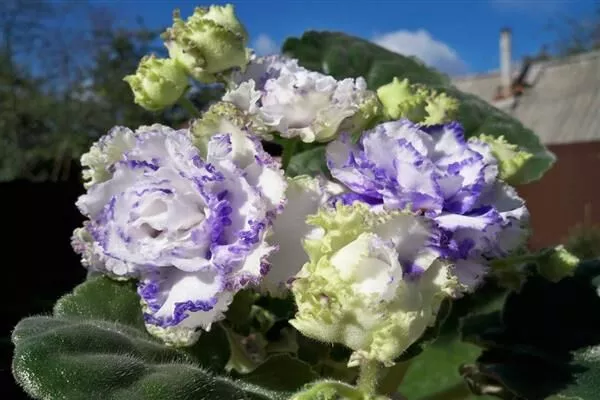
EK-Green Knots (E. V. Korshunova)
Breeder E. V. Korshunova developed a beautiful variety called "Green Knots." The plant is covered with large, double, magenta flowers with almost black petal tips and a wide green fringe along the edges, appearing to be twisted into knots.
The rosette is covered with pointed green leaves, creating a vibrant and exotic bouquet.
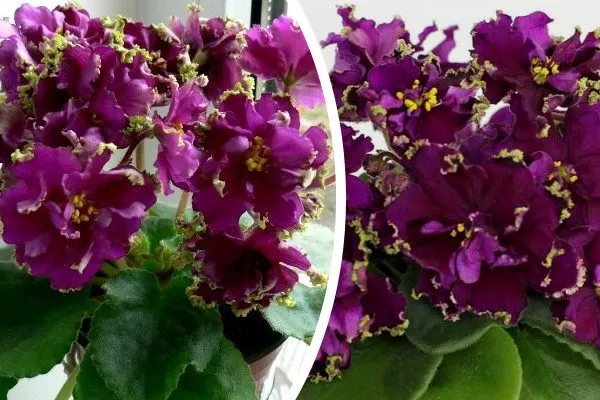
EK-Golden Pheasant (E. V. Korshunova)
Golden Pheasant is a violet developed by Korshunova. It features large, multi-petaled flowers with white-purple petals. It has a yellow eye. A bronze-green fringe adds a unique touch.
The neat rosette is covered with wavy, scalloped leaves, painted a bright green. The name comes from the fact that the bright and unusual flowers resemble a beautiful bird.
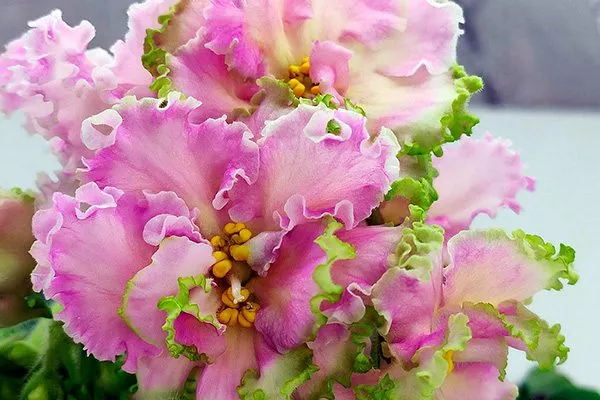
EK-The Frog Princess (E. V. Korshunova)
In developing the "Tsarevna Lyagushka" variety, breeder E. V. Korshunova succeeded in creating a Saintpaulia with white pansy-like flowers, a pink glow in the center, and green fringes adorning the petal edges. The veins are dark pink. A single stem can produce up to 15 flowers.
The smooth, neat rosette is adorned with fringed leaves with oval teeth. The foliage is dark green.
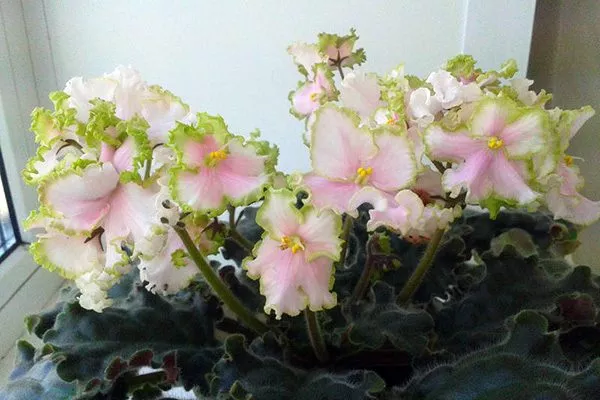
AV-Ecstasy (A. Tarasov, Fialkovod)
Double star-shaped flowers, white with a pink center, feature a soft green, fuzzy edge along the petal edges. The flowers are voluminous and fluffy, and the color transition from the center to the edges makes them even more beautiful. The diameter is approximately 6 cm.
The Ecstasy violet has a smooth, neat rosette up to 25 cm in diameter. Green leaves cover the flower. This variety is renowned for its abundant and frequent blooms.
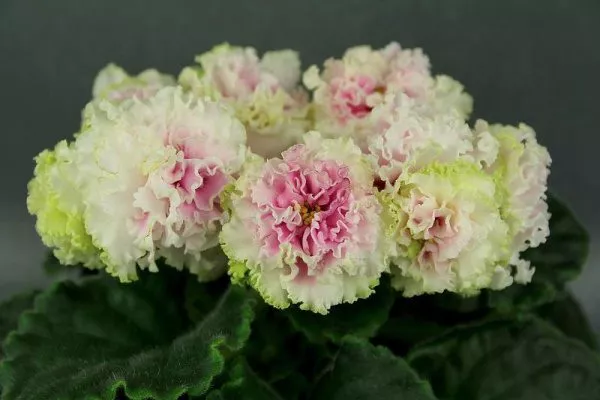
AV-Ring with Ruby (A. Tarasov, Violet Breeder, sports)
The violet "Ring with Ruby" boasts not only a unique name but also an attractive coloring. Large, white-pink star-shaped flowers with dense petals are framed by a golden-green, ruffled border. The petals are accented with dark crimson streaks and spots.
The compact rosette is covered with serrated, slightly wavy leaves, colored dark green.
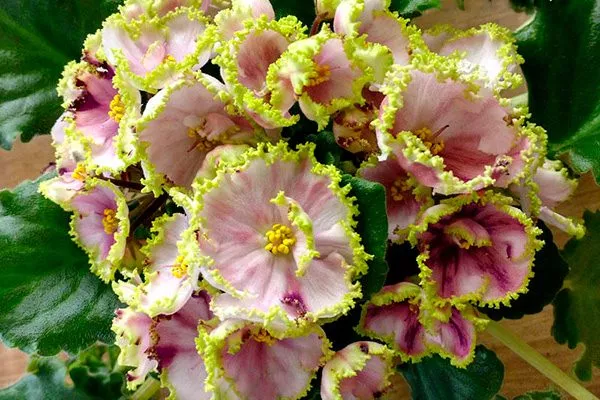
AV-Viennese Strudel (A. Tarasov, Fialkovod)
Viennese Strudel is a Saintpaulia with large, white-and-green, double, star-shaped flowers. They are distinguished by a ruffled, raspberry-green edge. This plant makes a stunning sight.
The standard rosette is covered with serrated, quilted leaves, colored a medium green. This variety is easy to care for and is renowned for its abundant flowering.
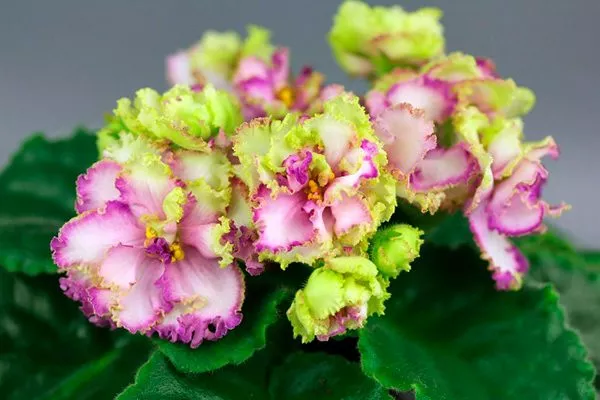
LE-Galatea (E. Lebetskaya)
Elena Lebetskaya developed the Galatea variety. The plant is covered in delicate lavender flowers reminiscent of pansies. The petals have a deeper color at the edges and a greenish, slightly ruffled border.
The smooth rosette is covered with variegated leaves. The Galatea variety is characterized by abundant and long-lasting flowering.
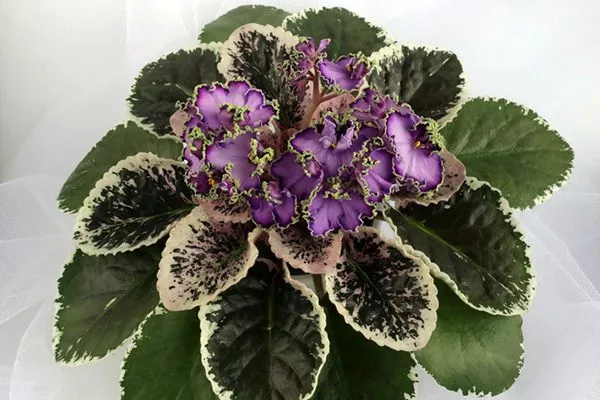
LE-Green Rose (E. Lebetskaya)
Elena Lebetskaya, who developed the variety, obtained a plant with semi-double white and pink flowers reminiscent of pansies. The coloring is not uniform, but features vibrant crimson highlights. The petals are edged with a green, heavily ruffled fringe.
The smooth, neat rosette is studded with wavy, green-hued foliage. This variety is easy to care for and blooms abundantly.
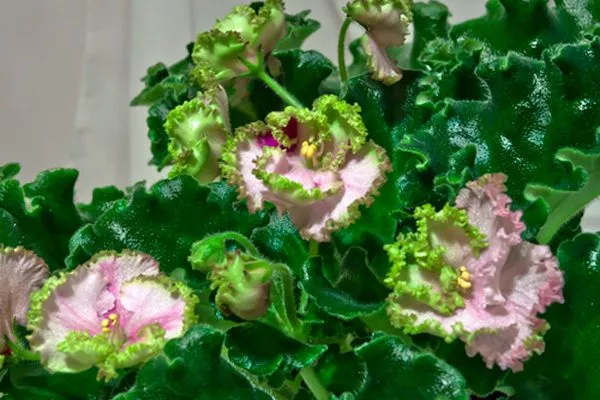
AN-Kopeechka (N. F. Andreeva)
This violet, bred by N. F. Andreeva, is considered unique because of its eye-catching coloring. "Kopeechka" is a plant covered in simple, watercolor-like lilac flowers with a pencil-like purple border and dense green fringe.
The neat, compact rosette is covered with fringed foliage, colored in a medium green shade.
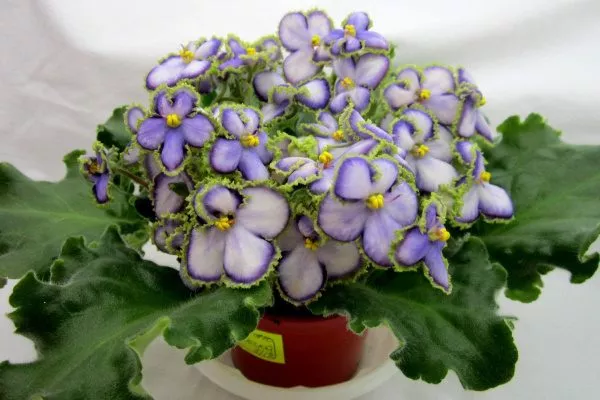
RM-Illyria (N. Skornyakova)
Illaria is a variety developed by N. Skornyakova. The plant is covered with large, semi-double, white, ruffled star-shaped flowers with a distinct blue mesh. The petals have a lacy green fringe along the edges.
A plant with a compact rosette covered with wavy green leaves. This variety is renowned for its abundant, long-lasting blooms and ease of care.
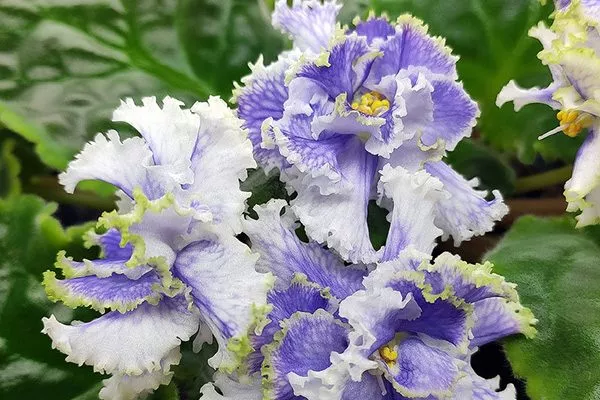
KO-Molodo-Zeleno (O. Kosobokova)
A very beautiful variety with an interesting name from breeder O. Kosobokova. Young-Green is a Saintpaulia with large, double white flowers. They feature blue highlights and dense green fringing.
The standard rosette is covered with light green, wavy leaves. This variety is characterized by long flowering and a lush bouquet.
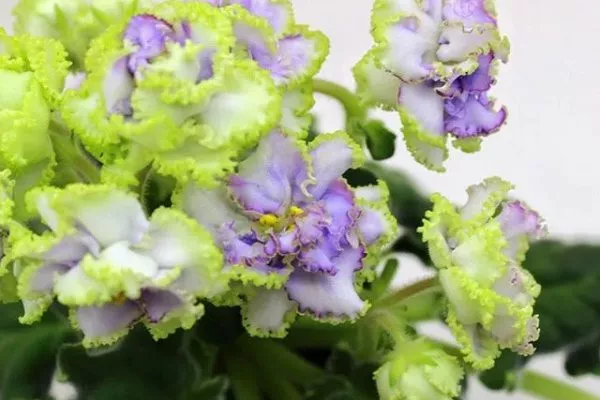
Green Ice (Volkmann)
Green Ice is a violet with small but very beautiful flowers. The soft pink petals with light green fringes make the plant incredibly neat and attractive.
The very compact rosette is studded with wavy leaves, tinged with emerald. The plant is easy to care for.
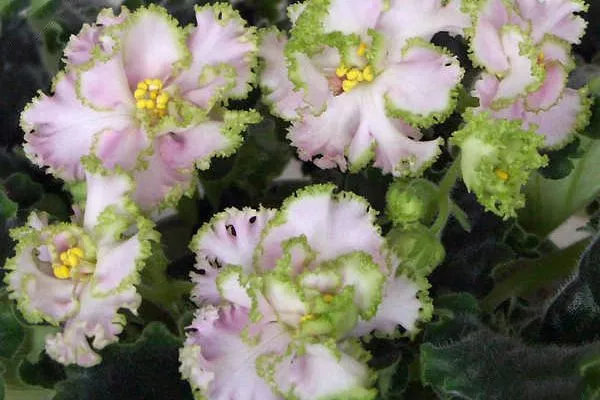
Features of cultivation
It's believed that violets require special care. In fact, Saintpaulias do require attention, but with the right approach, you won't encounter any difficulties. Provide the houseplant with the right conditions and you'll have a beautiful flower.
- ✓ The optimal temperature for violets should be maintained within the range of +20-22°C without sudden changes.
- ✓ The air humidity level should be increased; it is recommended to use a tray with expanded clay and water.
- ✓ Lighting should be bright, but diffused, without direct sunlight.
- ✓ Watering is carried out twice a week with settled warm water, avoiding over-watering and drying out of the soil.
Basic rules:
- Temperature. Violets require temperatures between 20-22 degrees Celsius. They react negatively to sudden changes in room temperature, so be careful, otherwise the plant may die.
- Humidity level. With increased humidity, the violet will reward you with abundant and prolonged flowering. You can create suitable conditions by placing the flowerpot on a tray filled with expanded clay filled with water.
- Lighting. Violets are plants that thrive in sunlight. However, they should be protected from direct sunlight, as it can burn the leaves. Place the violet pot in a shaded area. In winter, provide additional lighting.
- Watering. Violets are quite fussy flowers, sensitive to both too much and too little moisture. Water the plant twice a week, using only warm, settled water.
- Top dressing. Saintpaulias need fertilizer to prolong their flowering period. Violets need vitamins, amino acids, and microelements. A specialist store can recommend good fertilizers specifically for violets.
Feed the plant twice a week. After repotting, do not apply any fertilizer for 1 month. - Trimming. Although the violet is a compact houseplant, it requires periodic pruning. This will keep the plant looking attractive. It will also help you create a three-tiered shape and remove any yellowed lower leaves.
Prune along the older leaves, leaving only the central young rosette. If the plant is heavily overgrown with side shoots, pull them out or cut them out to free the base. - Pests and diseases. Like most other houseplants, Saintpaulias are susceptible to disease. The violet is susceptible to late blight, which occurs when humidity is high. Disease can be avoided by frequently ventilating the room and following all watering guidelines.
There's also a risk of powdery mildew, which causes a white coating to appear on the upper surface of the leaves. The disease occurs with frequent temperature fluctuations and poor watering practices.
Violets are often susceptible to gray mold, which develops in cold temperatures and overwatering. Avoid these mistakes.
As for pests, Saintpaulias can be attacked by spider mites and aphids. Various pest control products can help get rid of these insects, such as Aktara, Fitoverm, Mospilan, or Actellic. - Reproduction. There are several ways to propagate the plant, but most often, Saintpaulias are propagated by using leaves. This procedure is typically carried out in the spring and summer.
To begin, select a healthy leaf from the plant, preferably from the second or third row. Then break it off or cut it off. You can root the leaf in water or soil. Once the leaf has rooted, transplant it into its permanent pot.
How to choose?
At first glance, choosing a green-flowered violet may seem very difficult, but this is not at all the case. Simply decide on the variety by looking at the photo and choose the one you like.
Experienced violet growers recommend visiting a specialty store or purchasing from trusted sellers when choosing a plant. Counterfeit varieties with no varietal value are often offered for sale.
To avoid unpleasant situations, pay attention to a few nuances when choosing a violet:
- Condition of cuttings. Inspect the plant carefully. If you notice elongated leaf bases, this indicates the plant was grown from weak planting material, especially one that was deprived of sunlight. Avoid buying such a plant.
- Rosette density. You should be wary if the plant has a tight center and the stems and leaves are tightly packed together. It's best to look at another plant.
- Coloring of leaf blades. Violet leaves should be attractively shaped and uniformly colored, or they should have a matching pattern. If you see any unusual spots or stripes, do not purchase the plant—this could be a sign of disease.
- ✓ Cuttings must be strong, without signs of elongation.
- ✓ The rosette should be evenly developed, without excessive density.
- ✓ The leaf blades must be uniformly colored, without any extraneous spots or stripes.
Among the wide variety of green-flowered violets, there are many interesting and attractive varieties. Based on your own preferences, you can choose the one that catches your eye.
These are very unusual green violets. Honestly, I've never even heard of them. Now I'm dying to buy one! Especially since you explained the growing and seedling selection process so thoroughly and clearly.