
Blue violets are not such a rare sight on the windowsills of Russian gardeners today. These varieties range in shades from light blue to blackish-blue, and they possess a refined appearance. These violets are easy to care for, and various propagation methods are used. Breeders love blue violets for their ability to convey their unusual color.
Which violets are blue varieties – distribution by category
The main difference between blue Saintpaulias and other species is their indigo hue, which is particularly prized. Even in ancient times, it symbolized purity of intentions and modesty. Blue Saintpaulias include a wide variety of species—with double, single, or semi-double flowers, small or large buds—but they all share one thing in common: a distinct fragrance.
Breeders conventionally divide indigo violets into the following categories:
- dark blue;
- bright blue;
- violet-blue;
- blue with white border;
- blue with white rays.
Based on the classification, blue violets include flowers not only with blue petals, but also blue, purple, lavender, and even lilac ones.
The most beautiful blue varieties
Despite the nobility and beauty of the blue hue, not all varieties are considered popular and sought after, but only a few, possessing unique external characteristics.
| Name | Flower type | Petal color | Flowering type |
|---|---|---|---|
| EK-Blue Frost | star-shaped, semi-double | blue-cornflower blue | bouquet-shaped, long-lasting |
| EK-Roses for the Mermaid | semi-double | blue-light blue | bouquet-shaped |
| EK-Gift for a Loved One | terry, fringed | bright blue | cap growth type |
| EK-Sea Wolf | semi-double, star-shaped | soft blue | long-term |
| EK-Sunny Italy | semidouble | bright blue | exhibition socket |
| EK-Snow and Sky | semi-double or single | dark blue | exhibition socket |
| EK-Glare on the Water | exhibition | blue with white trim | exhibition socket |
| EK-Shanzhan | semi-double | blue with pink polka dots | shimmers with different colors |
| EK-Waltz of Fireflies | star-shaped, corrugated | blue with pink-crimson fireflies | bouquet |
| AB-Water Lily | semi-double | blue | scarce |
| AV-DiCaprio | semidouble | ultramarine blue | long-term |
| LE-Beautiful Creole | semi-double | bright blue with a purple tint | wave |
| LE-Venus Curls | densely double | bright blue | bouquet |
| K-Heavenly Blue | stellate | bright blue with a white border | constant and early |
| Summer Twilight (K. Morev) | star-shaped, double or semi-double | blue-violet with white edging | abundant, long-lasting |
| Magic Night (B. Makuni) | terry | dark blue with pink dots | abundant and almost year-round |
| AE-White Nights (Arkhipov E.) | semi-double | light blue | abundant |
| DS-Shining Bell | bell-shaped | dark blue | long-term |
| Harmony's Little Stinker (Harmony) | semidouble | blue | cap |
| Apache Magic (J. Munk) | semidouble | volatile | long-term |
| Humako Sharon (Humako) | simple | white with bright blue stripes | long-term |
| Mac's White Water (G.McDonald) | semi-double | white with bluish strokes | long-term |
| Ramblin` Lassie (S. Sanders/R. Brenton) | semi-double | blue-light blue | branching |
| My Smokey Trail (H. Pittman) | semidouble | lavender blue | long-term |
EK-Blue Frost
The selection was carried out by florist E. V. Kuvshinov. The violet's main advantage lies in its unusually beautiful cornflower-blue petals and its low maintenance. The plant grows rapidly, so it requires formative pruning.
Other indicators:
- flower variety – star-shaped, semi-double;
- petals - corrugated, with a white border;
- peduncle type – shortened;
- flowering is bouquet-like, long-lasting (almost year-round);
- rosette – self-forming;
- stem - at first, growth is directed only upwards, then it slides down so that the leaves “embrace” the pot;
- leaves are oval-ovate in shape, dark green in color;
- the veins are clearly visible;
- On the inside, the leaves have a lilac or light green tint.
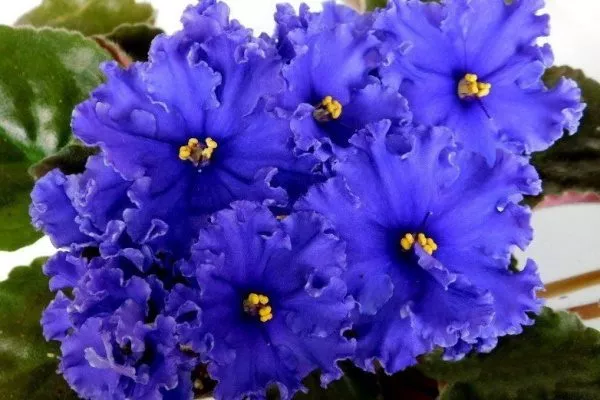
EK-Roses for the Mermaid
This variety was officially registered in 2013. It is distinguished by its blue-light blue color and densely double flowers. A special feature is the light-colored reverse side of the petals. Other nuances:
- The petals have a slight corrugation and a white border.
- number of buds on one peduncle – up to 3 pcs.;
- peduncle – strong and long;
- bush type – spreading;
- socket – standard;
- cuttings - elongated, rapidly growing;
- Leaves are dark green, with serrated edges, rounded in shape.
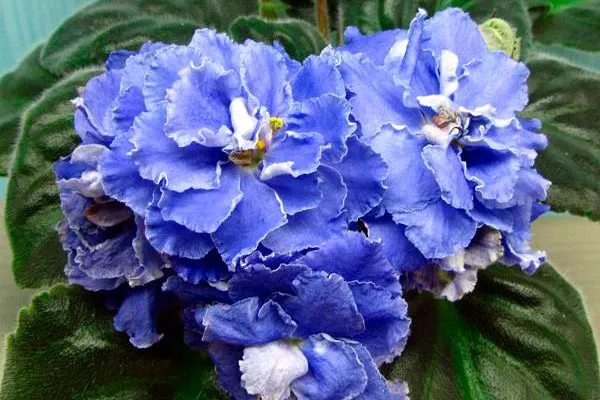
EK-Gift for a Loved One
Thanks to flower grower Korshunova, connoisseurs of beauty have acquired a new hybrid, considered a masculine one. It can be safely presented to men as a gift.
This exhibition plant has the following characteristic features:
- flower type – double, fringed;
- color - noble, very bright blue, with a slight purple-burgundy border, a barely visible mesh on the petals;
- peduncles are characterized by an abundance of buds and a cap-like growth type;
- blossomed flowers do not fall off for 30-45 days;
- rosette – self-forming, smooth;
- The foliage is decorative, dark green, with a pinkish-cream border.
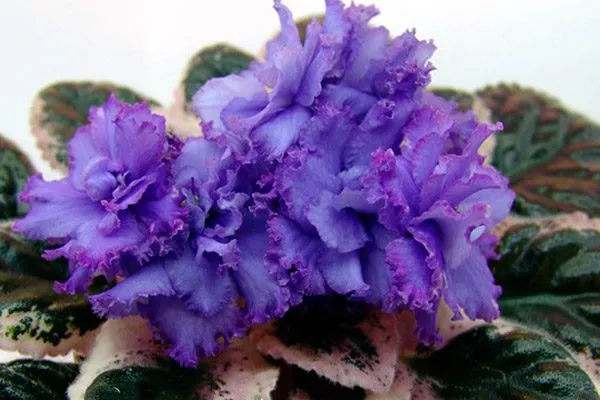
EK-Sea Wolf
This variety is characterized by very large flowers (averaging about 8 cm in diameter). It belongs to the semi-double Saintpaulia stellate type. Its name comes from its unusual color, reminiscent of sea waves.
Characteristic features:
- the color of the petals is soft blue, the covering is uniform;
- the petals are corrugated, there is a yellow dot in the center of the flower;
- the surface is terry, especially after the second flowering;
- standard socket;
- The foliage is dark green, with pronounced veins and very large, oval-shaped leaves with a heart-shaped base.
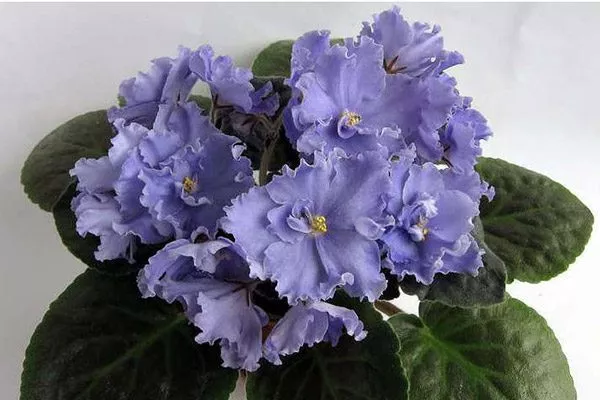
EK-Sunny Italy
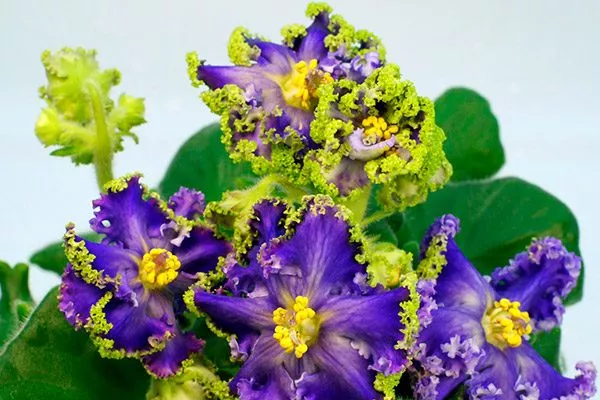
In 2017, E. Korshunova bred a stunningly beautiful Saintpaulia named "Sunny Italy." This variety features a show-quality rosette and large, semi-double flowers. The base color is bright blue, with a mesh-like pattern and lush, light green fringe on the petals. The center of the petals is adorned with yellow highlights.
EK-Snow and Sky
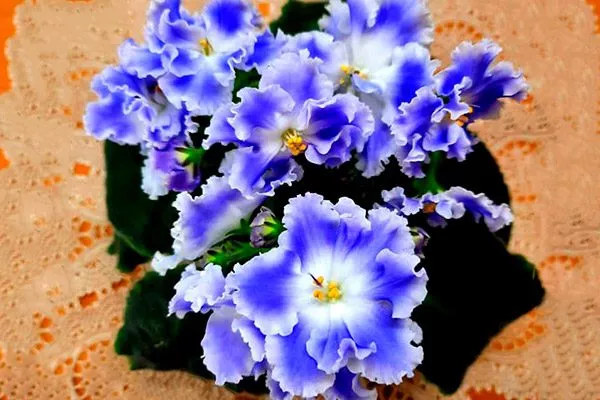
This variety, bred in 2016, is characterized by a show-quality rosette and large semi-double or single flowers. The unusual color of the petals is particularly noteworthy: dark blue imprints, a white eye, and a wide border of the same color.
Other characteristic features:
- flowers are large – about 7 cm in diameter;
- The foliage is rich green, uniform in color, with pointed edges.
EK-Glare on the Water
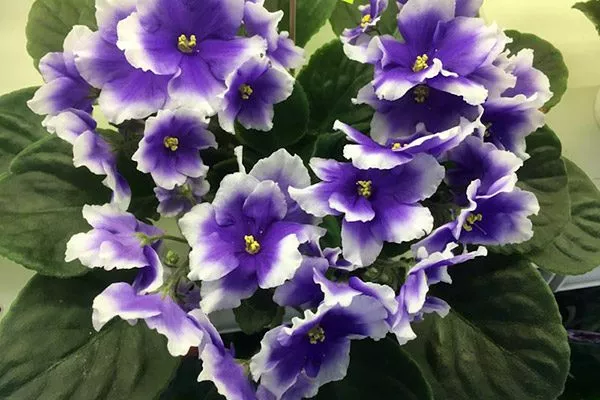
A show flower of blue color with a white border. The leaves on the rosette are bright green, quilted, but with light-colored veins. This violet was registered in 2021, so it is considered a newcomer to the world of violet growing.
EK-Shanzhan
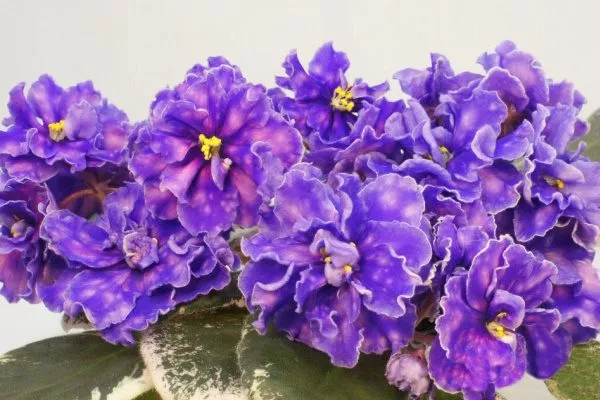
This semi-double Saintpaulia stands out from other varieties with its wavy, notched blue flowers with a whimsical pattern resembling large pink polka dots. It's a variegated plant with bright green leaves that also feature creamy-pink blotches along the edges.
The unique feature of the Shanzhan variety is its chameleon properties: the flower shimmers with different colors in good light.
EK-Waltz of Fireflies
This new violet was introduced to the world in 2020. It features blue, star-shaped, ruffled flowers that form a charming bouquet. Small, fantasy-style fireflies in a pinkish-crimson hue are scattered across the petals. This is a striking example of modern Saintpaulias.
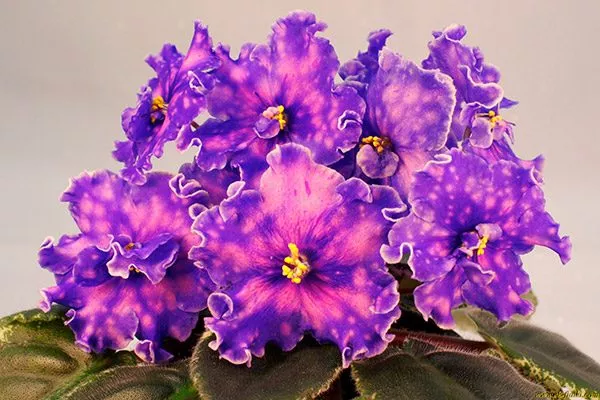
AB-Water Lily
The variety was developed by our domestic breeder, Alexey Vsevolodovich Tarasov, resulting in a semi-double African violet. Characteristics:
- the evenly horizontal and completely symmetrical rosette has medium dimensions;
- the leaf blades are spoon-shaped like water lily leaves, with a flat surface and raised edges and clearly defined veins;
- cuttings are short and strong, but easily break under mechanical stress;
- the leaves are variegated and rich green, with white and yellow tints;
- cup-shaped flowers are edged with slight waviness;
- petal color - blue, uniform;
- number of buds on a peduncle – maximum 3 pcs.;
- flowering type – sparse.
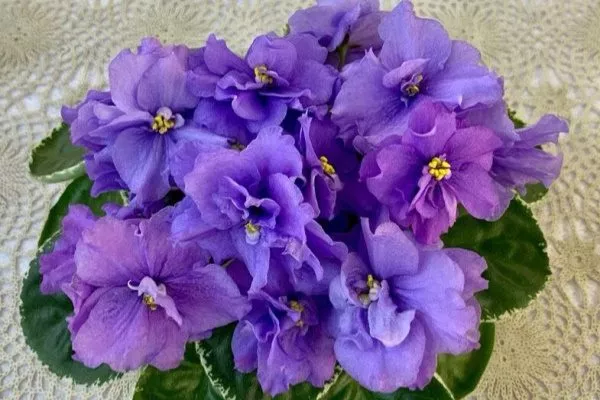
AV-DiCaprio
Our renowned violet breeder, Alexey Vsevolodovich Tarasov, developed this variety, achieving an ultramarine blue hue on the outer petals. However, the undersides have a reddish tint. The variety was officially registered in 2016.
Peculiarities:
- semi-double flowers with corrugated stars;
- the rosette is quilted, has slight teeth and medium green foliage;
- the bush size is standard;
- The petals may show slight light outlines along the edges, but this happens rarely (to achieve this, you need to keep the violet in cool conditions).
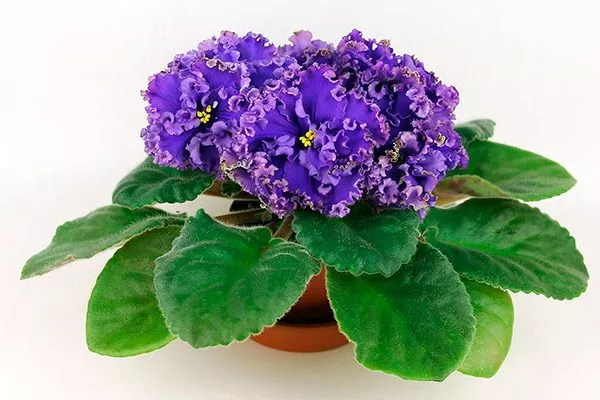
LE-Beautiful Creole
This variety is completely easy to grow and boasts a vibrant blue color. Characteristics:
- the tint on the blue background is purple;
- the edges of the petals are edged with a white line;
- flowering type – wave (approximately 45-40 days);
- flowering is abundant, bouquet-like;
- flower diameter – about 4-5 cm;
- The leaves are dark green, wavy at the edges, with a very sensitive structure; any spraying is strictly prohibited.
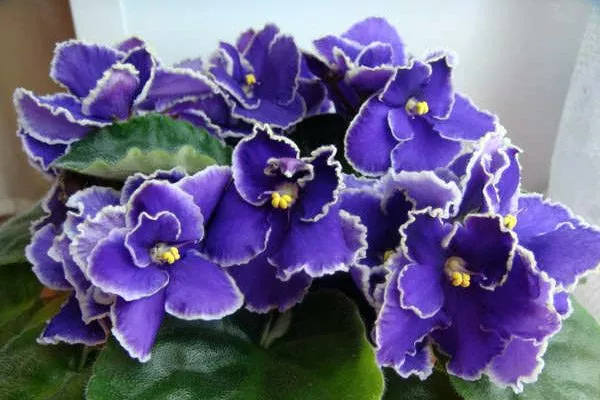
LE-Venus Curls
This variety is characterized by a very large rosette on elongated stems. Other features:
- leaves – large, rounded, serrated at the edges;
- the color of the leaves is rich green, but becomes lighter with age;
- the flower is densely double, medium in size, but if compared to the rosette, it looks small;
- Colour: bright blue, with a pencil-like greenish border on the corrugated edges of the petals.
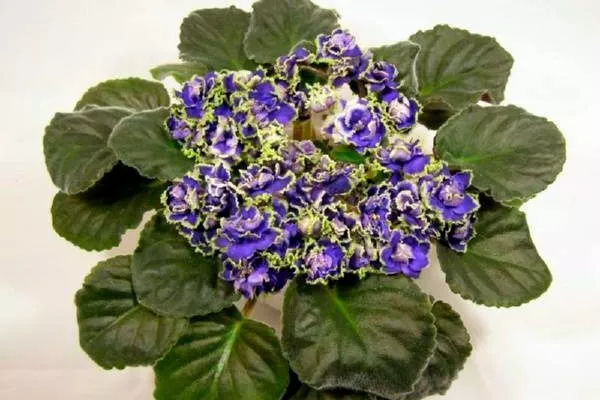
K-Heavenly Blue
The creator of the blue hybrid is Elena Kraiduba, a native of Odessa. The result is a violet with a "docile nature," requiring no special growing conditions. It grows rapidly, forming neat bushes that require no pruning.
Features of the variety:
- the shape of the flowers is star-shaped, the edges are wavy;
- petal color - bright blue with a pencil white border;
- number of buds on a peduncle – from 3 to 5 pcs.;
- flowering is constant and early (already 8-9 months after planting);
- bush – standard;
- leaves - rounded, with serrated edges, pointed tip, very juicy, have a pattern on the veins;
- The color of the foliage is rich green, with light pink spots forming in some places.
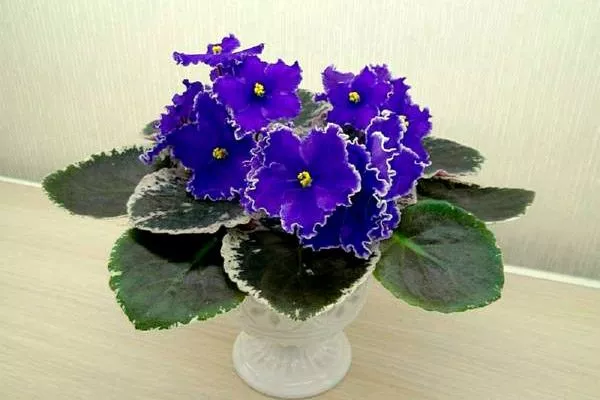
Summer Twilight (K. Morev)
Our compatriot Konstantin Morev worked on developing the hybrid in 2007. The result was a superb variety with beautiful flowers – blue-violet petals with a white border.
How to recognize the variety:
- flower type – star-shaped, double or semi-double;
- the edges of the petals are light and very velvety, slightly wavy;
- bud diameter – 5-6 cm;
- peduncle – thick and short;
- the blossoming flowers are heavy, if there are many of them, it is recommended to place a support under the flower stalk;
- flowering – abundant, long-lasting;
- leaves are green, oval or round with a heart-shaped base, the surface is slightly concave, there is a light border of a blurry type along the edges;
- The sockets are small and neat.
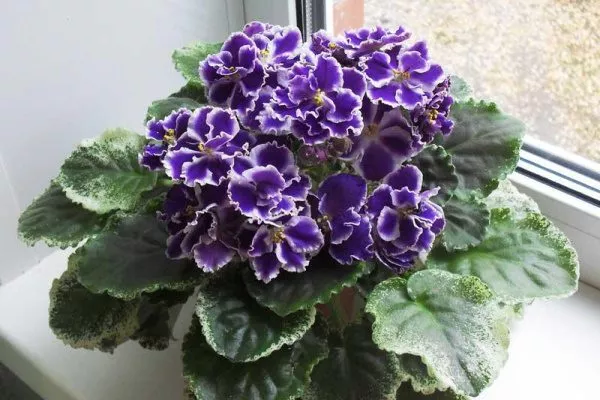
Magic Night (B. Makuni)
The double violet stands out from its "relatives" with its unusual, iridescent flowers of a dark blue hue with pink spots. Like a mysterious night sky, the flowers are adorned with light polka dots, which is the main distinguishing feature of this Saintpaulia.
The variety is easily recognized by the following characteristics:
- large flowers with oval, slightly twisted petals;
- the peduncle forms a cap of a beautiful shape;
- flowering is abundant and almost year-round, but during the first blooming of flowers, light spots on the petals do not always appear;
- the leaves have serrated edges, are green in color, have neat serrations on the edges, and have a fleshy and juicy structure;
- socket – standard.
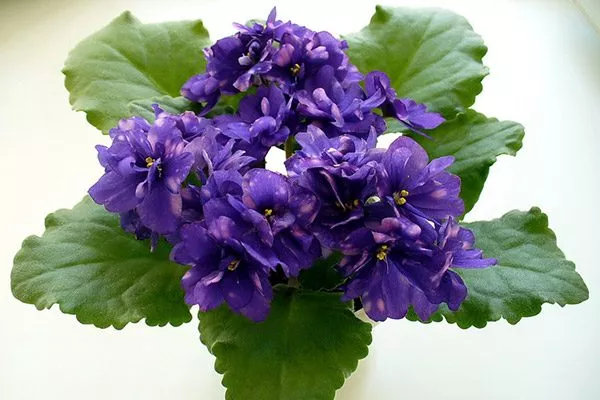
AE-White Nights (Arkhipov E.)
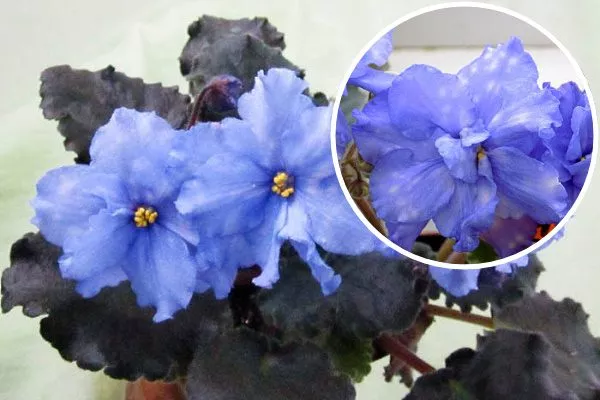
AE-White Nights is a variety renowned for its large, light blue, semi-double, star-shaped flowers with a fantasy-like coloring. The center features a yellow pith. This variety is renowned for its abundant blooms.
The violet's rosette consists of several tiers of velvety leaves with pointed edges. The foliage is dark green.
DS-Shining Bell
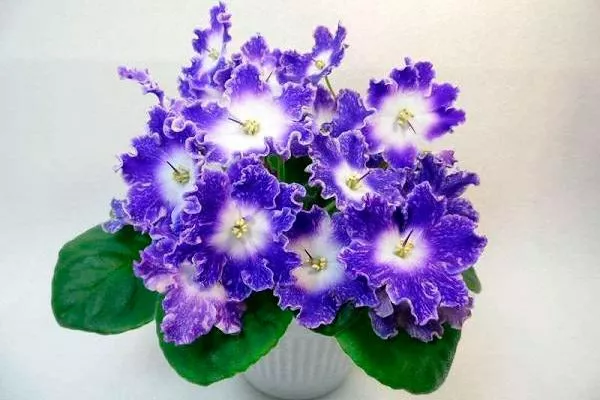
Breeding work to develop this variety was conducted in 2014 by florist Elena Enikeeva. Characteristics of the Shining Bellflower:
- flower shape – bell-shaped, size – large;
- petal color - dark blue at the base, fantasy type;
- the central part of the flower has a large white eye;
- the edges of the petals are wavy, sometimes forming a light pencil stripe;
- the socket has a neat and correct shape;
- leaves – have completely smooth edges and a rounded shape, the base is heart-shaped, and there is a vein pattern;
- The color of the foliage is dark green.
Harmony's Little Stinker (Harmony)
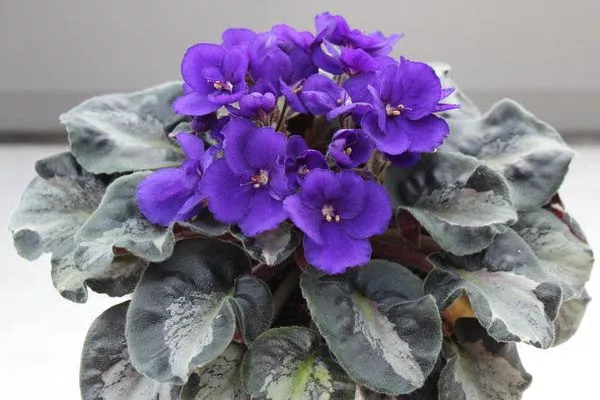
Translated into Russian, it means nothing more than "Little Stinker of Harmony." Although the violet's aroma is quite pleasant. Characteristics of the variety:
- flowers are semi-double, have a variable whitish eye in the center (if the violet is grown at very high temperatures, the whiteness does not appear);
- peduncles – heavily budded, strong, flowering like a cap;
- petal color – blue;
- the rosette is medium-sized and belongs to the leaf chimera, therefore there is a large amount of green mass;
- The leaves are round, with wavy edges and slight serrations, very variegated green, but towards the center there is a white-silver spot.
Apache Magic (J. Munk)
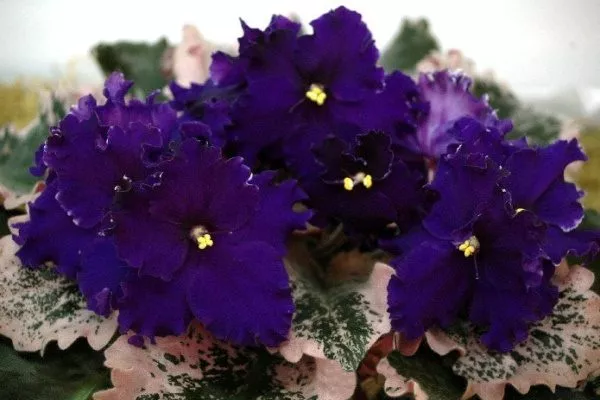
The cultivar's creators are Lenora Munk and James Calvin. Apache Magic is a semi-double Saintpaulia variety with petals featuring a light, pencil-like, intermittent edge.
The variety has special characteristic features:
- flowers - large, without imprints, but with an inflorescence of the orchid or butterfly type (the lower tier of petals is unfolded, and the upper one is curled upward);
- color - changeable, depending on the lighting there are shades from purple to violet and dark blue;
- bush – reaches 25-35 cm in diameter;
- rosette – massive, dense, round;
- leaves - corrugated type, very variegated, green with a creamy cream or pink "flamingo" tint;
- The shape of the leaves is slightly pointed, spoon-shaped, the edges are serrated and slightly wavy.
Humako Sharon (Humako)
The florist worked hard on selection, resulting in a fully industrial variety grown on a large scale. Saintpaulia's characteristics:
- color – white with large bright blue stripes in the center of each petal;
- flowers are roundish, look simple, similar to pansies;
- bush size – standard;
- the crown shape is even, neat, no need to trim or shape the bush;
- The leaves are round in shape, the edges are smooth, the surface is covered with patterned veins.
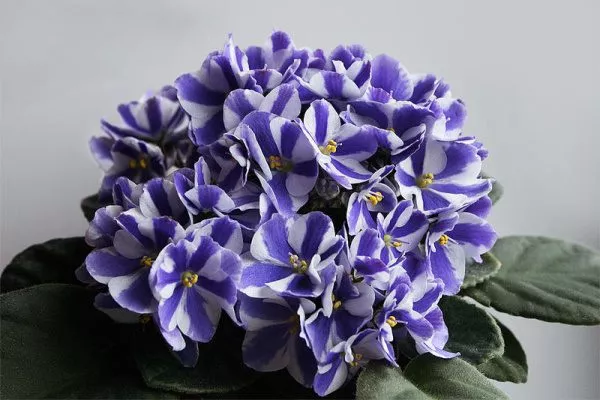
Mac's White Water (G.McDonald)
Mac's White Water features semi-double white flowers with bluish streaks and splashes (usually on the three lower petals). The violet has a smooth rosette covered with light green, quilted leaves with a beautiful white edge.
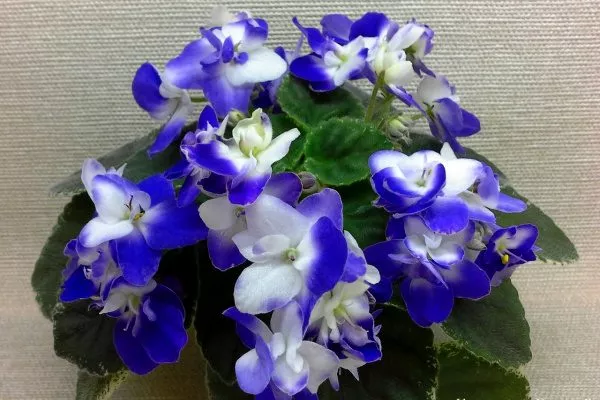
Ramblin` Lassie (S. Sanders/R. Brenton)
This violet is a trailing, semi-miniature variety with a highly branched rosette. It is distinguished by its rapid growth, rapid development, and propagation through side shoots and leaves.
There are other characteristic features:
- the flowers are small with elongated petals, which have a special darkening closer to the center;
- the color is blue-light blue, but there is also a lavender tint;
- the number of buds on the peduncle is multiple, during flowering branching and the formation of new flowers appears;
- The leaf type is girlish, the shape is round, wavy at the edges, and is characterized by crown variegation.
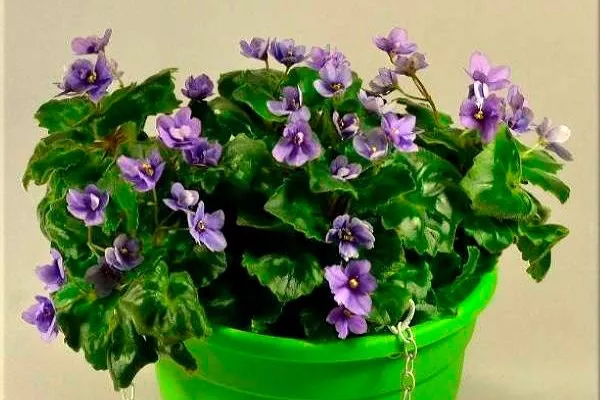
My Smokey Trail (H. Pittman)
The Violet is officially recognized as a semi-miniature trailer. It differs from others in the following ways:
- flower type – semi-double;
- color - lavender-blue, with a darker shade in the central part;
- bush appearance – neat, compacted;
- socket – compact;
- branching – good;
- leaves – small, light green, evenly covered, with veins;
- The shape of the leaves is elongated, the base is heart-shaped, the edge is pointed.
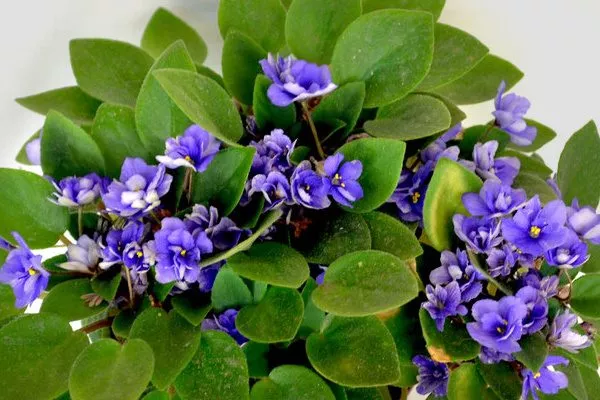
Recommendations for selection
There are many varieties of blue violets, so choosing the right one can often be challenging for beginners. To avoid these issues, consider the recommendations of experts and experienced violet growers:
- If you don't have enough time to meticulously care for indoor plants, choose easy-to-grow blue varieties so they are disease-resistant.
- Consider the flower's shape – if you like unusual shapes, buy ruffled Saintpaulias. If you prefer classics, opt for simple, non-ruffled violets;
- Pay attention to the size of the bush - is it possible to place it on a small windowsill or shelf.
- Choose only trusted sellers. It's best to purchase seedlings from nurseries.
- Before paying for a plant, inspect it carefully. It should be free of dried or rotted parts, spots, or other signs of disease or pests.
Care tips
To ensure your blue violet brings joy to its owners, devote at least a little of your time to the flower. Here's what you should pay special attention to:
- When planting, choose the right pot - it should be 2 or even 3 times smaller in diameter than the Saintpaulia rosette.
- The location should be bright, but not in direct sunlight. Shade is preferred by only some varieties of blue violets; carefully study the growing requirements for each variety.
- Provide your plants with a full daylight period—at least 12 hours. If natural light is insufficient, use fluorescent lamps.
- The soil should meet the plant's needs. The optimal composition is 1 part sphagnum moss and turf soil, 0.5 parts vermiculite and perlite, and 2 parts peat. If necessary (for looseness), add sand and ash.
- When watering, avoid splashing water on the stems and leaves. Use safe irrigation methods, such as wick or drip irrigation.
- The water should be 2-3 degrees warmer than the room temperature. It's not only left to settle, but also boiled to remove any salts.
- During winter nights, remove pots of blue violets from the windowsill – they may become too cold.
- The optimal temperature range is from 19 to 24 degrees Celsius. Humidity is 55-65%.
- To increase flowering, fertilize with potassium and phosphorus complex fertilizers according to the specific instructions. However, if applying fertilizer frequently, it's best to reduce the dosage by 3-4 times (compared to the dosage stated in the instructions). Fertilize twice a month, no more often.
- Keep Saintpaulias' pots 30-40 cm away from the glass on the windowsill. This will prevent heat stroke in the summer and freezing in the winter.
If you strictly adhere to all the proper growing practices when growing and propagating blue violets, you'll have the most beautiful, and most importantly, healthy, violets blooming on your windowsill. Don't forget about the selection guidelines, which directly affect the frequency of watering, loosening, and other procedures.