
The black violet looks majestic and unrivaled, like any other black flower. However, no such violet exists in nature or in the history of breeding. Instead, the black violet category includes all very dark varieties, which also attract universal attention.
Description of the species
Dark violets are considered unusual flowers that share common characteristics, including not only the color of the plant but also the type of rosettes, leaves, etc.
Color features
It's commonly believed that nature gives us black flowers. In reality, they are rare, and none at all among violets. Looking at the shade characteristics, Saintpaulias lack true black, but they do have shades that come as close as possible to this noble hue.
Based on this, the black violet species is considered conditional. This group includes flowers with the following dark colors:
- blue;
- violet;
- red;
- brown;
- burgundy.
How blackness can manifest itself:
- full petal coverage;
- edging;
- strokes and spots.
General structural features
It's difficult to give a single characteristic to all dark violets—the characteristics vary depending on the cultivar. What they all have in common is a very dark sheen on the petals. Characteristics:
- Flower. It can be double, single, or semi-double, miniature, medium, or large, with star-shaped and other types of inflorescences. Flowers range in diameter from 2 to 10 cm, and all are very richly colored.
- Socket. Always neat, symmetrical, with dark green shades.
- Foliage. It can be oval, heart-shaped or other shapes. Color is dark green, sometimes with light veins.
Black violet varieties
There are many varieties, but only a few stand out. These are the ones that best match the description of black Saintpaulias in color.
| Name | Petal color | Flower size | Socket type |
|---|---|---|---|
| Mac's Black Pearl | inky purple | 2.5 cm | semi-miniature |
| Mac's Black Uhuru | purple-black-burgundy | large | quilted |
| Apache Midnight | dark blue-violet | average | large |
| Purple Passion | dark purple | large | loose type |
| AE - Witch Night | dark purple | star-shaped | uneven |
| LE-Demo | dark blue | average | exhibition |
| AV-Ink Heart | inky | star-shaped | medium-large |
| AV-Noble Rose | burgundy-black | large | horizontal type |
| AN-Black Tulip | dark purple | small | standard |
| RS-Milord | black and purple with white | star-shaped | medium-sized |
Mac's Black Pearl
This is a foreign variety of violet, which, unlike our own, is characterized by an inky sheen. How to recognize the variety:
- The petals are inky purple in color, and when viewed from different lighting angles, can have a burgundy, blue, or violet tint, with a frilled edge.
- The peculiarity of the coloring is that the edges of the petals are bordered with a whitish line.
- The flowers are only 2.5 cm in diameter, velvety, simple pansies.
- The peduncle is elongated and erect.
- The buds open slowly, taking 10 to 15 days.
- The rosette is semi-miniature, compact, but at the same time rather untidy, up to 17 cm in size, and tends to lift its leaves upwards (to prevent this, provide at least 12 hours of daylight).
- The leaves are small, rounded, with serrated and slightly curled edges, and medium green in color. The petioles are long.
Mac's Black Pearl was bred by botanist G. McDonald.
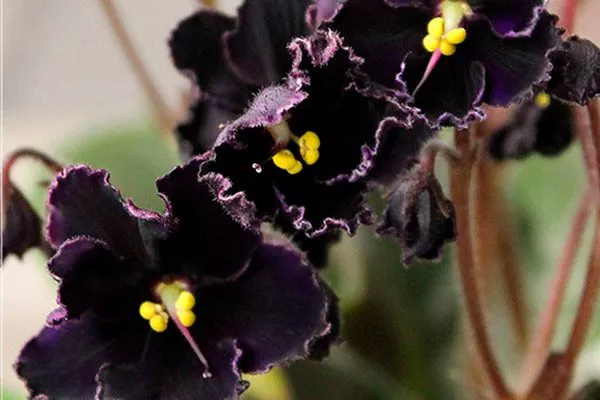
Mac's Black Uhuru
The Max Black Uhuru cultivar was created by amateur gardener G. McDonald. It's a semi-miniature variety with purple, black, and burgundy coloring, with beautiful petals edged with a whitish line.
A brief description of the variety includes the following indicators:
- The flowers are quite large, similar to those of the larger varieties. The type is double. The color is variable: almost black at budding, later turning purple-burgundy with violet notes.
- The flower stalks are short, but very strong and resilient. Each inflorescence contains 3 to 5 buds.
- The flowering period is long, but a beautiful bouquet forms on the bush.
- The rosette is quilted with strong, dark green leaves. The foliage is very large – up to 17 cm in diameter, rounded and quite textured (with tubercles and yellow stripes on the veins). The color is marsh green.
- The cuttings are shortened, especially when compared to the leaf blade.
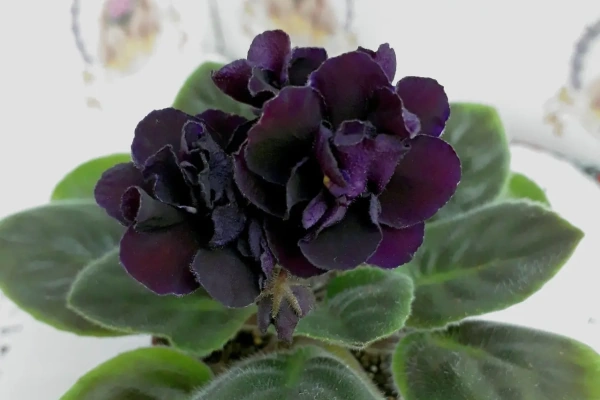
Apache Midnight
The variety was bred by J. Munk, who officially registered it only in 2003. This variety absolutely does not tolerate high humidity, so it dies if overwatered. It will need to be repotted more than once a year.
Characteristic features:
- The flowers are semi-double pansies of medium size. The petal edges have wavy ruffles with a white-green border and no imprints. However, the white border only develops in favorable, cool conditions; when grown in hot climates, it is completely absent.
- A special feature is that the petals at the top are more saturated in color than those located at the bottom.
- Colour: dark blue-violet.
- The flower stalks are sturdy and not very long, making them difficult to release from the rosette. The number of buds ranges from 3 to 4, and the flowering pattern is cap-like and profuse, but infrequent.
- The rosette is quite large – 30-40 cm, as the leaf blade is also large, while the petioles are considered short. The color is dark green.
- The foliage is variegated and rich green. It has a white and pink margin (a wide, curved line). The shape is spoon-shaped.
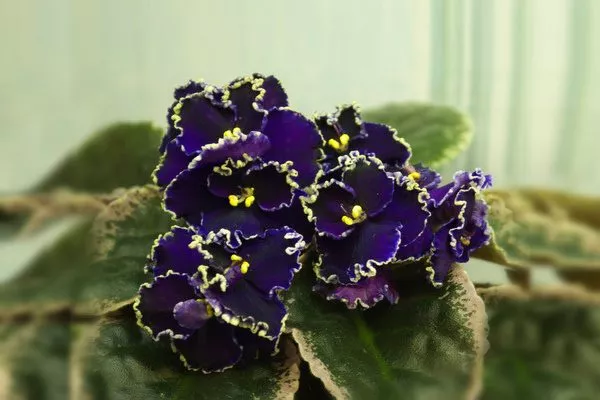
Purple Passion
The variety was bred abroad by S. Sorano. Purple Passion is considered an unusually beautiful flower, captivating with its large, star-shaped, variable petals. Their tips are edged with a greenish tint.
Other characteristics:
- variety of the cultivar - standard in size, purple in tint, double on the surface;
- the color of the petals is dark purple, with proper care it acquires an almost black tint;
- the edges of the petals are strongly corrugated;
- socket – loose type;
- the shape of the leaves is round, the base is clearly defined, the edges are slightly wavy, and as they mature they curl downwards;
- foliage color – medium green;
- The petioles on the leaves are elongated and very strong.
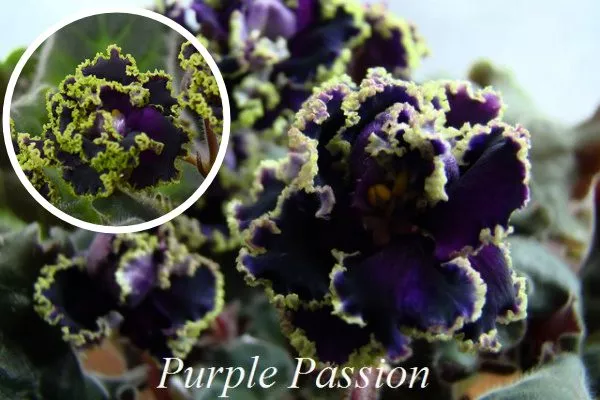
AE - Witch Night
Our compatriot E. Arkhipov worked on the selection. The variety, having participated in exhibitions at the "House of Violets," has repeatedly won awards. It is characterized by a dark purple color with a pencil-like whitish-green line along the edge and a wavy margin.
Other characteristic features of AE-Witch Night:
- flower shape – star-shaped;
- Feature: the salad border on the petals turns silver by the end of the growing season;
- the flower stalks are quite tall, which does not allow for the creation of a cap;
- number of buds – from 3 to 4 pcs;
- bush type – uneven, with twisted leaves growing upwards;
- leaves are wavy, with large serrations;
- foliage color – dark green;
- the stalk is shortened.
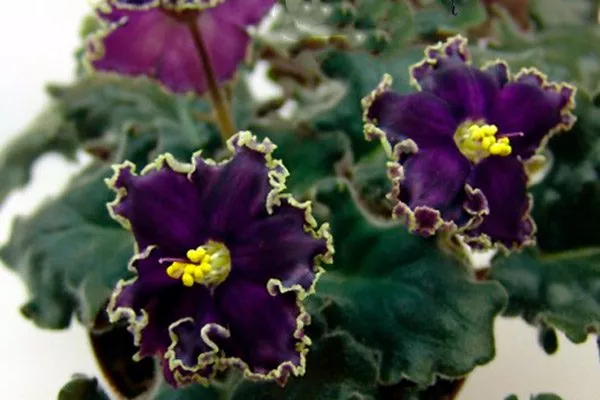
LE-Demo
A very unusual variety with distinctive leaves from breeder E. Lebetskaya. LE-Demo was bred in 2014 and is not yet widely available.
Brief description:
- the main color of the flower is dark blue, rich;
- flower variety - star-shaped;
- petals - wavy and pencil-like, interrupted at the edges (white tone), medium in size, with a double surface;
- flower stalks are strong and in large quantities, but there is no abundance of flowers during flowering (only a small bouquet);
- bush size – standard;
- rosette – exhibition, variegated;
- shape – symmetrical, easy to shape, grows well;
- the leaves are variegated and rounded, with slight wavy edges and slight serrations;
- The foliage is swamp-green in colour, with unusual white borders along the edges.
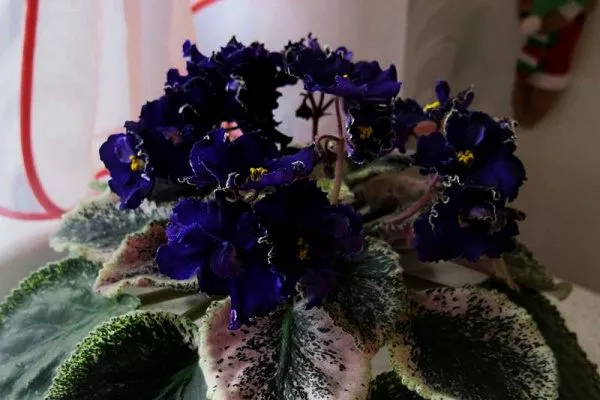
AV-Inkheart (sport)
Alexey Tarasov gave this violet its unusual name. The reason for its name remains unknown. However, the Saintpaulia is distinguished by its incredible beauty and truly inky coloring. Its edges are pencil-like, a pale light green.
Brief description:
- flower type – double, star-shaped, corrugated;
- rosette – medium-large;
- foliage - very large in relation to the stem and flowers, the color of the leaves is rich green, the edges are wavy, the capillary network is pronounced;
- The peculiarity is that the foliage grows in different directions, which creates chaos, so it is important to shape the bush.
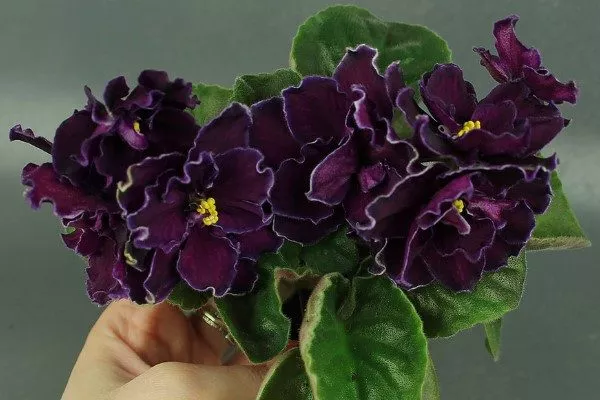
AV-Noble Rose
This Saintpaulia is characterized by its standard size and unusual flower bud shape—like a beautiful noble rose. The author of the selection is our compatriot Alexey Tarasov.
How to recognize the AV-Noble Rose:
- color - burgundy-black, but at the very beginning of development, that is, after planting the leaf, it is light burgundy;
- flowers are quite large, double with a yellow central part;
- the edges of the petals are wavy;
- size – standard;
- rosette - horizontal type, smooth, flattened and long, due to which the rosette leaves cover the pot from all sides;
- the foliage is unusual for black violets in color (it is light green), elongated, with pointed ends and teeth along the edges;
- The length of the cuttings is average.
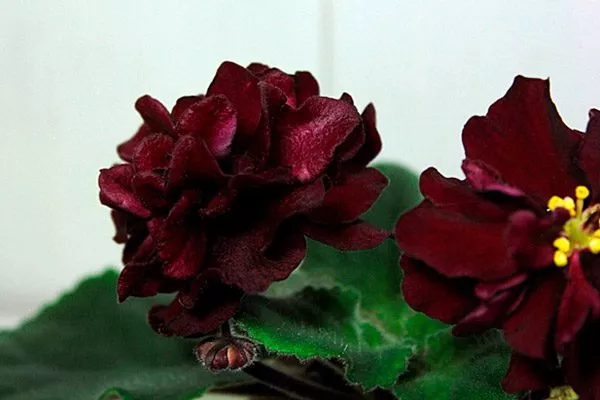
AN-Black Tulip
Breeder N. Andreeva gave the name to Saintpaulia due to the similarity of its flowers to tulips, although the biological name for a similar shape is bell-shaped.
Characteristics of the variety:
- flowers are small in size and have a peculiarity: in the evening (after sunset) the “bells” close and open in the morning (however, a full opening is not observed);
- color - dark purple, almost black in adulthood;
- as the flowering period ends, the shade becomes lighter;
- sometimes inclusions of a coral shade with fantasy stripes are formed;
- flowering type – spreading, with gradual rise of peduncles, which are scattered throughout the rosette;
- the number of buds on one peduncle is a maximum of 3-4 pieces;
- the socket is standard in size, but has a not very neat configuration;
- Leaves - with a smooth surface and shine, dark green shade.
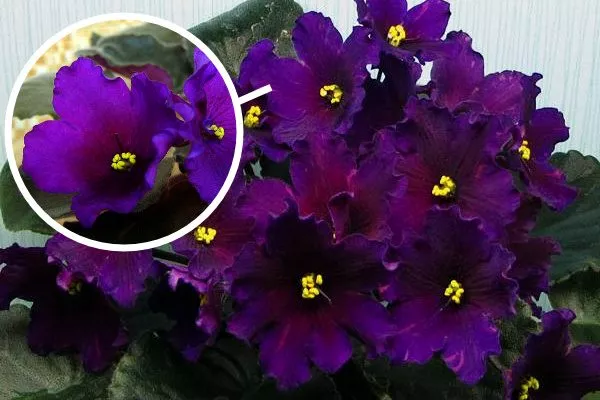
RS-Milord
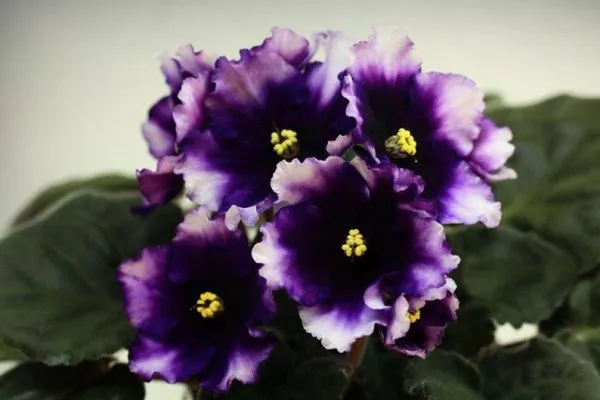
The creator of this extraordinary black violet variety is Svetlana Repkina. However, the flower is more accurately considered a white variety, as the petals are half white and half dark purple with a purple tint.
Other features:
- flowers are star-shaped, with wavy edges, slightly reminiscent of a bell;
- petals - wide open, separate;
- color type – gradient (with a black-violet center and whitish edges);
- rosette – medium-sized, perfectly straight;
- leaves – large, dark green, rounded, convex at the top, slightly serrated at the edges;
- Formation is often not required – the bush itself forms a beautiful shape.
Advantages and disadvantages
The main advantage of black Saintpaulias is their elegant dark hue, sometimes with a blackened sheen. These colors look great on both light and dark windowsills and complement almost any interior style. This is why amateur gardeners and designers often use these Saintpaulias in room decor.
Other advantages:
- brightness and maximum saturation of green mass;
- decorativeness of flowers;
- a wide variety of shapes, shades, etc.
There aren't many downsides, but users note that the main varieties of black violets require a lot of care, and their flower stalks tend to grow long.
Features of flowering
Most dark-flowering Saintpaulias bloom for a long time—at least 6-7 months, but with proper care, this can extend to 11 months. However, experts do not recommend artificially prolonging the blooming period—the plant also requires a resting period.
Planting a flower
Dark violets are planted using the same principles as other violets. Here's what you'll need:
- Pot. It should be about half the size of the future bush's leaf blade (this is the diameter). The height is also short, as the root system is shallow. Avoid planting in large containers, otherwise you'll wait too long for flowering (all the energy will be spent on root development, trying to fill all the empty spaces in the pot).
The flowerpot material is clay or plastic. - Location. Violets love light, but don't tolerate high temperatures or direct sunlight well, so the ideal location is a northeast- or north-facing windowsill. If planting in the south, consider hanging blinds or light curtains.
- Daylight hours. Its duration is at least 12-12 hours, so turn on the phytolamps in winter.
- Planting time. You can plant at any time except during the dormant period, that is, winter.
- Priming. The requirements here are more stringent. The pH should be between 5.5 and 6.5, and the structure should be breathable and loose. Therefore, prepare the substrate properly. It is advisable to use soil from under trees (but not fruit trees). Avoid using soil from under oak trees due to its tannins.
Optimal composition of the soil mixture:- turf soil and crushed sphagnum moss - 1 part each;
- vermiculite and perlite - 0.5 parts each;
- peat – 2 parts;
- Additionally – river sand and charcoal – 5% of the total mass.
- Planting material. Leaves with and without petioles, leaf fragments, roots, rosettes and seeds are used.
Here's a quick step-by-step guide to planting, regardless of the type of material:
- Prepare leaves, rosettes, flower stalks, or other planting material. Treat the cut areas with activated charcoal or wood ash powder.
- Place the soil mixture into plastic cups and lightly moisten with a spray bottle.
- Place the cutting in the center of the container and press it down lightly. To prevent the plant from falling over, place a support next to it.
- Cover the seedling with a plastic bag or a cut bottle or glass.
- Leave the plant in a warm place to root for 1-2 months. During this time, water the plant periodically and open it for ventilation.
- After rooting, transplant the crop to a permanent location.
You can also plant black violet leaves in water immediately after cutting. The root system develops twice as fast in liquid. The key is to ensure that the cutting, not the leaf itself, is in the water. The water should not only be settled but also boiled.
Peculiarities of home care
After proper planting, it's important to pay attention to care—the plant's health, frequency and abundance of flowering, bushiness, and much more depend on it.
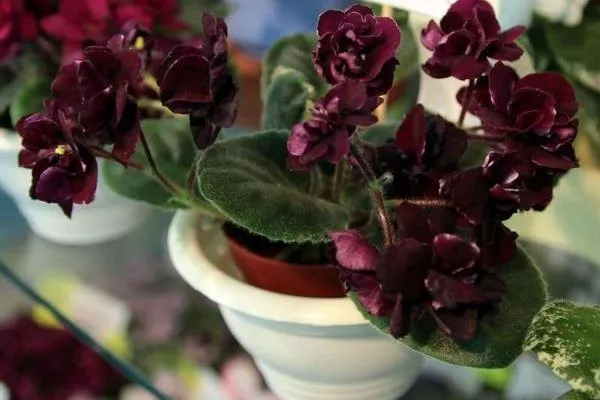
The main requirements for growing conditions and procedures:
- Temperature. To maintain the dark color, maintain a temperature of 19-20 degrees Celsius for mature plants and 22-24 degrees Celsius for young plants. Lower temperatures will slow down the flower's development, while higher temperatures will cause the flowers to become smaller.
- Lighting. This is an important point when growing black Saintpaulias, as they prefer 12-14 hours of light. Therefore, if natural light is insufficient, lighting fixtures that provide diffused light (never bright) should be installed.
- Humidity. If the room humidity is too high, the plant is susceptible to rot, which begins at the root system. If the room is too dry, the leaves will immediately react by drying out their green mass. Therefore, stick to average levels—between 55 and 65%. If you can't consistently maintain this balance, try the following:
- if there is dampness, turn on heating devices and ventilate the room;
- If the air is dry, install a humidifier, place containers of water nearby, and hang wet towels.
- Watering. Water regularly. Avoid allowing a dry crust to form on the surface of the substrate. Avoid waterlogging. One plant requires 100 to 200 ml, depending on the age and size of the plant. Before watering, let the water sit for 3-4 days, then boil and let it cool.
The liquid temperature should be not just room temperature, but a couple of degrees higher than the room temperature, no matter the season. There are several humidification methods:- Top or "under the socket"Watering with a watering can or syringe is recommended, but experts do not recommend this. This is because there is a risk of dripping onto the stems and foliage, which is extremely dangerous for violets.
- Bottom or undertray. A good option is to add liquid through the bottom of a pot with holes. All you need to do is place the flowerpot in a tray or other container filled with water. Keep young plants in this water for about 10 minutes, and older plants for 20 minutes.
- Wick or cord. The best option, which doesn't require supervision from the gardener, is to use a fabric wick during planting; it's inserted through the bottom hole in the bottom of the pot, leaving a 20-30 cm gap. As the pot fills with soil, the wick is placed in a circular pattern all the way to the top layer of the substrate.
When watering, simply insert the cord into a jar of water. The plant will absorb as much liquid as it needs.
- Top dressing. Fertilizing is especially important during the flowering period, as it requires a lot of energy and nutrients. Fertilize with potassium and phosphorus twice a month, and apply nitrogen only after the dormant period. Prefer liquid fertilizers—they make it easier for violets to absorb the fertilizer.
For Saintpaulia, use purchased preparations, apply according to the instructions. - Trimming. Separating the leaves and stems of violets is only necessary for the purposes of rejuvenating the plant (old leaves are torn off), shaping (to give it shape) and preventing the development of diseases (damaged elements, those with spots, etc. are cut off).
How to propagate violets at home?
There are many ways to propagate black violets, but for novice gardeners, the best method is considered to be pinching and rooting the leaves.
Rooting a leaf cutting
First, remove a healthy leaf along with the cutting. Next, trim the stem to about 3 cm in length, making the cut at a 45-degree angle. To speed up the rooting process, it is recommended to place the cutting in water first before transplanting it to its permanent location.
How to do it right:
- Treat the cut area with activated carbon and let the substance soak in for 1-2 hours.
- At this time, prepare a glass of water, but it is better to take a bottle made of dark glass.
- Boil the settled water for a couple of minutes and cool to room temperature.
- Place the plant cutting into water so that there is no leaf in the liquid.
- Move to a warm place for 20-30 days (the warmer it is, the sooner the roots will form).
- Plant the future bush in a pot.
- ✓ The water temperature for rooting should be no lower than 22°C and no higher than 25°C.
- ✓ Lighting should be diffused, without direct sunlight, lasting at least 12 hours a day.
For more information, watch the video below:
Pinching out stepsons
Another simple method involves separating the shoot from the mother plant and planting it in a prepared substrate using the standard method. After 40-50 days, transplant it to its permanent location.
To learn how to pinch out violet shoots, watch the following video:
Transfer
Repotting is required after planting black violets in temporary containers. Sometimes it's necessary to transfer a mature bush to a new substrate (for dark varieties, this is necessary once every 7-9 months).
The procedure is quite simple. To do this, follow the instructions:
- Moisten the soil mixture in the container. This is necessary to make it easier to remove the plant from the pot and because the Saintpaulia is transplanted with its root ball.
- Prepare a new container. Fill the pot halfway.
- Tilt the glass with the flower slightly, take a small garden shovel, and remove the bush.
- Place it in a new container and sprinkle with potting soil.
- Lightly compact the surface and moisten it.
- ✓ Transplantation should be carried out during the period of active plant growth, avoiding flowering and dormant periods.
- ✓ The new pot should be 2-3 cm larger in diameter than the previous one to ensure optimal root growth.
In this video, you can learn all the intricacies of replanting indoor violets:
Potential problems when growing
If you're growing black Saintpaulias for the first time, be prepared for unexpected problems. To avoid them, learn the most common ones:
- What do problems with leaves after planting indicate? Sometimes leaves wilt immediately after planting. This is caused by a lack of moisture. Therefore, it's best to use the wick watering method immediately.
- Pests. The most common pests are aphids, nematodes, thrips, mites, and woodlice. In all cases, immediate intervention is required, including spraying with powerful insecticides. Examples include Aktara, Confidor, Fitoverm, Vermitek, Actofit, and Mospilan.
These same products are used for preventive treatments according to the instructions. - Common diseases. Most often, excess moisture is the cause of all diseases. The most common problems are late blight, powdery mildew, and gray mold. Fungicides such as Topaz, Fundazol, and Baktofit can help prevent and treat diseases.
Be sure to pick off all affected parts of the violet. - Errors in care. This clause includes violations of agricultural practices. What exactly does it mean:
- brown spots on the leaves – improper watering, use of cold water, exposure to direct sunlight on the green mass;
- yellowing of the bush - over-dried or over-humidified air, overdose of fertilizers;
- paleness of stems and foliage – flowers are exposed to hypothermia;
- Stopping the growth of greenery and flowering - incorrect lighting.
Is it possible to plant in an open area?
Outdoor flower beds are typically planted with cold-hardy violets, including many dark-colored Saintpaulias. Despite this rule, even indoor plants can be transplanted into the garden, but in this case, you'll need to provide them with as similar growing conditions as possible.
Black violets are the most spectacular ornamental flowers, delighting households with their beautiful blooms almost year-round. The key is proper care and timely treatment with insecticides and fungicides to prevent them from dying from diseases and pests.