
The common violet is considered the most popular and sought-after houseplant among amateur gardeners and violet enthusiasts. It produces flowers almost year-round, but proper care is essential for this to happen. The main characteristic of Saintpaulias is their lack of a single stem and shallow root system.
The history of the discovery of the domestic violet
The first mention of violets dates back to ancient times. Descriptions of the flower appear in myths and legends. Despite these facts, today's Saintpaulias and the violets of Ancient Greece are completely different. Therefore, scientists and historians rightly place the discovery of the modern flower in the 19th century.
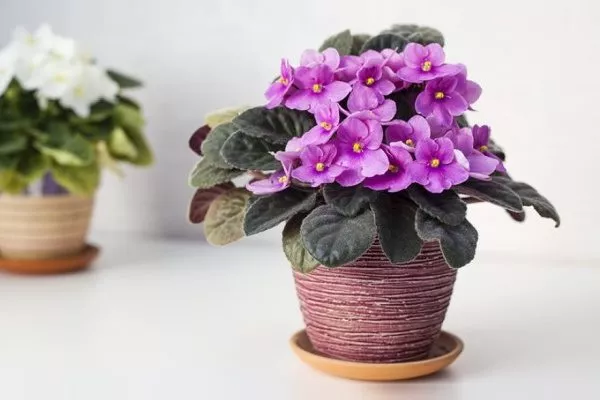
Historical events:
- It was first discovered by German Commandant Walter von Saint-Paul in Africa (eastern part) in 1892.
- The Saintpaulia was scientifically described by botanist Hermann Wendland. He was also the first to obtain a flowering seedling.
- In 1893, it was exhibited under the name "Usambara Violet." There, it deservedly found many admirers.
- Within a year, the culture had conquered Europe and America, which led to the formation of the Center for the Breeding of Violets (modern type).
- In 1898, flower growers from all over the world introduced flowers with burgundy, white and pink petals to the world.
- In 1920, Californians learned to propagate the crop using foliar propagation (previously, this was done only by seed). This led to a "violet" boom.
- In 1938-1940, the mass distribution of Saintpaulias throughout the world began, and many new varieties and species appeared.
Biological description
The Usambara violet blooms almost year-round—for 8 to 10 months. Some species take short breaks, while others produce buds gradually rather than en masse, making the decline in flowering activity unnoticeable.
The culture consists of a shallow root system (due to which deep planting pots are not required), a rosette with leaves, where buds are formed first, and then flowers.
Brief characteristic features of modern indoor violets – average, generalized (specific characteristics depend on the species and variety):
- Saintpaulias (also known as Uzambara violets) are herbaceous, low-growing perennials that are considered evergreen plants;
- shoots - shortened, mostly erect;
- basal rosette – contains rounded leaf blades of a hairy type;
- leaves - the uniformity of the color is influenced by the sex of the plant (female flowers have a light spot at the very base, while male flowers have a color covering without this inclusion);
- the base of the leaves is most often heart-shaped, and the top is slightly pointed or rounded;
- flower diameter in cross-section – from 20 to 40 mm;
- leaf color – green (from light to dark tone), sometimes there are specimens with inclusions, borders;
- petals - can be plain, with prints (like fingerprints) and edging;
- inflorescence type – racemose;
- The root system is predominantly superficial, with radicular shoots spreading out to the sides.
Distribution in indoor floriculture
The indoor violet is considered a very common flower in gardening. It is loved by violet lovers worldwide. This is due to its extraordinary beauty, pleasant fragrance, long and abundant blooms, hardiness, and a huge variety of varieties and shades. Many beginners believe that this plant is capricious, but in fact, this is not the case at all.
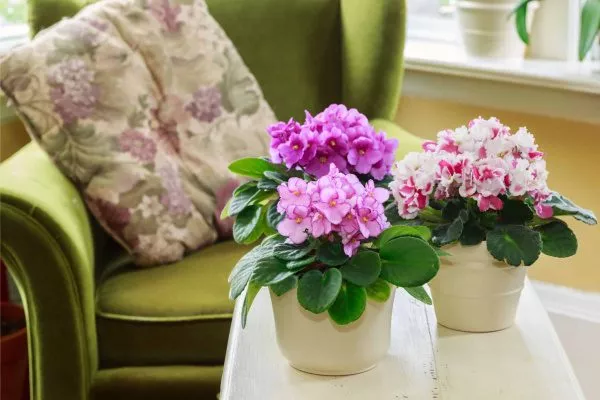
To ensure your violets don't cause problems, don't get sick, and don't wilt, it's enough to follow very simple cultivation guidelines. You can also purchase violet varieties that are highly disease-resistant and easy to care for.
Classification of domestic violets
There are so many varieties of Usambara violets (not to mention cultivars) that even experienced violet growers sometimes have trouble distinguishing them. The reason for this is simple: a single cultivar can belong to several species simultaneously. For example, it can be in the miniature violet group alongside semi-double violets, girls, and so on.
Socket size
| Name | Outlet diameter (cm) | Irrigation type | Peculiarities |
|---|---|---|---|
| Micro-mini | 2.5-8 | Wick | Very compact bushes |
| Mini | up to 15 | Wick | They take root more easily and form flower stalks in abundance. |
| Semi-mini | 17-20 | Ordinary | Does not tolerate excess light |
| Standard | 20-37 | Ordinary | The most common varieties |
| Standard large | 40-60 | Ordinary | The largest Saintpaulias |
Rosette parameters are determined by the mature plant. They can be:
- Micro-mini. The smallest rosette diameter ranges from 2.5 to 8 cm. These are very compact bushes, requiring only wick watering.
- Mini. The maximum rosette diameter is 15 cm. Unlike larger varieties, these violets root more easily and produce abundant flower stalks. As with the previous case, wick irrigation is recommended.
- Semi-mini. This is a medium-sized bush, equal to 17-20 cm. Its peculiarity is that it does not tolerate excess light.
- Standard. The most common varieties, the rosette of which varies from 20 to 37 cm.
- The standard is large. The largest Saintpaulias have a rosette diameter of 40 to 60 cm.
Trailing violets are also included in the classification of violets by rosette. Unlike typical species, they have not one, but several growing points. The word "trail" translates from English as "trailer" or "tail." In botany, this indicates that the bush's main shoot is branched, resulting in multiple growing points. However, the foliage is not as abundant.
Trailers, in turn, are divided into 2 subtypes:
- Bushy. The stem grows exclusively upward, as do the flower stalks (upright). Some varieties lean slightly to one side.
- Ampelous. The rosette produces elongated, creeping stems, as well as flower stalks. This species is considered the most easy to grow.
Despite established standards, sizes may not meet them. This can be due to improper care, planting in improper soil, etc. Typical violets with more than one growing point are not allowed at exhibitions. Trailers are an exception.
Type and shape of flower and petals
| Name | Flower shape | Number of petals | Peculiarities |
|---|---|---|---|
| Pansies | 5 petals (3 large at the bottom, 2 small at the top) | 5 | Natural form, preserved during selection |
| Star | 5 identical petals, symmetrically arranged | 5 | Reminds me of the rays of a star |
| Wasp | 2 petals on the side, distinguished by their curve and size | 5 | Looks like cyclamen flowers |
| Bell | 5 petals, gathered and fused at the bottom | 5 | Bell shape, does not open fully |
Violet flowers come in a wide variety of sizes, ranging from 2 to 10 cm. But by the shape of the flower violets are divided into the following:
- Pansies. The flower has five petals (three large ones at the bottom, two small ones at the top), and the anthers in the center are like eyes. These varieties often have a border around the edges. Other names include pansy, standard Saintpaulia, violet, and classic.
Pansies have a purely natural form, which is perfectly preserved during selection.

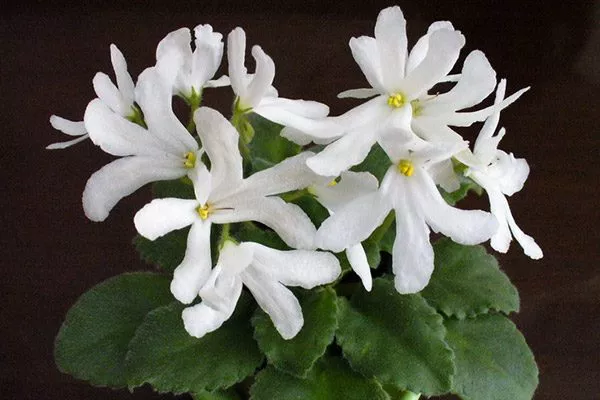
- Star. It consists of five identical petals arranged symmetrically. Viewed from above, the flower resembles the rays of a star. The edges are either rounded or pointed. Other names include stellate, star-flowered, and star-flowered.
- Wasp. The flower's shape resembles that of this insect, as it has two lateral petals that are particularly distinctive in their curve and size. The upper petals are slightly curled into a lip-like shape. It also bears a resemblance in appearance to cyclamen flowers.
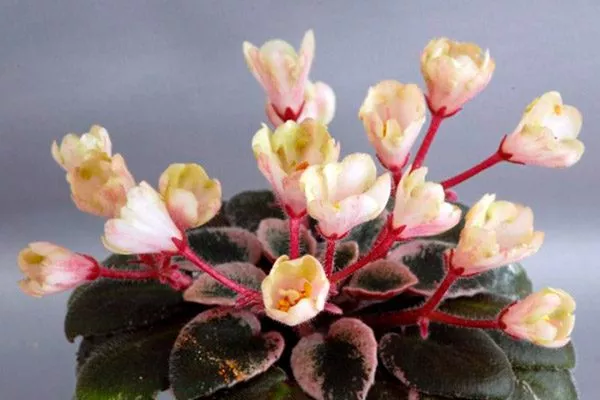
- Bell. This is a simple five-petal flower, but with unique curves. Specifically, the petals are gathered and fused at the bottom, creating a bell-shaped form. The flower never fully opens.
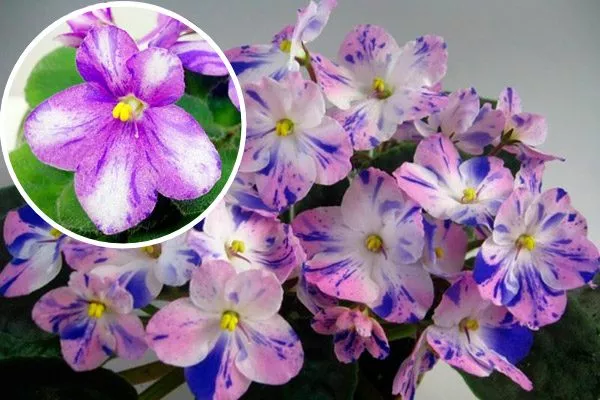
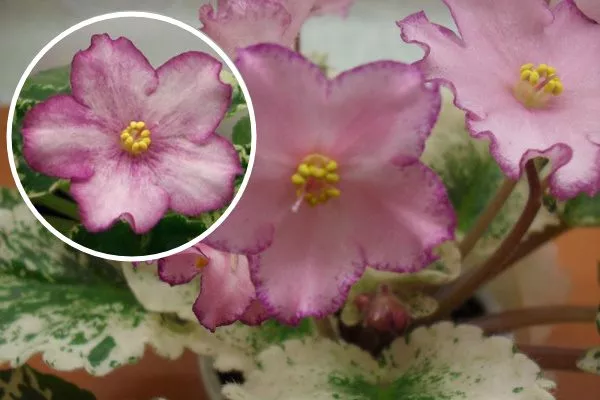
By the number of petals Saintpaulias are divided into the following varieties:
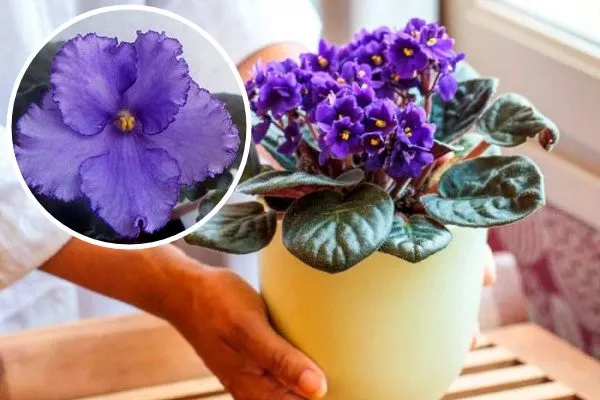
- SimpleThese are flowers consisting of 5 petals, where the top two are smaller in size than the bottom three.
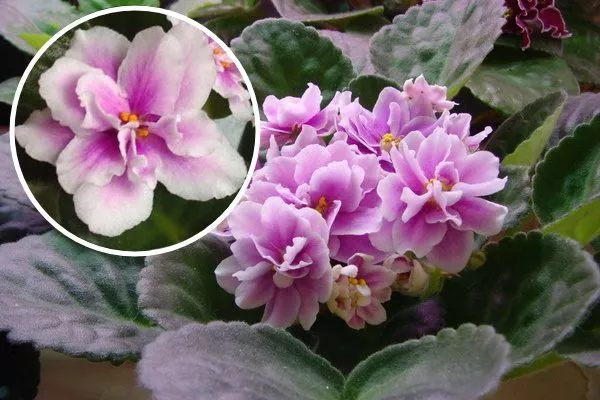
- Semi-double. The number of petals is usually more than five. This is because semi-double flowers have several additional petals growing near the anther (stamens), forming a bow or comb. The anther is visible.
- Terry. The number of petals varies, but the key is that they are all arranged in tiers. The largest are at the bottom, then medium-sized, and then the smallest. The double variety includes flowers with both open and closed anthers.
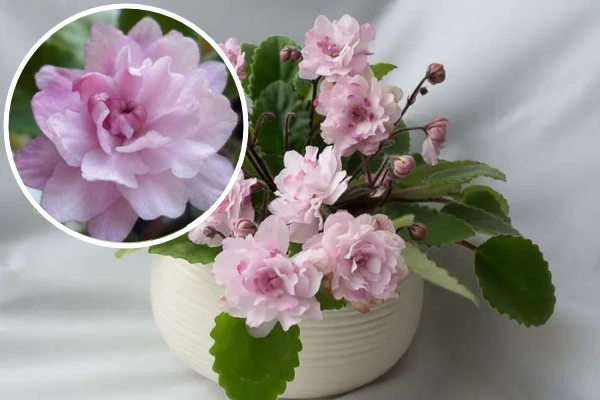
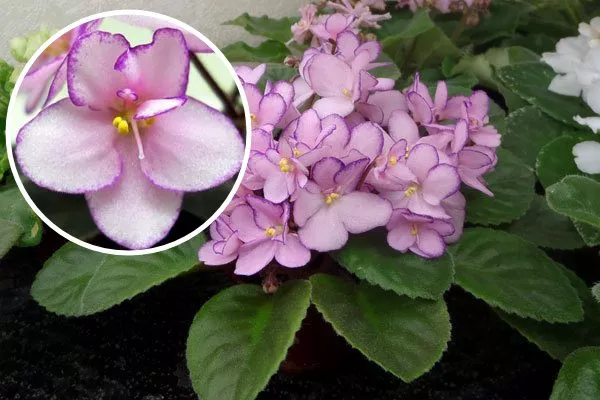
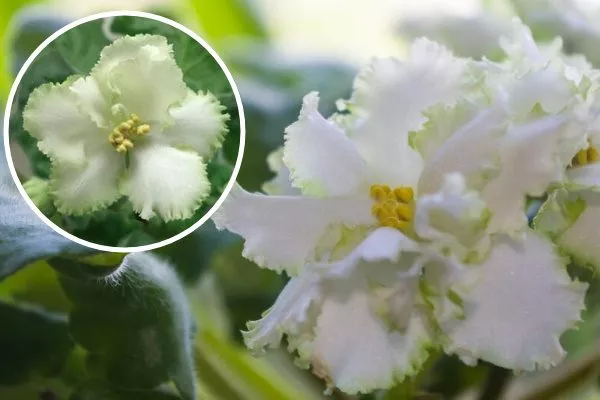
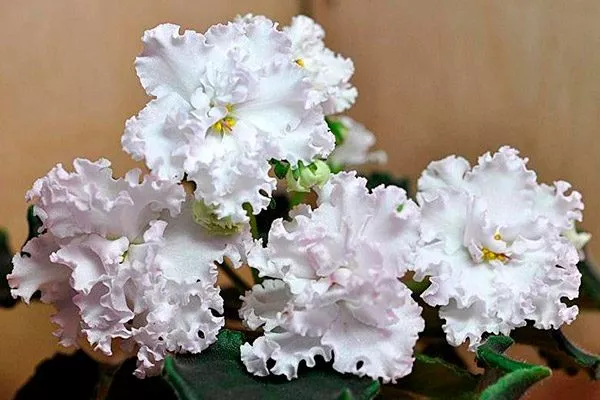
The classification of violet indoor flowers also extends to the structure of the petals themselves. For example, by the shape of the petal edges there are:
- Smooth. The petal edges are perfectly smooth—not curled or jagged. The surface texture is also smooth. Descriptions also include terms such as simple petals, standard, and classic edges.
- Corrugated. Other names include fringed, fringed, and lacy. In this case, the edges are serrated or fringed, resembling lush ruffles in appearance.
- Wavy. It's a "golden mean" between the two previous options. Specifically, the edges are slightly wavy.
Petal color
There are violets that are completely monochromatic, but many gardeners consider this option boring, so interesting colors are popular:
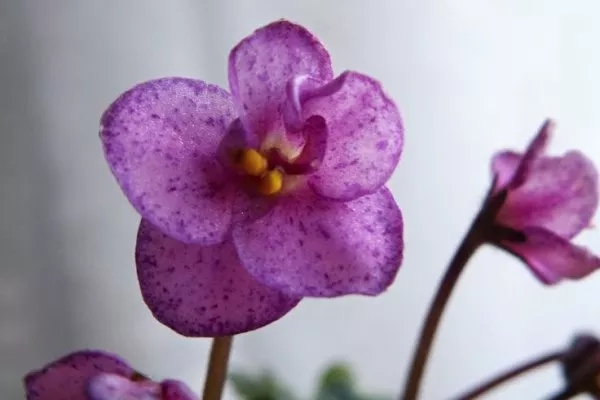
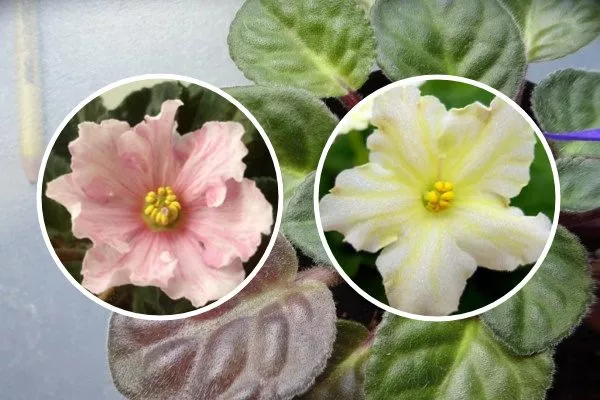
- Fantasy. Fantasy is considered the most popular variety, as the basic tone of the petals is infused with various inclusions—dots, imprints, splashes, strokes, specks, polka dots, and more. When propagated vegetatively, 70-90% of this quality is retained. It's best propagated by shoots or leaf cuttings.
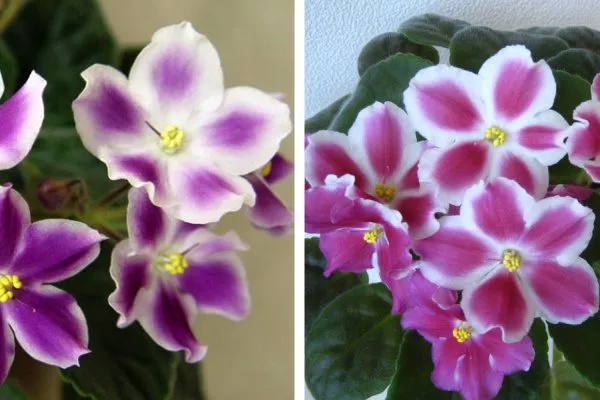
- Chimeric. Characterized by radiating, contrasting stripes from the center of the flower. This trait is transmitted through propagation by side shoots or by rooting flower stalks (but not by cuttings!).
There is a similar color pattern in the form of stripes running from the center of the flower to the edges of the petals, but the stripes are thinner and more even. These are called rays. These are not necessarily chimeras. This color pattern is also found in regular varieties. Rays are transmitted during propagation by cuttings, unlike chimera coloration.
- With a little eye. In this case, a dark (or light) spot is noted in the center of the flower - that is, an eye.
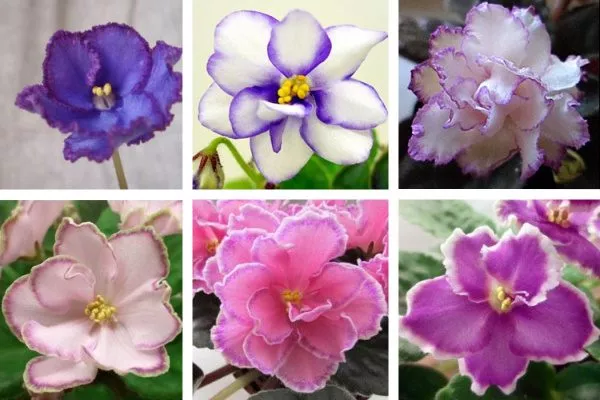
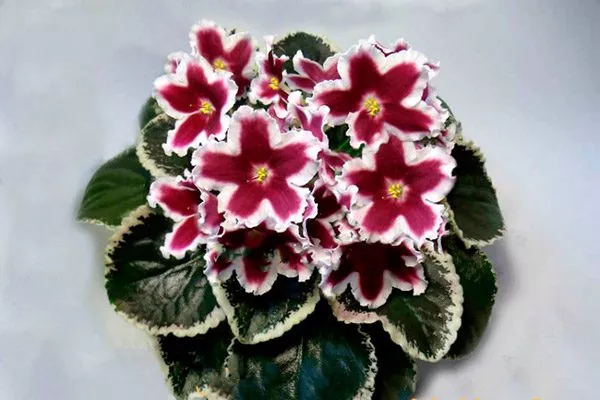
- Bordered. In this case, each petal has a border of a different color around the edge. For example, the flower has a pink base color and a white border. This variation is called "Geneva." The width varies from thin (called pencil) to thick. There are varieties with a two-tone border (see the bottom row of flowers in the next photo).
There is also a fantasy border, when the dots and splashes gradually thicken at the edge of the petals, and thus form a border.
- FingerIn the middle of the petal there is a spot (as if a finger was dipped in paint of a contrasting color and made a smear).
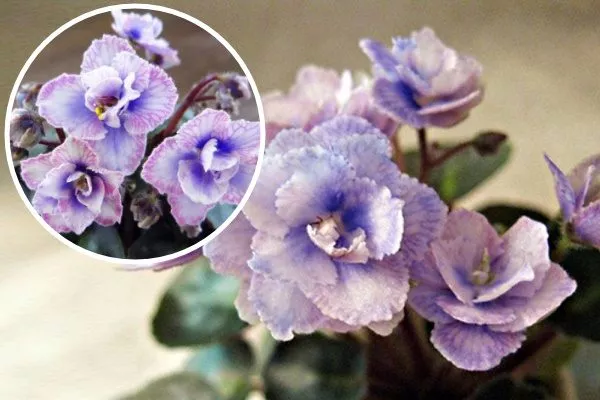
- With a meshThe color of the petals resembles a venous network (i.e. the veins are visible).
- StreamsThis color has the appearance of marbled streaks with veins.
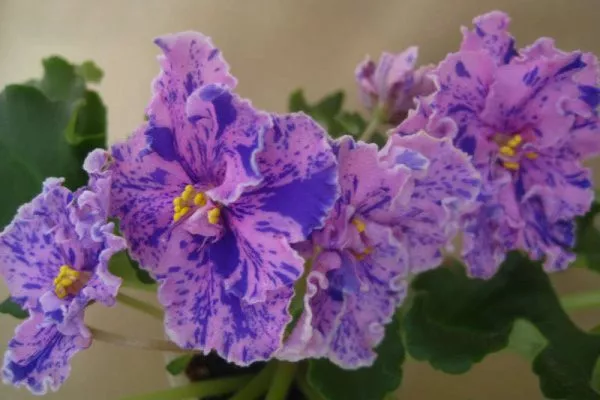
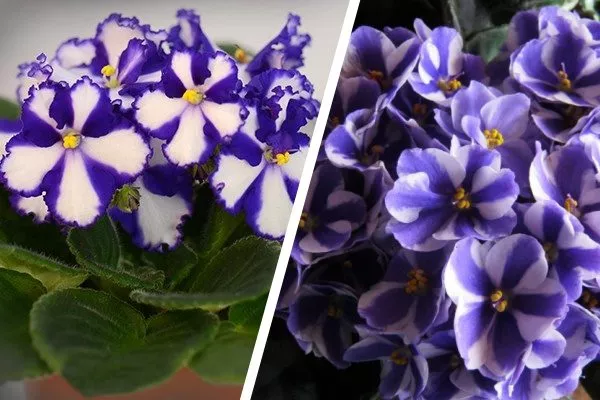
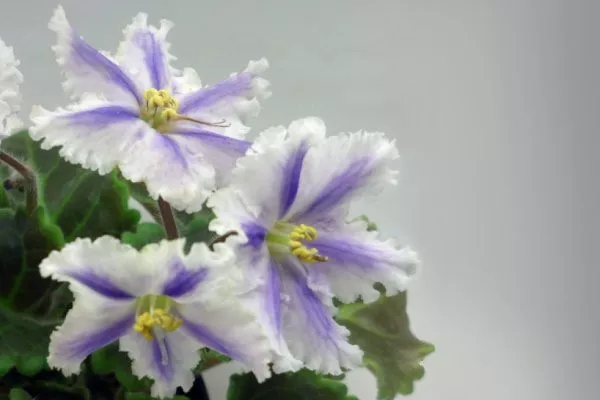
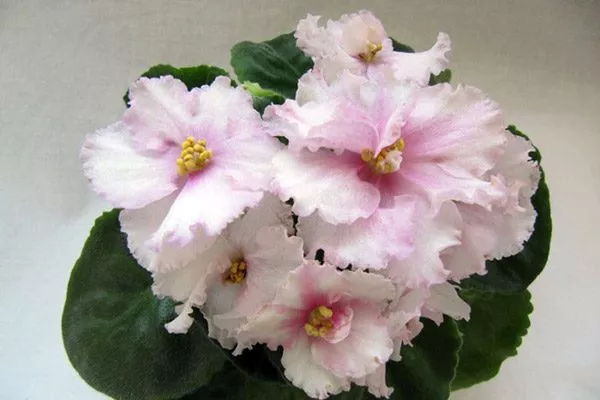
Leaf type and shape
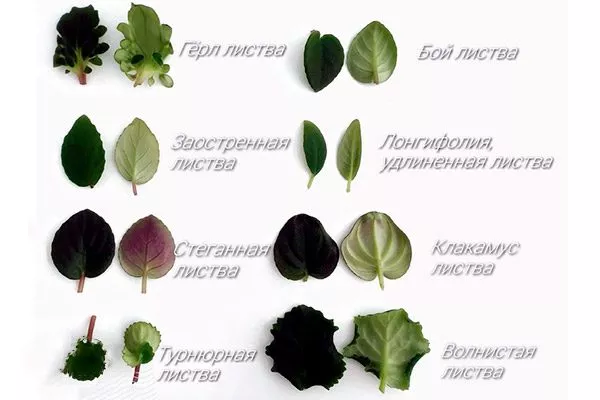
Leaves are divided into the following groups:
- longifolia (spider-like leaves, spider) - spider-like foliage is extremely rare, characterized by narrowness and length;
- supreme is also a rare species, in which the leaves are covered with thick fluff, and the petiole is as thick as a pencil;
- bustle - the bustle type is equipped with stipules, at the very base on the underside there are leaf shoots, and if they grow together, a “fan” is formed;
- show-list – distinguished by its symmetrical, correct shape and color;
- serrated - along the edges there are identical rounded or blunt teeth, between which there are sharp notches;
- girl - a leaf from a female bush, which has a light spot at the base;
- battle - male leaf, without a spot;
- shagreen type – characterized by a slightly pubescent surface;
- giant (excellent, perfect) - very large leaves with thick petioles are distinguished by their increased fleshiness for a violet, but at the same time they break easily;
- rounded – a common type, the edges can be either smooth or folded;
- heart-shaped – resembles a heart in shape;
- holly - a long leaf blade with a large comb and very wavy edges that either curl downwards or bend upwards;
- pointed (sharply pointed) - wedge-shaped tip, elongated shape;
- quilted - distinguished by a rich structure and density, the veins deepen so that the area between them is raised, therefore resembling a quilted blanket in appearance;
- Clackamus (watermelon vein, cracker-type) is a very interesting innovative option:
- shape – oval-elongated;
- the arrangement of the veins is parallel;
- The vein type is depressed, so they protrude more on the reverse side.
- spoon-shaped (boat, ellipse, cup) - the name is given due to the outward curvature of the leaf edges, but sometimes inward, which is why it resembles a tablespoon.
Leaf color
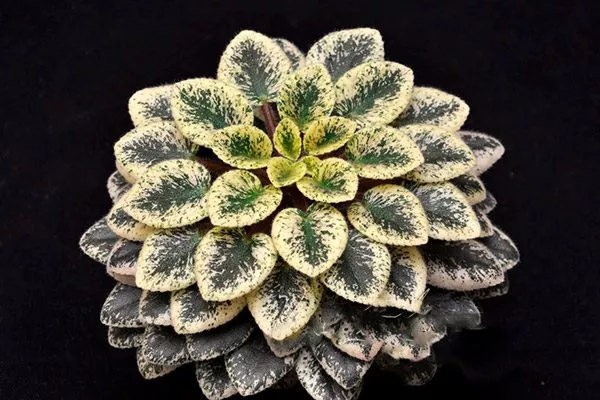
With proper care, healthy violets have dark green leaves. Additionally, violet leaves vary by variegation:
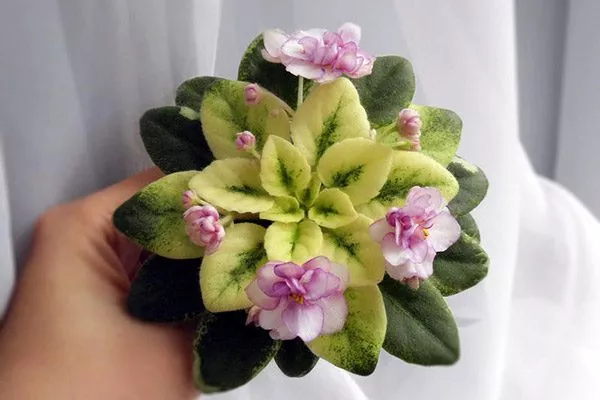
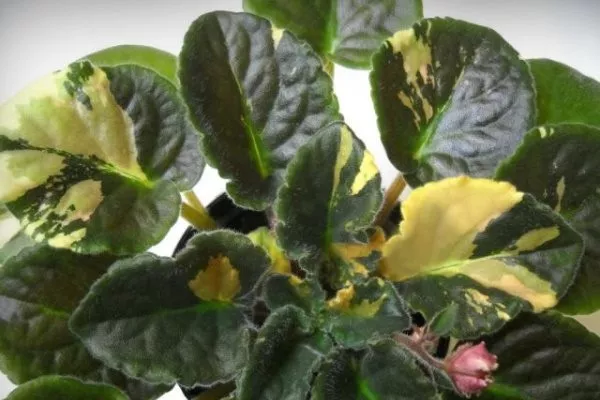
- Tommy Lowe (TL). This is the edging type and the most well-known among gardeners. The color scheme can be solid or mixed, most commonly featuring shades of cream, white, and pink.
- Mosaic. This is a rare variety with stripes, streaks, or spots of various shades—silver, snow-white, light green, pink, but other tones are also found. All of these are located exclusively in the central part of the plate, while the edges are always green.
- Crown. It is divided into 2 subspecies:
- at a young age of the plant, the leaves growing from the central part of the rosette have a lemon, light yellow or pinkish tint;
- In an adult bush the color is green, but sometimes the variegation described above may also appear.
- Spontaneous. In simple terms, it's a mutation, as the leaves are completely uncharacteristic of the violet variety. A plant can develop either a single spontaneous leaf or several. Variegation can be permanent or temporary; this trait is not passed on when propagated by petioles or leaves.
Stages of the violet life cycle
Saintpaulias are most often propagated from leaves. Before forming a mature bush, the plant goes through a specific life cycle. This cycle manifests itself as follows:
- leaf cuttings – planting material that requires root growth for further planting;
- rooted cutting - when white root shoots have already formed on it (this takes 8-15 days);
- mother leaf - a cutting with roots that has been transplanted into a permanent pot;
- babies or stepsons are shoots formed near a rooted leaf that need to be transplanted into a separate container;
- a starter is a plant that has reached its “adolescent” stage;
- adult violet (mother plant) - when the bush is fully formed, many side shoots grow from it, it is the “parent” of more children, starters.
The entire cycle takes about 12 months.
Planting and replanting violets
When planting Saintpaulias, it's important to strictly follow all soil, pot, and other requirements. The flowers are transplanted using the transshipment method, meaning they are transplanted with the root ball. To do this, the plant is first watered, then removed from the old pot, and placed in a new one.
If you need to divide a bush, watering is not required; the flower is removed from the pot without the root ball.
Flower growing requirements
To ensure the flower quickly takes root, follow these simple planting rules and growing conditions:
- ensure the required air temperature and humidity;
- pay attention to the length of daylight hours;
- plant only during the active period - any time of year except winter and late autumn;
- Choose a location – ideally on a western or eastern windowsill (the northern one will be cold in winter, the southern one will be hot in summer).
How to choose the right pot?
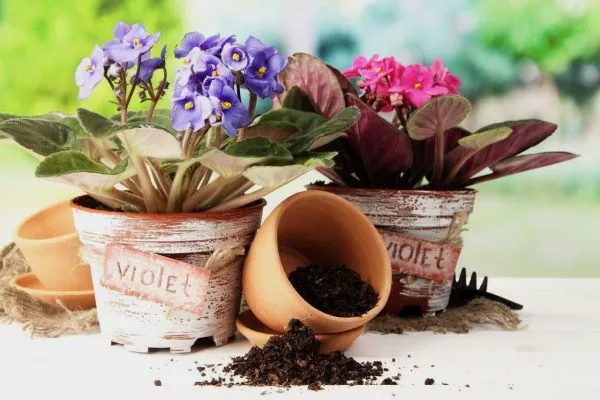
Since the root system is shallow, the permanent pot should be shallow. Choose a diameter half as large as the violet's intended rosette size. The recommended width for plastic cups for rooting is 4 to 6 cm.
Soil composition
The soil for violets should be breathable and loose, with a neutral pH (5.5-6.5). You can buy the soil at a gardening store or make your own. There are several options:
- perlite and peat - 1 part each, leaf humus - 2 parts, charcoal - 1/3 of the total mass;
- 2 parts each of sphagnum, moss and coniferous humus, 1 part river sand, 4 parts leaf humus;
- 1 part perlite and turf soil, 2 parts peat, a little charcoal.
How to plant?
Planting at home is often done using a leaf with a petiole. Only take cuttings from the second or third tier, where the leaves are considered the most nutritious and healthy. Be sure to cut at a 45-degree angle and treat the area with crushed activated charcoal.
- ✓ The optimal petiole length for rooting is 3-4 cm.
- ✓ The water temperature for rooting should not be below 22°C.
- ✓ The use of activated carbon in water prevents the development of putrefactive processes.
The procedure is simple – just a few steps:
- Place the substrate into the prepared plastic cup and moisten it slightly.
- Place the seedling into a shallow hole.
- Sprinkle with soil mixture and compact lightly.
- Cover with a plastic bag or plastic cup/bottle.
- Leave for about 30-50 days.
- Transplant into a permanent container with the same substrate.
Caring for an indoor flower
Caring for an indoor Saintpaulia isn't as difficult as it initially seems. Simply follow these guidelines:
- Lighting and temperature conditions. Maintain a temperature of 18-24 degrees Celsius. At higher or lower temperatures, the plant feels uncomfortable and stops growing.
Provide lighting for at least 12 hours, but 14-15 hours is ideal. It's recommended to use fluorescent lamps, but keep them at least 30 cm away from the flower. Avoid direct sunlight on the leaves, as this will cause sunburn. - Watering mode. The frequency and amount of watering depend on the pot size, the age of the violet, the humidity level, and the room temperature. Therefore, always pay attention to the soil condition. A dry crust should never form on the surface, and liquid should not accumulate (stagnate) inside the container.
Use settled and boiled water. Water in one of the ways:- through the tray - pour water into it, put the pot for 15 minutes, remove;
- from above – pour around the root from a thin watering can or syringe;
- through a wick - insert the tourniquet into the pot in a spiral when planting, releasing one end through the hole in the bottom, insert the wick into the water (keep it like this all the time - the flower will not absorb more water than it needs).
- Features of feeding. Fertilizers are used to promote abundant and consistent flowering. This requires potassium and phosphorus, so buy complex fertilizers (superphosphate and similar), but use a concentration 3-5 times lower. Apply fertilizer twice a month. In the spring, fertilize with nitrogen.
- Do I need to trim? This procedure helps create a beautiful bush, but not all varieties require pruning. On any violet, remove spent flower stalks, old leaves, and damaged parts. Don't forget to treat the edges with activated charcoal.
- Winter care. During the cold season, be sure to turn on lamps, move pots 50 cm away from windows, and avoid placing them near heating devices. Repotting the flowers is also not recommended, as they are dormant.
Reproduction
The domestic violet propagates in different ways:
- flower stalks, which are cut into several pieces and inserted into the soil;
- leaves - rooting occurs in a substrate or water;
- leaf fragments - cut into pieces and rooted;
- stepsons - new rosettes are broken off and transplanted into the soil mixture;
- dividing the bush - only if necessary (the plant, together with the roots, is divided into several parts, after which it is planted in different containers).
For propagation, select specimens up to 5-6 years old. Plants must be healthy and strong. In all cases except the last, the planting material is first planted in plastic/peat cups and then transplanted into a permanent pot.
Diseases and pests
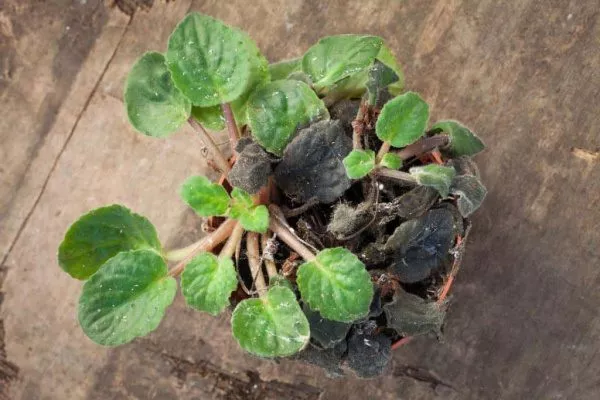
With proper care, diseases are extremely rare, and the main cause is precisely poor agricultural practices. Most often, these include overwatering of the soil, improper temperature and humidity, and insufficient or excessive lighting.
Sometimes violets are susceptible to diseases and pest infestations such as:
- Late blight. The main symptoms are curling leaves and drooping flowers. For treatment, use Fitosporin.
- Root rot. Symptoms include leaf drop and softening of the stem and roots. Treat with Fitosporin.
- Brown rot. When the disease occurs, the stems soften. For treatment, use Fitosporin, Trichodermin, FitoDoctor, Skor, and Fundazol.
- Stem rot. The shoots are susceptible to rot—they're rotting. Treat with any fungicide.
- Botrytis or gray mold. The disease can be identified by the pubescent coating on the foliage. Apply fungicides.
- Powdery mildew. Also characterized by a light-colored coating. Use Fitosporin.
- Spider mites and cyclamen mites. Punctures and cobwebs are found on the leaves.
- Aphid. The entire green mass is covered with a light fluffy coating.
- Mealybugs. The leaves turn yellow or grey, and the soil gives off a mushroom-like odor.
- Nematodes. Dark green spots form on the stems and leaves.
Violet Grower's Dictionary with Explanations
In violet growing, there are terms like "sports" and so on, but many of them are quite understandable to novice gardeners. There are others that are impossible to understand without a dictionary. Some of them are:
- sport – a prefix to a variety, meaning that the flower has undergone a mutation during reproduction, that is, has completely lost its maternal qualities;
- velvetiness – dense pubescence of the surface;
- head – the upper part of the rosette;
- mother plant - a plant from which shoots are taken;
- meristem – the growth point of a plant (can be apical, i.e. top/central, and also lateral, i.e. side – this is a stepson).
- leaf humus is soil together with leaves that have rotted over the winter;
- sphagnum – white peat moss;
- stepsons – stems with leaves formed in the axils of the rosette;
- dormancy is the time when the plant is in a state of hibernation (that is, at rest), so development is suspended;
- The letters before the variety name (LE, EK, etc.) indicate the name of the breeder, for example, LE – Elena Lebetskaya, EK – Elena Korshunova.
Frequently asked questions
There are a number of questions that are important for beginning gardeners:
- How to humidify the air? To do this, install humidifiers, place containers of water nearby, spray water from a spray bottle near the flower (not on it).
- How to bathe a violet? This can be done once every 2-3 months. Rinse the violet under running water or spray it, but after cleaning, be sure to wipe each leaf and stem with a soft, dry cloth.
- How to care for a violet after replanting? Don't water the plant immediately after planting—wait at least 7-10 days. Fertilize after a month.
Reviews
The indoor violet isn't a particularly fussy plant, but it's important to follow proper care and planting guidelines. Failure to do so will prevent abundant and long-lasting blooms, and the plants will be susceptible to disease due to a weak immune system.
I've never been able to grow violets. For some reason, they always rotted. And no matter what I did to fix the situation, nothing helped. Thanks for the interesting article. Now I understand the reason—I was just watering them with water from a mug, misting them consistently once a week, and not fertilizing them. I only added tea leaves.
But now you know how to care for violets, so you can try growing them again ))
Yes, you're right, violet leaves rot if they come into contact with water. Therefore, you shouldn't mist them, and in general, you should water them carefully, ensuring the top layer of soil doesn't get wet (it's better to pour water into the tray, but you need to make sure there are holes in the bottom of the pot, otherwise the violet won't be able to absorb the moisture).
And be sure to check the plant an hour after watering and pour out any excess water from the tray that the violet was unable to absorb.
She's such a violet... she doesn't like to swim ))
Thanks for the interesting article! There are so many different kinds of violets. I've never seen an wasp violet. I really love violets.
I was very impressed by the "Violet Grower's Dictionary with Explanations" section. I even saved your article so I'll always have the information at hand.