
If your violet isn't blooming, don't blame it on the plant's fussiness, as many novice violet growers do. The problem isn't the violet's demanding nature, but rather a violation of proper cultivation practices. This is especially true if the flowers previously delighted with an abundance of blooms.
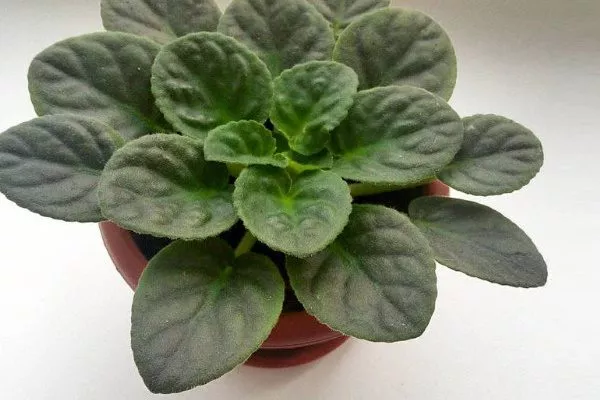
Reasons for the lack of flowering
The blooming period of violets depends largely on the variety. The average duration is 6 to 9 months. Some species bloom for only 2-3 months, while others bloom year-round.
If flower development has slowed down and flowering activity has decreased (based on the frequency for a particular variety), then there is a specific problem that needs to be addressed as soon as possible.
Age
The lifespan of violets varies. On average, it's about 6-10 years. Once a plant reaches 4-5 years of age, it's considered old. It stops producing flowers in the required quantity or doesn't produce them at all.
If ovaries do form, they are very weak and will require especially careful care. If you don't know the age of your Saintpaulia, pay attention to the key signs of advanced age:
- the trunk at the very base of the rosettes becomes bare;
- the leaves lose their “youthful vitality” and color saturation;
- much fewer sockets are formed.
Landing errors
It's no wonder that specialists develop special planting techniques for violets and other houseplants—each crop has its own comfortable conditions. The following mistakes can be made during planting, preventing flowering:
- containers and tools were not disinfected, as a result of which the plant became infected (some diseases stop the production of inflorescences);
- the pot is not the right size;
- wrong container material;
- lack of drainage holes.
- ✓ The optimal diameter of the pot for an adult violet should be 3 times smaller than the diameter of the leaf rosette.
- ✓ The depth of the pot should not exceed its diameter to avoid water stagnation.
In the first case, the cause can be identified by the symptoms of the disease. If the potty is found to be "problematic," pay attention to the following:
- The pot is too small. If it doesn't meet the required parameters, the flower becomes cramped, and the roots have no room to grow, which negatively impacts the formation of flower stalks. The green mass increases significantly, and the roots fail to grow. This is a helpful indicator for identifying the cause.
- The capacity is too large. Saintpaulias most often have a shallow root system, so the container should be shallow but wide. If the diameter exceeds these parameters, the root system quickly becomes active, but the leaves, stems, and rosettes stop developing, leaving the plant looking half-naked.
- There are no holes on the bottom. Violets prefer a loose, water-free soil. Providing drainage holes for water drainage is essential for the plant's healthy growth.
Signs of this problem include wilting of the green mass, stunted stem growth, and root rot. When water stagnates, the top layers of the soil mixture remain wet for a long time. - Material used to make the pot. This plays an important role, as it must be able to breathe. Clay containers are best for this. If the containers are made of plastic (not plastic), and also painted with toxic paints, the plant will feel uncomfortable.
Flower transplant
Replant violets for two reasons: to avoid overcrowding and to refresh the soil mixture.
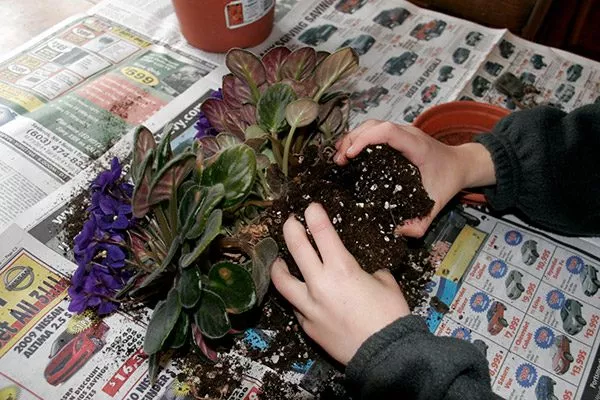
The peduncle does not develop in two cases:
- if the transplant was carried out too late;
- when the plant has not been transplanted at all.
There is an exception: flowering ceases immediately after a timely repotting. This is because the Saintpaulia devotes all its energy to adaptation and recovery rather than to its own development. This phenomenon is temporary—lasting only 2-3 weeks.
Unsuitable soil
Saintpaulias are sensitive to soil quality due to their delicate root system. Therefore, it's necessary to purchase a specialized substrate or prepare a homemade soil mixture, strictly adhering to the proportions of specific components. An example of a suitable mixture:
- turf soil (preferably taken from a forest belt under any tree except oak) – 1 part;
- peat – 2 parts;
- vermiculite – 0.5 parts;
- perlite – 0.5 parts;
- crushed sphagnum moss – 1 part.
Additionally, if the soil structure is not suitable, add river sand, wood ash and coconut fibers.
If flowering is absent due to improper soil, the following additional symptoms are observed:
- leaves stop growing;
- when the soil surface dries out, a lump of earth is formed;
- a white coating forms on the ground.
Unsuitable neighbors
When growing Saintpaulias, consider the proper placement of other potted flowers nearby. Avoid placing taller plants near violets, as this will overshadow them. Other unsuitable neighbors include:
- climbing - because they send their vines onto nearby plants, as a result of which they not only create shade, but also suppress the violet;
- flowering - when close together, cross-pollination occurs;
- Citrus bushes - the violet suffers from their smell.
When it comes to garden violets, neighborhood will play a key role. Undesirable neighbors:
- lilies of the valley;
- peonies;
- sweet pea;
- calla lilies.
In addition to the lack of flowering, the following signs are also observed with improper neighboring plants:
- decrease in color brightness;
- leaf fall;
- drying out of green mass;
- formation of different spots - from light to dark shades.
Insufficient lighting
When there's not enough light, Saintpaulias refuse to produce flower stalks because they're simply going dormant. How to tell:
- the leaves become small and pale, sometimes they stretch out too much upwards;
- the bush takes on an inclined position – it reaches towards the brightest part of the windowsill;
- unlike the leaf, the petiole lengthens;
- the lower tiers with leaves die off.
- ✓ Violets require 12-14 hours of light per day, but direct sunlight can cause leaf burn.
- ✓ Using a grow lamp with a spectrum close to natural light can significantly improve flowering.
Incorrect watering
Flowers won't form if there's insufficient moisture or if the water is too wet. Water quality can also negatively impact productivity—avoid cold water or water that contains harmful substances (i.e., water that hasn't been settled or boiled). If watering requirements aren't met, the following symptoms will appear:
- the leaves droop and fade;
- if there is not enough water, the surface of the soil becomes covered with a dry crust and peels off from the walls of the pot;
- the edges of the leaves turn brown;
- When overwatered, the leaf rosette becomes watery.
Unsuitable conditions
Saintpaulia plants don't thrive in unfavorable conditions. They don't tolerate the following:
- temperature – you must not allow the thermometer reading in the room to go above +25 degrees (the plant will gradually begin to burn) or below +16 degrees (the violet will become overcooled);
- drafts – to stop blooming, the violet only needs an open window, even in the summer heat;
- the air conditioner is on – leads to sharp temperature fluctuations and hypothermia;
- humidity – at low levels the plant dries out, at high levels it starts to rot.
Lack or excess of fertilizers
It's no coincidence that specialists conduct extensive research into formulating specific dosages, as a deficiency of a particular substance slows down plant development. An excess of nutrients also has a negative impact.
For example:
- If the nitrogen dosage is exceeded, green mass develops, but not flower stalks; if there is a deficiency of this element, smaller foliage and a lack of stem growth are observed;
- If there is no potassium and phosphorus, the flowers do not form at all; if there is an excess, there are too many of them, but they are excessively small.
Diseases or pests
If all the requirements for growing violets are met, but there is still no flowering, the cause may be disease or pest damage.
When this happens, the plant throws all its protective forces into resisting negative factors, and there is not enough energy and nutrients to produce flowers.
The most common symptoms are the following:
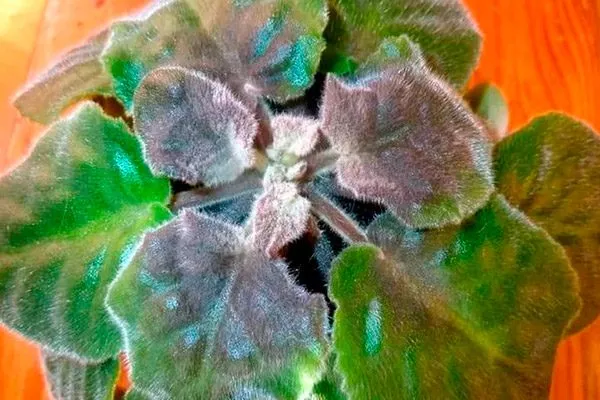
- Fusarium. First, the root system is damaged, then dark spots appear on the basal stems, flowers, and leaves. The plant wilts and loses its turgor.

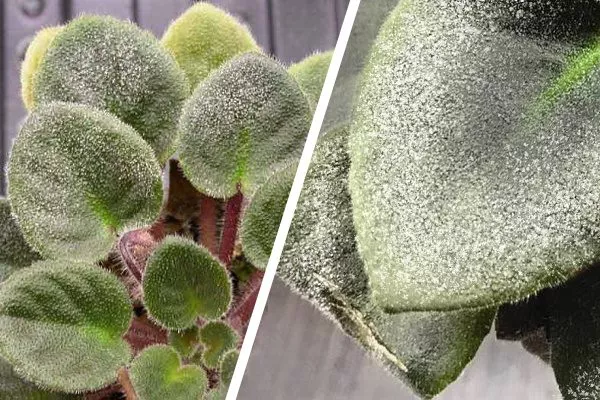
- Powdery mildew. A whitish coating forms on the foliage, the stems thicken, the color intensity fades, the green mass dries out, and the leaf blade becomes discolored. Shoots stop growing, and old stems rot and die.
- Gray rot. Brown spots and a grey (fluffy) coating appear on the leaves, and the stems become soft, watery and weak.
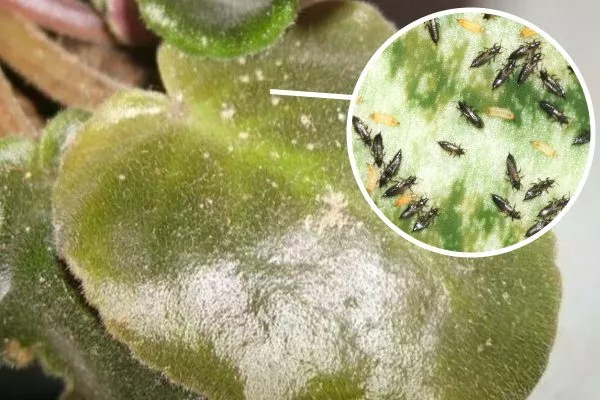
- Thrips. Foliage is eaten, the surface darkens, and dries out.
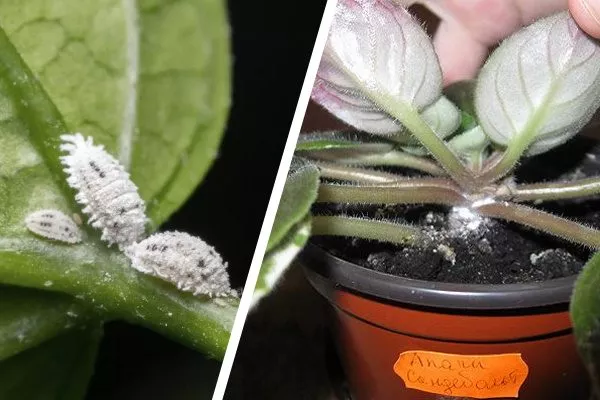
- Mealworms. The green mass weakens, and larvae are observed on the underside of the leaves.
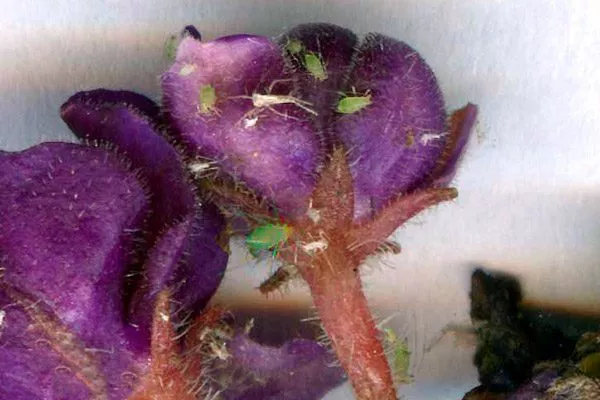
- Aphid. A cluster of insects forms, resembling a dusty coating in appearance.
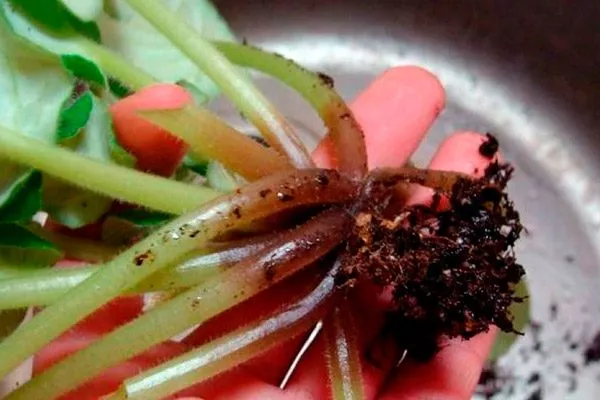
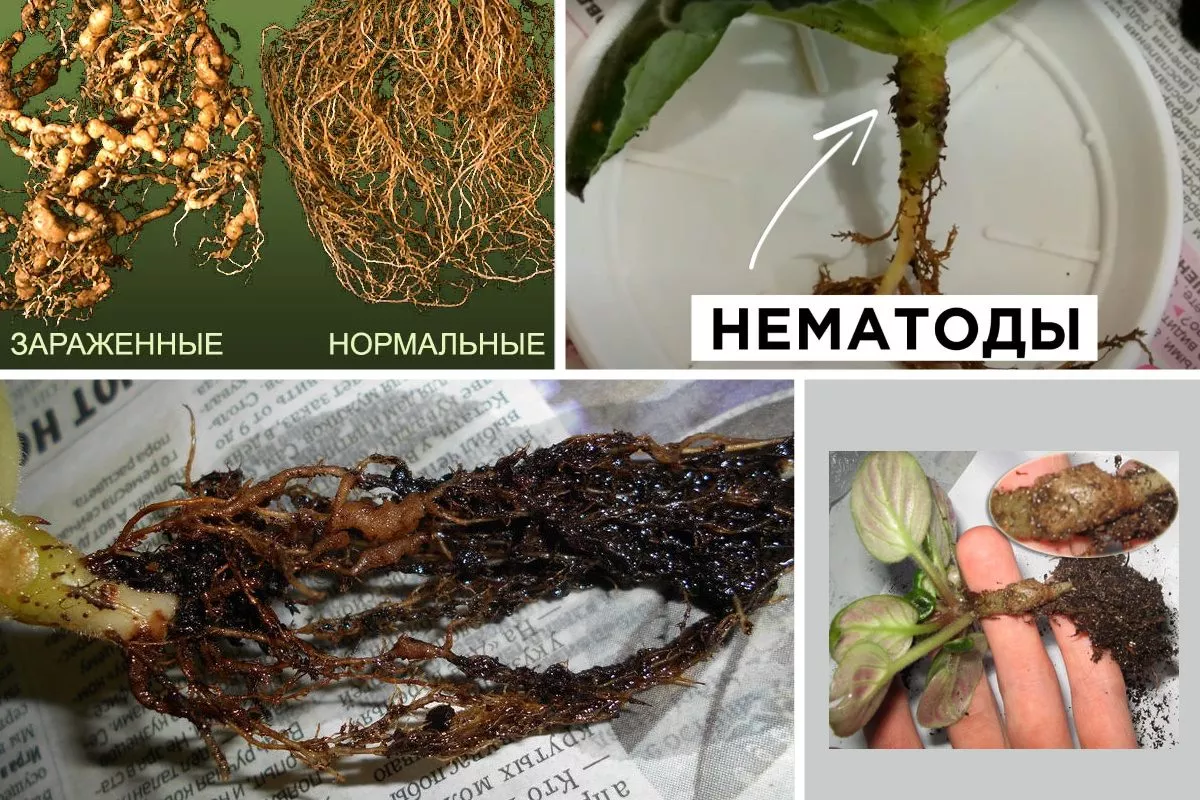
- Nematodes. The root system is affected (bulbs and thickenings are formed), then green-white spots appear on the leaves.
Injuries
The roots and above-ground parts of Saintpaulias are very delicate. The plant is easily damaged and broken. Damage can be caused not only by physical impact, but also by sharp supports, jagged pots, watering cans, and other factors.
Abundance of old leaves
If a violet isn't pruned or rejuvenated, it's left with old leaves that suck the plant dry. As a result, not only does the violet fail to bloom, but it also stops developing. Signs of old leaves:
- location on the lower tiers;
- faded color;
- drying and curling.
What to do?
To urgently save the plant and stimulate flowering, act immediately, especially if the situation has worsened with unpleasant consequences. Depending on the cause, here's what you can do:
- In case of overwatering, improper soil, diseases, or too large/small pot, immediately transplant the Saintpaulia into a new container with the correct substrate.
- If the bush is old, cut off a rosette from it, root it and plant it - you will get exactly the same variety, but younger.
- If there are old leaves, remove them all immediately and give life to new green mass.
- If your violet is affected by disease, purchase a fungicide and treat the plant. Copper-based products are considered the most effective, as are products such as Topaz, Fundazol, Alirin-B, and Gamair.
- If pests are present, collect them, and tear off and burn the damaged parts of the plant. Treat the remaining bush with Neoron, Fitoverm, or Sanmite.
- If the Saintpaulia gets too cold, move the pot to a warmer place, but not near heating devices.
- If the plant is hot and you can't change the air temperature, place bottles of frozen water near the violet—it will cool it quickly. Then, maintain the temperature in the same way or buy a cooling device.
- If injured, cut off the damaged area and dust it with crushed activated carbon or wood ash.
- If you notice a nutrient deficiency, add more. If you notice an overdose, repot the bush immediately. Make sure the new soil doesn't contain the elements that negatively impacted flowering.
- If the plantings become too dense, transplant the flowers.
See also the video on this topic:
What if nothing helps?
The first thing to do is make sure the violet variety is designed to bloom. This is due to genetic factors—some Saintpaulia varieties are genetically designed to produce only a small number of flowers.
If, after all these steps, the violet still doesn't bloom, take more radical measures. This involves putting the plant into a state of shock (stress). This stimulation forces the plant to begin growing, developing, and blooming.
What extreme effects are used:
- water the flower with hot water – temperature from 40 to 60 degrees;
- Force the plant into a dormant state by placing it in complete darkness for 10-15 days, then quickly move the pot to the windowsill (this will signal that it is time to wake up and bloom).
How to prevent lack of flowering?
To prevent stunted growth and budding, take action early. Strictly adhere to the following agricultural practices:
- For watering, use water that has been standing for 3-4 days. Be sure to boil it for two minutes. The temperature should be 2-4 degrees higher than the room where the violet is located.
- Moisturize properly to avoid overwatering. There are three main methods for this:
- from a watering can with a narrow neck – pour into the root zone near the walls, for one bush approximately 150-200 ml of water is enough;
- from a pallet – place the pot in a container with water and leave for a maximum of 20 minutes (this method is suitable for an adult plant);
- through a filter - thread a string through the hole at the bottom of the pot, bring it out, and dip it in water (you can leave it like this for the entire time).
- Don't overuse nitrogen fertilizers—they're designed to promote foliage growth. Apply nitrogen only at the beginning of the growing season, in the spring, and then use potassium and phosphorus. Don't overdo it with fertilizers—fertilize once or twice a month.
Use liquid fertilizers—they're more readily absorbed by plants. The best options are:- Ideal;
- Uniflor
- Saintpaulia;
- Master.
- In summer, move the Saintpaulia to an east- or north-facing location; in winter, to a south- or west-facing location. Remember that violets require 12 to 14 hours of daylight per day. In winter, use artificial lighting. Fluorescent and phytolamps are best.
- To increase flowering, folk craftsmen recommend watering violets with a decoction of onion peels, coffee grounds, tea leaves, and even sugar syrup.
- When replanting and performing other work, act with extreme caution to avoid damaging the delicate plant.
- Plant the babies early to avoid overcrowding. Otherwise, the violet will refuse to produce a flower stalk.
- Inspect the bush frequently—look for and pluck off aging leaves. Don't be afraid to do this—new, younger ones will quickly take their place.
- Repot violets into new soil once a year. This will ensure the plant is always in a loose and nutritious soil. Disinfect tools and pots during planting.
- Choose varieties that bloom profusely and, most importantly, are considered low-maintenance. For example, Anastasia, Emerald Pink, etc.
- For planting, buy clay vessels – violets prefer this material most of all.
- Be sure to loosen the soil, which will saturate the soil and root system with oxygen, but do not forget that the roots of the Saintpaulia spread along the surface layers of the earth.
- A large number of dried flowers and leaves remaining on the plant negatively affects the formation of buds, so remove them promptly.
If your violets have stopped blooming, don't ignore the plant's signals. Pay attention to additional signs that point to the root of the problem. Correct any growing errors, and your Saintpaulia will soon delight you with lush blooms.