
Violets are a favorite flower of many gardeners. This beautiful, delicate plant, characterized by soft leaves, is found in almost every home. Proper flowering requires some effort and basic care, so these easy-to-grow plants will bloom profusely.
How to ensure a dormant period for Saintpaulia?
To ensure your violets grow well, stay healthy, and avoid any problems, provide them with proper care. Maintaining proper temperature, humidity, and watering is essential.
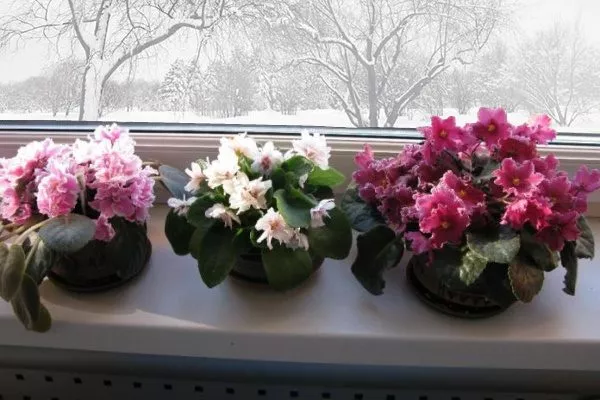
- ✓ The optimal temperature for the dormant period should be no lower than +16°C and no higher than +22°C.
- ✓ The air humidity level should be maintained within 50-70%.
How to prepare violets for winter?
The most important rule for caring for Saintpaulias is proper placement. Since violets are accustomed to warm climates and filtered sunlight in their jungle home, it's important to place the pots near west- or east-facing windows.
Helpful tips for winter preparation:
- Place the plants not on the windowsill, but on a small table or shelf. This will ensure the violets receive sufficient sunlight. Keep in mind that violets do not tolerate being moved, so try not to disturb them unnecessarily.
- If you see yellowing foliage, it's a sign that the plant isn't positioned correctly. Turn it toward the sun.
- It's important to choose the right pot and substrate. Choose a container that's not too large for your violet; 15 cm is ideal. Fill the pot with loose, lump-free soil. Use a ready-made violet substrate or make your own: mix regular garden soil and expanded clay in a 1:1 ratio.
Protection from hypothermia
Low temperatures are very dangerous for Saintpaulias. If the pots are kept on windowsills, protect them from freezing, as there's a risk of them freezing in winter.
Recommendations for protection:
- The best option is a foam stand, as this material retains heat well and has low thermal conductivity. Foam also prevents the violet from overheating from hot air from radiators, which is very useful in winter.
- Be careful not to let the plant's leaves touch the window glass, as this can lead to rot or fungal infestation. Insulate the glass with a special material or protective film. Use plastic pots with low thermal conductivity for your Saintpaulia.
Saintpaulias are often susceptible to severe frostbite. This typically occurs during transportation from the store in winter. However, homeowners may forget to remove the flowers from the balcony during cold weather. This can have serious consequences. Interestingly, the symptoms don't appear immediately, but rather after several days.
- ✓ Leaves darken, droop, and become soft within a few days after frostbite.
- ✓ Spots resembling burns may appear on the leaves.
Leaves will tell you about frostbite:
- they darken, droop and become soft;
- turn black and may develop burn-like spots.
After warming, spray the flowers with warm water with a growth stimulant added. After a few days, remove any leaves that haven't been revived and fertilize the violet with a root growth solution.
For severe frost damage, follow these tips:
- Warm the plant, then wait until frostbite signs have fully developed.
- Carefully remove most of the leaves and shoots, then begin resuscitation.
- Water the flower with a solution consisting of water, growth stimulants and fertilizers.
Watering rules
During winter, the plant's internal processes slow down, causing moisture absorption to be slower. Therefore, reduce water usage when watering to prevent stagnation of water in the pots. If the top layer of soil is constantly wet and doesn't dry out for a long time, the plant will lose its turgor, and the root system will rot.
Saving a violet is quite simple:
- Remove the plant from the pot, remove damaged roots and leaves.
- Dry the root ball, then transplant the flower into fresh soil.
- In winter, water the violet only when the soil is completely dry. Do not soak the soil completely.
- Use water at room temperature or slightly warmer for watering.
- Water violets less frequently during the winter.
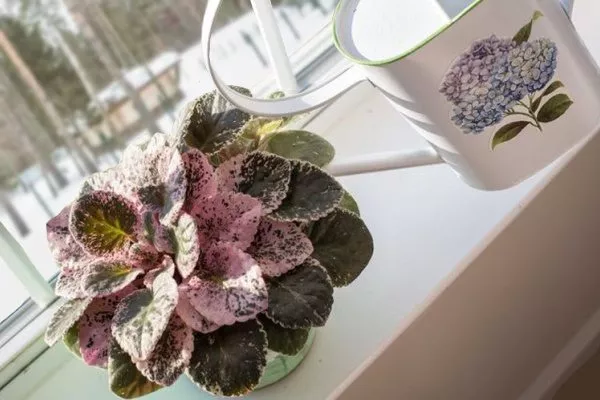
What temperature should be maintained?
The preferred temperature for violets is considered to be between 18 and 22 degrees Celsius. If the temperature drops below 16 degrees Celsius, the plant enters a dormant state, which leads to a decrease in carbon dioxide levels and slower water movement through the plant.
Helpful tips:
- At low temperatures, overcooling the soil is risky, as it can lead to the development of root rot, fungal diseases, or infectious diseases. At temperatures above 26°C (80°F), growth and flower stalk formation cease, and at temperatures above 30°C (96°F), the flower dies.
- In hot weather, a weakened plant can be susceptible to pest attacks. Higher temperatures can weaken the violet's immunity, leading to bacterial blight. If left untreated, the plant will die.
- During the winter, when violets are kept on a concrete windowsill, they can suffer from root rot due to the soil becoming too cold. It's best to install a protective covering on the windowsill, such as chipboard, plywood, or thick corrugated cardboard. Foam boards are ideal.
Violets can also suffer from hot air from radiators. If you notice leaves wilting or drying out, or flowers fading on some plants, this could be due to extreme heat. Place wide trays of water or a humidifier near your violets.
What level of humidity do violets need?
When cold weather sets in, heating systems in apartments are turned on, causing the air to become dry and humidity levels to drop to 15-20%. This is detrimental to violets, which require humidity levels of 50-70%.
Use these tips:
- install a tray with wet pebbles or expanded clay;
- hang a wet towel on the radiator;
- hang a plastic bottle of water from the radiator pipe, making holes in the lid;
- Ventilate the room.
When airing, cold air should not reach the violet, since the Saintpaulia does not like drafts and may die.
Lighting regime for violets in winter
The violet is considered an excellent light indicator, as it can warn of insufficient light by growing upward-stretching leaves with a large, growing blade. If the Saintpaulia suffers from too much light, its leaves become limp and dull, clinging to the pot.
For the plant to thrive, it requires 10-12 hours of light. Because daylight hours become shorter in winter, provide additional lighting: use fluorescent lamps or LED lights.
Are drafts harmful?
Drafts are always harmful to violets, especially in winter. To ensure adequate ventilation in your apartment and protect your plant, follow these guidelines:
- During the procedure, move the flower away from the window.
- If this is not possible because there are too many flowers, cover the plant with plastic while airing.
Is it possible to transplant violets during a cold period?
Violets can be repotted, but don't do it casually; only when necessary. Certain rules must be followed.
When and how often should you repot a violet?
Even if you don't like the pot the plant was originally planted in, don't rush to change it. Wait at least a month to allow the Saintpaulia time to adapt to its new location and to ensure the repotting doesn't cause too much stress.
Young violets shouldn't be repotted frequently, as their root system, although well developed, is still very fragile and requires more stable conditions. It's best if the starter is repotted no more than once a year (in the spring).
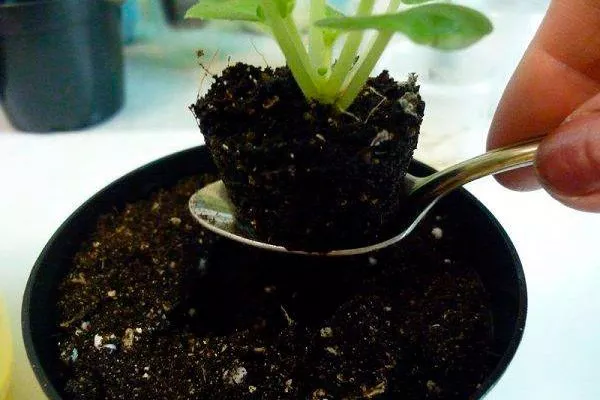
Soil for violets
Violets prefer light, loose soil that retains moisture well. Store-bought soil for Saintpaulias is preferable. Other options aren't always suitable. Be sure to add a soil conditioner, such as vermiculite or perlite, otherwise the soil will compact and retain moisture.
Prepare a soil mixture for your violet:
- Purchased soil, crushed sphagnum moss (1-1.5 cm pieces), perlite and vermiculite in a ratio of 6:2:1:1.
- Store-bought soil, vermiculite, crushed sphagnum, perlite in a ratio of 1:1:1:1.
Be sure to add 5 g of charcoal per pot to the soil mixture; for mini violets, 2-2.5 g will be enough. Mix all ingredients thoroughly to ensure an airy and uniform mixture.
Pot for Saintpaulia
Choose a pot that's not too large for your violet, otherwise it will take a long time to grow and won't bloom as quickly. A pot with a top diameter several times smaller than the plant's crown is ideal. Its height should be approximately the same as its width, or slightly smaller.
- ✓ The diameter of the pot should be several times smaller than the plant rosette.
- ✓ The height of the pot should be approximately equal to its width or slightly less.
Proper transplantation and further care
To properly replant a violet, follow important rules to avoid the death of the plant.
Step-by-step instructions:
- Remove the violet from the pot and remove the old soil from the roots. The loose soil should fall off on its own; simply shake it off gently.
- Make drainage from expanded clay, pouring a layer of 1-2 cm.
- Add the potting mix and place the violet in the center, carefully filling it with soil. Don't pack the soil too hard; just press gently to ensure the plant sits comfortably in the pot.
- Moisten the soil slightly.
Further care consists of watering every 5-6 days. During this period, the damage to the roots will heal, and the violet will begin to grow.
Violet diseases in winter and their prevention
Occasionally, even with proper care, there's a risk of violet disease. In this case, the cause may be virtually invisible pests that damage the plant's leaves, stems, and roots. Learn about violet diseases to save your plant in time.
Root rot
When violets become infected with root rot, flowering stops, the lower leaves become limp, and the petioles become soft. The disease is caused by a fungus that thrives in waterlogged soil.
There are several reasons for the proliferation of fungi:
- poor soil quality;
- overwatering;
- lack of drainage holes in the pot;
- soil freezing.
To treat Saintpaulia, proceed as follows:
- Remove the violet from the pot and inspect the roots.
- Get rid of diseased roots by removing the damaged part of the stem down to the healthy area.
- Treat the stem with a fungicide and leave it in the substrate to form new roots.
After this, place a synthetic bag on the flower, place it in a cool room and provide artificial lighting.
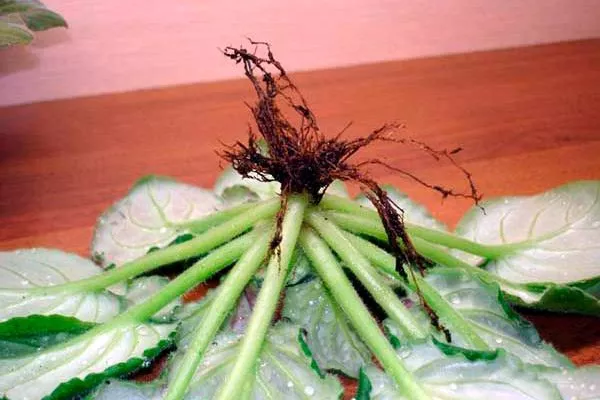
Rotten roots of a violet
Leaf rust
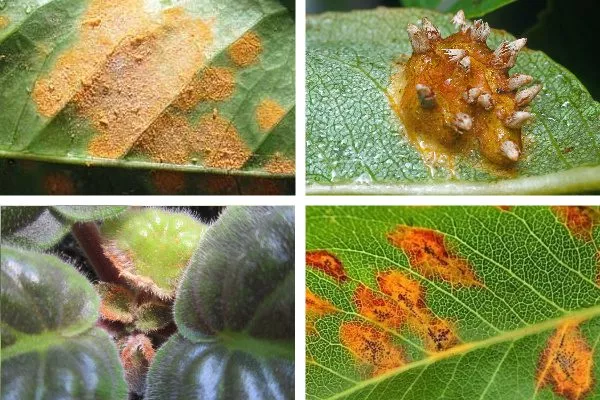
Violets can be affected by the Phragmidium fungus, which causes rust. It's important to treat the disease promptly to save the plant. The disease typically appears in late winter, when sunlight is insufficient.
Rust appears as yellowish spots on the outer surface of leaves, while fungal spores—red pustules—are visible on the underside. When these pustules rupture, they can spread to neighboring plants.
Treat your violet:
- Remove rust-infected leaves and then discard them.
- Move the plant away from neighboring flowers.
- Treat the violet with a fungicide.
Experienced gardeners recommend treatments such as Baktofit, Fitosporin-M, and Topaz. If the disease is advanced, you will likely have to remove the plant.
It happens that yellowish salt crystals appear on the violet leaves due to overwatering and/or low planting of the rosette:
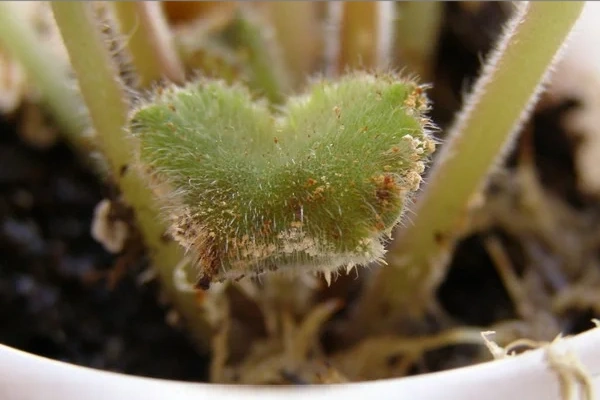
This is not a disease, but simply a violation of the rules for growing violets!
Brown rot
Very young rosettes, rooting leaves, and shoots can be susceptible to a disease called brown rot. When affected, the base of the stem becomes thinner and softer, turning a brownish-brown hue. White mycelial threads may be hidden in the soil beneath the rosette.
Seek immediate treatment:
- For prevention, treat the plant with contact fungicides.
- Water the soil with Fitosporin.
- Use a loose, well-drained soil mixture for the plant.
Water the violet frequently, but in small amounts, to avoid the plant dying.
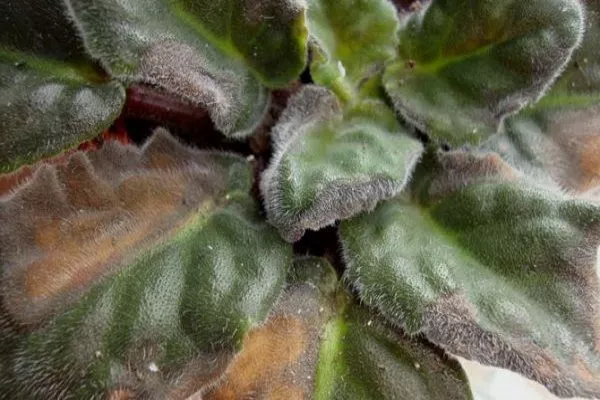
Powdery mildew
This is a fungal disease that causes a white coating to appear on leaves and stems. The fungus spreads through spores in the soil. Recently transplanted or old flowers, or faded violets, are often susceptible.
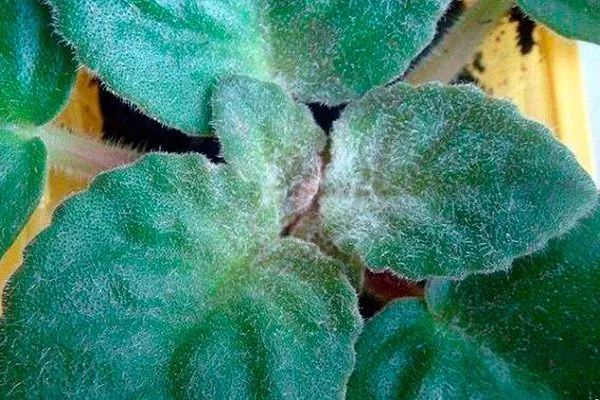
The plant can be affected by downy mildew and powdery mildew, both of which are very dangerous for Saintpaulias. Downy mildew causes a white coating to form, which develops into ulcers and further deformation. Eventually, the plant slows in growth and wilts. Poor care and excess nitrogen are the causes.
Downy mildew appears as a silvery or white coating on the underside of leaves, with light green, brown or reddish spots appearing on the upper side.
Disease prevention:
- when replanting, treat the plant with fungicides: Infinito, Previkur, Thanos;
- use potassium-phosphorus fertilizers for feeding;
- Ensure the recommended balance of potassium, nitrogen and phosphorus in the soil.
As soon as you notice the first symptoms of powdery mildew, remove damaged leaves and stems and treat the plant with Fundazol or Topaz. Be sure to place the plant in a warm, dark place to dry completely.
Late blight
A fungal disease characterized by drying brown spots on the leaves. Over time, these spots grow, eventually causing the tissue to die and the rosette to completely wither. Watering won't help with late blight. The disease is triggered by cold, high humidity, and insufficient sunlight.
Save the violet:
- Remove damaged parts of the Saintpaulia and roots.
- Take store-bought soil, disinfect it and add perlite, then place the violet in it.
- Treat the flower with Fitosporin and root the undamaged foliage to grow a new flower.
- Monitor temperature and humidity, provide additional lighting.
Features of aftercare
In spring, violets are actively preparing for flowering. During this period, it's important to support the Saintpaulia with certain treatments. Different varieties and individuals are ready to bloom at different times. However, gardeners know how to ensure blooms occur at the right time.
Don't miss the first flower stalks – apply fertilizer as soon as they appear and provide the optimal amount of water. To ensure abundant and uniform flowering, prune the first flower stalks.
Frequently asked questions
Beginner gardeners may encounter some challenges when growing violets. To avoid these problems, we suggest reviewing these frequently asked questions:
- What to do if the flower is cold? If the violet is growing on a windowsill, reduce watering, but don't let it dry out completely. The plant has thin, delicate roots that can dry out quickly, and subsequent watering can cause rot.
- What to do if pests appear? If you notice pests attacking your violet, separate it from other plants and treat it with appropriate products. Use insecticides for insects and acaricides for mites.
- Why do mold and gnats appear? This indicates high humidity. In this case, reduce watering and treat the soil with Fitosporin. If this treatment doesn't help, repot the Saintpaulias.
- If the leaves have become wilted? Don't wait until spring; begin repotting immediately. Be sure to remove any damaged leaves.
Violets are considered easy-to-grow plants, but they do require proper care. If neglected, they can die from cold or heat, and resuscitation will be futile. To avoid various problems, it's best to pay attention to the plant promptly.
Thank you so much for the information about preparing for the dormant period. I didn't know many of the details. This year, I tried all your recommendations, and the plant is overwintering successfully.