
An important step in caring for dracaena at home is pruning to create a refined crown. Over time, the plant's trunk elongates, exposing the lower parts as older leaves gradually fall. Pruning helps maintain its aesthetic appeal and recreate a decorative crown.
Why does dracaena need pruning?
Dracaena pruning is often necessary for its preservation and care. It may be done for other reasons:
- for renewal and rejuvenation, to give the plant a more presentable appearance;
- to control the size and shape to select comfortable dimensions and avoid excessive height;
- for sanitary and preventative pruning, especially if the plant is sick or the leaves are starting to fall off.
Pruning helps maintain the desired crown shape and save the plant from disease or leaf loss. This process allows the dracaena to develop a beautiful crown while maintaining its attractive appearance and health.
When to prune?
The best time to prune dracaena is spring or early summer, when the plant is actively growing and developing. This period is associated with increased hormonal activity, which promotes rapid healing and stimulates new shoot growth.
Methods for pruning dracaena at home
Dracaena attracts attention with its ability to reach significant sizes and maintain vitality for many years. However, problems can arise over time. To restore its original beauty and vigor, there is an effective solution: pruning.
Pruning dracaena for branching
Brief instructions on pruning dracaena for branching:
- Identify points on the trunk where you want to stimulate new branch growth. These are typically areas above the nodes (where leaves previously grew).
- Carefully prune the trunk at the designated points. To encourage lateral shoots, leave a small portion of the top.
- Treat the cuts with an antiseptic to prevent infection.
Remove wilted and dead leaves regularly. yellowed leavesto focus nutrition on new shoots. Provide the plant with sufficient light, moisture, and moderate fertilizer to ensure successful branching.
By following these steps and observing the correct timing and conditions, you can successfully prune and stimulate branching of a single-stemmed dracaena, creating a bushier and more decorative crown.
Crown formation
There are several ways to shape the crown of a dracaena. Pruning tips:
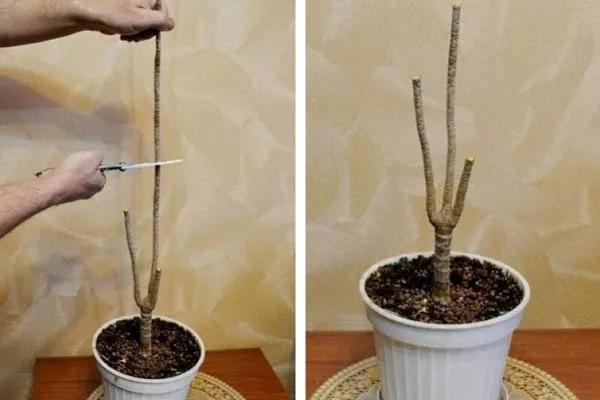
- If the plant has a single trunk, prune it so that about 15-20 cm remains from the base of the trunk. New shoots will soon begin to emerge near the cut.
- If you have a double- or triple-stemmed dracaena, prune each stem at a different height to allow the rosettes to develop in space. Pruning at the same height can cause competition between the rosettes.
Sanitary pruning
Sanitary pruning of dracaena is an important part of caring for this plant, aimed at maintaining its health, aesthetic appeal and preventing the spread of diseases.
The procedure is aimed at removing diseased, damaged, yellowed, or dead leaves and shoots, as well as trimming damaged parts of the trunk. This helps improve air circulation in the crown, creating a neater and more well-groomed appearance for the plant.
Regular sanitary pruning of dracaena is recommended throughout the year. Inspect the plant periodically and remove any yellowed, dried, or damaged leaves. Remove dead shoot tips if necessary.
The process of sanitary pruning:
- Use clean, sharp tools (pruning shears or garden shears). This will help avoid tearing or damaging the plant.
- Inspect the dracaena and look for yellowed, diseased or damaged leaves and shoots.
- Carefully trim these parts of the plant, trying to make even and clean cuts. Make leaf cuts close to the base of the stem.
- If you are pruning damaged parts of the trunk, make the cut above the damaged area to remove the affected tissue.
- After pruning, treat the cut areas with an antiseptic, such as garden pitch or a fungicide. This will help prevent infection.
Additional recommendations:
- Avoid removing too many healthy leaves at once to avoid weakening the plant.
- The trimmed parts can be placed on the soil as mulch, which will help retain moisture and nutrients.
To rejuvenate the plant
An old dracaena often loses its appeal, characterized by a long, bare trunk, sometimes even several. To restore the plant's decorative appeal, follow these steps:
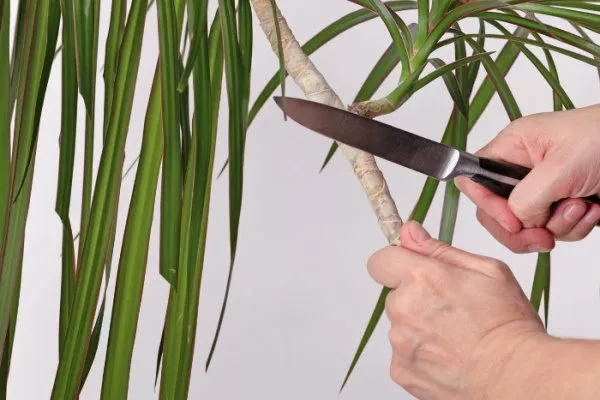
- Using a sharp knife, cut the stem at a distance of 25-30 cm from the top suitable for rooting.
- Trim the trunk, leaving a stump 15-20 cm high.
- Treat the cut area with growth stimulants and then fill it with warm paraffin.
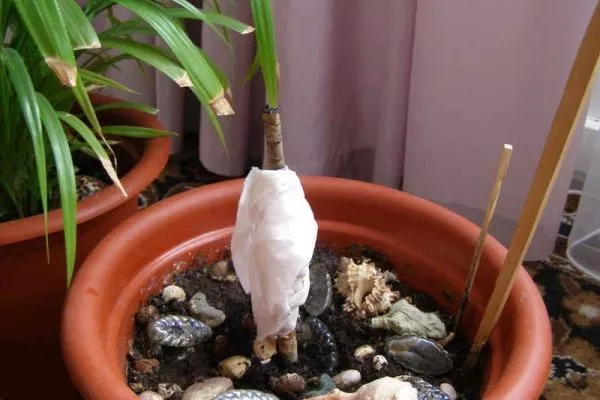
- To ensure optimal growing conditions, cover the pruning area with a plastic bag to maintain humidity.
To obtain new plants
There are two methods for growing new dracaena plants. Let's look at them:
- Cutting the exposed stem into segments and then planting them in the ground.
- Growing additional buds in the cut area, followed by pruning and transfer.
The second method, although more time-consuming, is preferable. To successfully implement it, it's important to wait until the new rosettes are large enough to separate from the parent plant, root, and grow separately.
How to trim a dracaena that has grown to the ceiling?
Large specimens of the pseudopalm with thick, woody trunks can be rejuvenated and divided into several plants. Prune one trunk higher than the others, while shortening the others at a lower level.
When pruning, use a disinfected saw to prevent infection of the leafless stump. This process must be performed quickly and carefully to avoid damaging the plant's inner layer, called the cambium.
Necessary tools and materials
Before you begin pruning your dracaena, gather certain items and tools. Here's what you'll need:
- Sphagnum moss. It's a useful component that effectively absorbs and retains moisture, making it easier to maintain optimal humidity. Wet wipes can be used instead, but they will need to be replaced frequently.
- Garden var. It's used to treat cut areas to promote rapid healing. If garden pitch is unavailable, beeswax or paraffin candles will do.
To obtain even and neat cuts, it is recommended to use a sharp knife or garden pruning shears.
General technology – step-by-step instructions
The process of pruning a dracaena can be divided into several stages. Here's a step-by-step guide:
- Preparation of tools and materials. Prepare a sharp knife or pruning shears, sphagnum moss, plastic wrap, string, matches, and a wax or paraffin candle. You'll also need Kornevin solution.
- Trimming the tops. Trim the dracaena's tops, leaving the desired amount of stubs. Place the trimmed tops in water to preserve them until further processing.
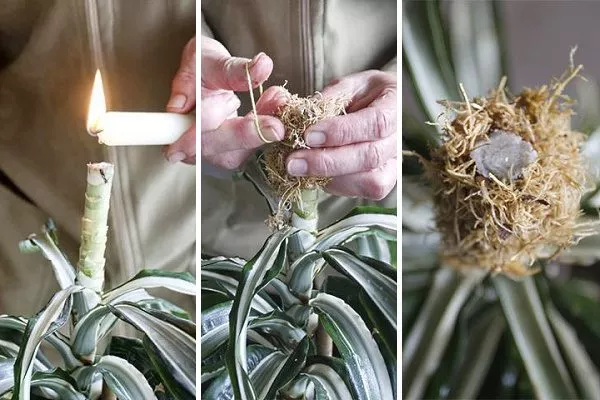
- Processing of cut areas. After pruning, immediately treat the cut areas with melted paraffin. Be careful not to let the paraffin come into contact with the leaves or trunk of the plant.
Next, wrap the stumps with sphagnum moss, secure with thread and spray lightly.
 Cover the top with plastic wrap. To prevent condensation from collecting under the wrap, make a few holes for ventilation.
 - Rooting cut tops. Dip the prepared cuttings into a Kornevin solution to stimulate rooting. This step will help the cuttings develop roots faster.
By following these instructions, you can successfully prune your dracaena and ensure optimal conditions for the continued growth and development of your pruned plants.
Which types of dracaena need to be pruned?
There are several species of pseudopalms that require regular crown trimming due to their ability to reach significant sizes in the wild. Suitable for indoor growing conditions types of dracaenathat require shaping include:
- Bent (Reflex). A variety with multicolored leaves that has the potential to grow up to 10 meters in the wild. With proper care at home, dracaena remains more compact. Top pruning helps control growth.
- Fragrance (Fragrant). This variety can reach up to 5 m in the wild, but indoors, its height is limited to 2 m with good care. Regular pruning of the upper panicles is recommended to control growth.
- Surculosa (Surculosa). This type of dracaena produces shoots from the root zone, and to prevent excessive growth in the pot, it is recommended to cut off and replant the shoots.
- Marginata. This variety is one of the most common. To maintain a bushy form, the plant requires periodic pruning and shaping.
Topping is a common correction method for these varieties, allowing you to control their growth and shape at home.
How hard should I prune a dracaena?
It's important to prune dracaenas only if they're clearly overgrown or if you want to shape them. Typically, prune no more than a third of the total height or half the length of each individual branch. Exceeding these limits can cause serious stress to the plant.
How to treat the cut of a dracaena after pruning?
After pruning a dracaena, it's recommended to treat the cut to prevent possible infections and promote healing. A good option is to apply garden varnish or melted paraffin to the cut area.
- ✓ Use only cold paraffin for processing sections to avoid thermal burns to plant tissue.
- ✓ Apply garden varnish with added fungicide for additional protection against infections.
This helps prevent the entry of harmful organisms and maintain the integrity of the plant. You can treat the cut with an antiseptic solution or fungicide for additional protection. Proper cut treatment promotes successful healing and minimizes risks to the dracaena's health.
What to do with pruned shoots?
The trimmed tops of the plant are suitable material for reproductionPre-treat them with Kornevin, then replant them in soil. To ensure optimal humidity, cover the dracaena container with plastic and leave it for a month.
At this time, roots begin to develop and new shoots emerge. The appearance of young leaves indicates the dracaena is ready for transplanting to its permanent location.
You can root a bare trunk, but it will take longer. To do this, divide the trunk into sections between the spaces where leaves used to be (internodes). Then cover it with soil and moisten it. After a few months, you should see new shoots emerging from the ground.
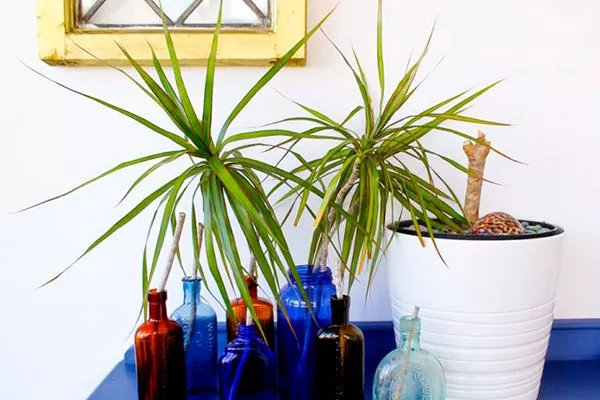
How to care for dracaena after pruning?
After pruning your dracaena, it's important to provide proper care to help the plant recover and continue healthy growth. Here are instructions for caring for your dracaena after pruning:
- Create optimal conditions. Place the dracaena in bright but indirect light to avoid direct sunlight, which can burn the pruned parts. The temperature should be comfortable, between 20-25 degrees Celsius.
- Watering. After pruning, keep in mind that the plant is under stress. Water moderately, maintaining soil moisture, but avoid overwatering. Allow the soil to dry out between waterings.
- Spraying. Continue misting your dracaena to maintain humidity around it. This is especially important during the first few weeks after pruning, when the plant may be stressed. Misting helps prevent potential pest problems.
- Protection from drafts. Protect your dracaena from drafts, which can increase stress and slow down the healing of pruned parts. Avoid sudden temperature changes and constant air currents.
- Additional care. If possible, use growth stimulants to help the plant overcome stress more quickly and stimulate new growth. Consider feeding your dracaena with a low-nitrogen fertilizer.
Closely monitor the dracaena after pruning. Watch for new growth and leaves. If you notice any changes in the plant's appearance or health, take appropriate action.
Pruning can be a useful method for maintaining the beauty and shape of your dracaena, but it may take some time for the plant to adapt to the procedure, so provide it with care and attention over the coming weeks and months.
Problems after pruning
To prevent dracaena cuttings from drying out after pruning, you can coat them with paraffin. To prevent possible trunk rot due to infection, treat the cuttings with a fungicide or copper sulfate.
New buds on the trunk may struggle to grow due to excessive humidity. To improve ventilation, poke holes in the bag or open it periodically for ventilation. It's important to maintain moderate watering during this period, avoiding both overwatering and allowing the soil to dry out.
Pruning dracaena is an important step to maintaining its attractiveness and health for many years to come. This process not only helps shape a beautiful crown and control growth, but also promotes rejuvenation and renewal, thereby bringing new life and energy to the space where it resides.