
To ensure successful propagation of money trees (crassula, jade plant) it's important to follow all the necessary requirements and conditions. There are three methods: leaves, seeds, and cuttings. Each has its own specific features, which should be familiarized with in advance.
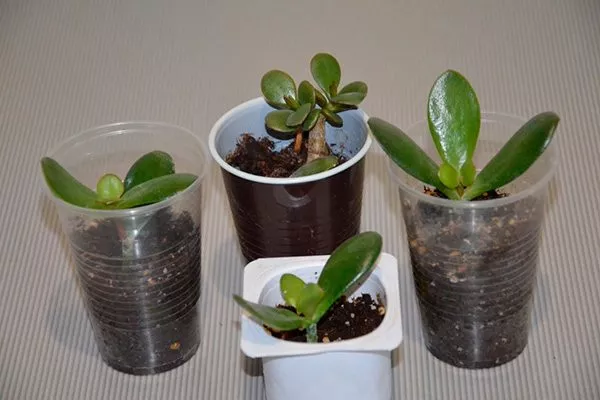
Peculiarities of propagating the fat woman at home
Before beginning the propagation process, carefully review some of the specifics of this procedure for crassula. It's important to choose the right container and substrate, and pay attention to the condition and age of the houseplant.
- ✓ The air temperature should be between +18 and +25 degrees for optimal rooting.
- ✓ Air humidity should not exceed 60% to avoid rotting.
Age and condition of the tree
It's not advisable to use planting material from a money tree that's too young. It should be at least three years old. Once this age is reached, the plant becomes strong and develops a well-developed immune system. Aerial roots are already forming, which is what enables rooting.
The bush must be completely healthy - without signs of wilting, rotting, thinning, drying out, diseases and pests.
Choosing a pot
The Crassula root system develops in such a way that it grows in diameter rather than in depth, so the container should be low and wide. There are two options for choosing a pot for propagation:
- if planned transfer, then you can initially use a plastic cup;
- When a cutting, shoot, or leaf is planted directly into a permanent container, you need to select a container with the same diameter as the mother plant.
Soil selection
For crassula, it's important to use light, very loose soil. This will allow the young root shoots to root easily and more easily break through the substrate. You can buy a ready-made soil mix designed for succulents, but you can also make your own.
Use one of the options:
- 1 part of river sand and turf soil, 2 parts of leaf soil;
- 1 part peat and any leavening agent (universal, sand or vermiculite), 4 parts garden soil.
Propagation of money tree by cuttings
Cuttings are considered the fastest method of propagating money trees. Unlike seed, cuttings produce plants with all the characteristics of the parent plant. The shoots root in water or a substrate.
How to take a cutting correctly?
You can use either apical or stem cuttings. Apical cuttings are convenient to use during scraps and the formation of the money tree, and the stems need to be specially pruned. The main thing is to choose the right planting material. To do this, consider the following:
- minimum stem length – 10 cm, maximum – 13-15 cm;
- the presence of leaves in the amount of three to four pairs;
- 3-5 knots are required.
- ✓ The presence of aerial roots increases the chances of successful rooting by 70%.
- ✓ The cutting should be elastic, without signs of wilting.
The optimal time for propagation by cuttings is the first two months of spring, when plant growth begins to accelerate. However, this can also be done in summer and fall. However, in this case, the seedling will take longer to root and develop.
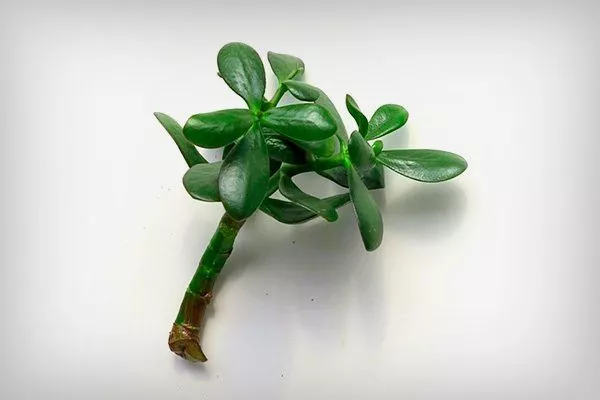
How to cut:
- Select developed stems.
- Disinfect a scalpel or utility knife.
- Make a quick cut below the aerial root.
Preparing the cuttings for planting
Immediately after cutting, begin preparing the shoot. To do this, follow these instructions:
- Dust the cut areas with crushed activated carbon or powdered wood ash.
- Spread a towel on the table.
- Place the cuttings on it. Leave them for 1-2 days to dry completely.
Rooting cuttings in soil
To root a cutting in a substrate, you need to follow special rules:
- Disinfect the pot (plastic cup).
- Place drainage material—expanded clay, pebbles, or small stones (also disinfected)—on the bottom. Make a layer of 2 to 3 cm.
- Fill the container with a special substrate (store-bought or homemade) to 2/3 of its capacity.
- Make a depression in the central part.
- Place the cutting. Experts recommend additionally using a rooting agent (Kornevin, Epin, etc.) – treat the cut area with the solution and then insert it into the planting hole.
- Cover the surface of the substrate with 1 cm of sand to prevent the formation and spread of mold.
- Tamp with light movements.
- Moisten slightly.
- Cover with plastic wrap or a cut plastic bottle, disposable cup, or glass jar.
Rooting cuttings in water
This is a faster method of rooting, since when using soil, rooting takes about 2 weeks, and when using water, only a week.
How to do it right:
- Prepare a container for water – this could be a plastic cup, a glass jar, or a plastic bottle (cut open). Be sure to disinfect it with antiseptic.
- Take settled water at room temperature and pour it into a container to a depth of 4-5 cm.
- Position the shoot so that the lower bud is under water.
Rules for caring for cuttings during rooting
Until the cuttings begin actively growing, open the cover daily for ventilation—this allows air to enter and stimulates growth. To make root development easier to monitor, which is important for beginners, it's best to use a water-based medium.
Determining the rate of root growth during soil rooting is also simple - if the leaves increase in size and new ones appear, and the top stretches upward, then this is an excellent indicator.
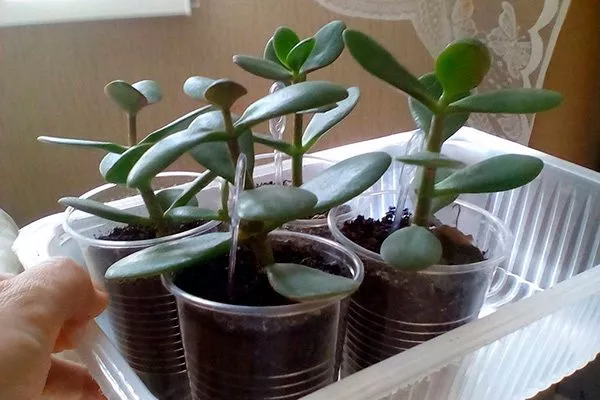
Other features of growing cuttings:
- Place the containers on the windowsill, but make sure that direct sunlight does not fall on the plant;
- do not apply fertilizer until replanting, and if replanting is not planned, do this no earlier than six months later;
- Moisten as the substrate dries out and add to the glass of water after partial evaporation.
Many experienced gardeners recommend applying one feeding during the period of root and foliage growth. You can buy Fasco Flower Happiness and Agricola Ava. Succinic acid is also used for stimulation: half a tablet per 100 ml of water.
Propagation of money tree by leaves
This method is most often used by gardeners because leaves sometimes fall off, and the procedure itself is considered simplified. And even if nothing works out, there's no regrets, like with a cut shoot.
How to choose the right sheet?
It is permissible to use leaves that fall off on their own, but only if they meet the standards for planting material of this type:
- the leaf must be fully formed;
- shade of a single color type;
- glossy surface;
- the structure is compacted (living);
- absence of traces of pest infestation, signs of disease, dryness, mold, etc.
- ✓ The leaf should be taken from the middle part of the plant, where it is most mature.
- ✓ The presence of at least one aerial root on the leaf petiole significantly accelerates the rooting process.
Do not propagate leaves with breaks, cuts, or scratches. The cut should be made approximately halfway along the petiole. Aerial roots are desirable.
Rooting leaves in soil
Use standard crassula substrate—either a special one or homemade. Any small container can be used as a container—a small cup or shot glass (either plastic or glass), a sour cream or yogurt jar, etc.
The procedure is as follows:
- Disinfect the container.
- Place expanded clay on the bottom, but make sure it’s fine-grained.
- Place 1 tablespoon of activated carbon or wood ash powder on it.
- Spray with water from a spray bottle.
- Add the substrate.
- Make a hole.
- Insert the leaf with the stem down.
- Place supports (from toothpicks, matches, etc.).
- Moisten slightly.
Cover the leaves until roots begin to form (the green mass will grow during this time). After that, don't cover them with anything, otherwise rotting will begin. Please note the following rules:
- It is allowed to plant 2-4 leaves next to each other, but the distance between them should be about 4-6 cm;
- water every third day, but in very small quantities;
- try to avoid getting water on the leaves;
- The fixing supports are removed after the formation of the process.
Rooting leaves in water
This isn't the best option for propagating money trees from leaves, as the leaf blades are fleshy and easily susceptible to rotting. However, it's worth a try.
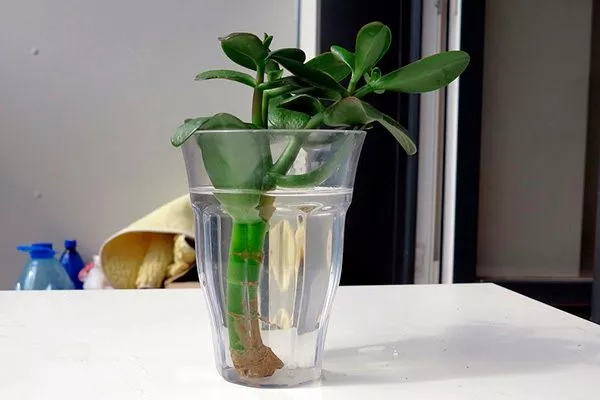
How to do it:
- Prepare containers and water as for cuttings.
- Place the leaf at 1/3 of the total length.
Don't add water periodically, but change it completely to slow down rotting. Ideally, do this every 1-2 days.
Rooting leaves on moss
This method isn't exactly traditional, but it's quite effective and common. It requires sphagnum moss (available at a flower shop or collected in a damp forest). The rooting medium used for moss propagation is considered to be the most natural.
Algorithm of actions:
- Cut a small piece of moss.
- Spray with a light pink solution of potassium permanganate.
- Additionally, treat with a special fly repellent (also sold at garden and flower shops).
- Place a piece of sphagnum moss in the container.
- Use a spray bottle to moisten.
- Insert a leaf of the fat plant.
How to propagate by seeds?
The seed method is considered the worst option for three reasons. First, it's time-consuming (about two years). Second, it's not always possible to obtain a tree with the same characteristics as the mother plant. Third, crassula blooms only once every 10 years, so waiting until the right time to collect seeds is difficult. To avoid these consequences, you can buy ready-made seeds.
Preparatory activities before collecting seeds
If you decide to use seeds from your own plant, it's important to take a number of steps to speed up the flowering process. This is entirely possible, especially since it could result in a completely new money tree variety.
Please note the rules:
- Take a bush that's at least 6 years old. Repot it in early spring into a pot twice as wide as the crown.
- Maintain a consistent temperature regime. In winter, the temperature should range from 14 to 16 degrees Celsius, and when warmer weather arrives and into autumn, keep the pot outside. However, keep in mind that sudden temperature changes can be detrimental.
- From mid-September until early March, do not apply fertilizer under any circumstances. However, water the plant no more than twice a month during the dormant period.
- Fertilize next March. Then place in a well-lit spot.
- From this point on, wipe the leaves weekly and moisten them with a solution of succinic acid (1 tablet per 250 ml of water).
Collection of planting material
Immediately after flowering begins, fertilize generously with flowering preparations, and when the buds dry out, begin collecting planting material.
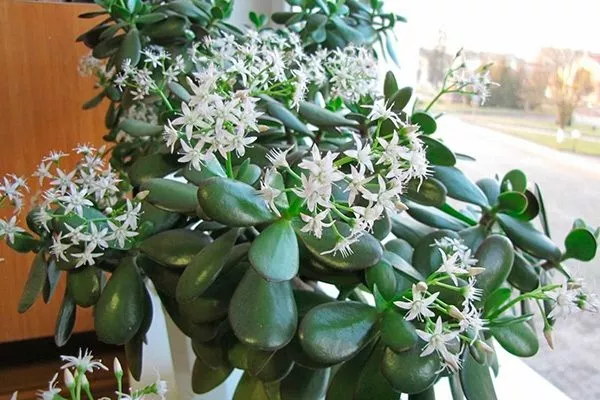
How it's done:
- You can tie the seed box with gauze or cloth and shake it out.
- The second option involves placing a sheet of paper under the seed pod and shaking out the seeds.
The procedure for propagation by seeds
To ensure good germination of seeds, it is important to strictly follow special instructions:
- Disinfect the substrate and containers with potassium permanganate. Do the same with the seeds—soak them in a light pink solution for 15 minutes. Additionally, you can treat them with fungicides and growth stimulants according to the instructions for the specific product.
- Place fine expanded clay in an even layer in the container.
- Pour some soil mixture on top (standard for crassula).
- Sprinkle with a 1 cm layer of crushed charcoal.
- Moisten with a spray bottle.
- Place the seeds in rows at a distance of 1 cm. Do not cover them with anything or bury them too deep.
- Cover the box with plastic or glass. However, keep in mind that you should leave small gaps along one or two edges to prevent rotting.
- Water and ventilate periodically by opening the cover. If condensation accumulates on the glass, wipe it off.
- After 2-3 weeks, remove the glass or plastic.
- When the seedlings reach 1 cm in height, transplant them into other containers.
- Do the picking when the seedlings reach 5-7 cm.
- When full-fledged seedlings appear, transplant them to a permanent location.
Aftercare
After transplanting to a permanent location, adhere to the standard growing rules money tree:
- keep it on a windowsill with diffused light;
- water moderately but often;
- periodically spray the plant and wipe it with a cloth;
- replant once a year;
- Fertilize if necessary.
In summer, be sure to take it outside or onto the balcony.
Possible problems
The money tree, being a succulent, requires careful attention to cultural practices, especially immediately after propagation or during rooting. If any of the rules are violated, problems may arise. Most often, these include:
- The plant weakens and stretches upwards, without widening the crown. The main reason for this is a lack of light, so move the pot to the windowsill, but make sure that the sun's rays do not burn the young leaves.
- The leaves turn yellow and the stem begins to fall. In this case, you're adding too much water at once, causing the root system, which hasn't yet fully formed, to rot. There are three ways to solve this problem:
- If the cutting or leaf is still in water, dry it and immediately transplant it into a pot with substrate;
- if the planting material is in a soil mixture, transplant it into a completely dry substrate;
- Stop moistening the soil completely for a while.
- The leaves are drying out. This occurs when the soil is dehydrated. Water generously, and then irrigate according to the proper guidelines the next time.
- The presence of dark spots on the leaves and stem. This most likely occurred due to a fungal disease, as the planting material, soil, and pots were not disinfected during propagation. The type of disease must be determined and treated with an appropriate fungicide.
- There is no process of root system formation. The cause is a lack of light and warmth. In the first case, move the plant into the light; in the second, ensure a temperature of 18 to 25 degrees Celsius. For any reason, add a growth stimulant along with watering.
- The seedling leans to one side. This means that he is drawn to the light.
- Slow root growth. Heavy soil is a negative factor, although it should be light, loose, and breathable.
Although the money tree propagates quickly, it's important to follow specific rules for rooting and care. After transplanting into a permanent pot, simply follow the standard instructions. Since there are three propagation methods, you can choose the one that suits you best.