
Anthurium — a spectacular tropical flower, popularly known as "male happiness," is extremely sensitive to any changes in its environment. Many care violations can cause the plant to turn yellow. Before taking any measures, it's important to determine the cause of the yellowing. Otherwise, treatment will be ineffective.
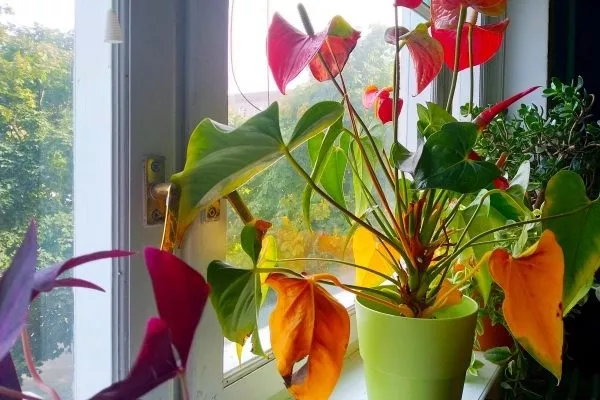
In what places does the flower dry out?
When determining the cause of yellowing leaves, it's important to consider the nature of the phenomenon. The location and position of the yellow spots or zones can help determine the underlying cause. It's important to remember that yellowing leaves can be caused by both a serious disease and completely natural causes that don't require intervention.
| Name | Sheet type | Flower color | Flowering period |
|---|---|---|---|
| Anthurium Andreum | Cordate | Red | All year round |
| Anthurium scherzeriana | Lanceolate | Orange | Spring-summer |
At the bottom of the flower
The most common cause of lower leaves turning yellow is aging. This is a natural phenomenon and requires no treatment or intervention. Over time, the plant loses leaves at the bottom, which negatively impacts its decorative qualities. In this case, it is recommended to rejuvenate the older anthurium.
How to rejuvenate an anthurium that has lost its lower leaves:
- Take a new pot and add a 3 cm layer of drainage material to the bottom. This can be made from expanded clay, pebbles, or broken brick.
- Fill the pot with soil or a commercial potting mix for Araceae plants. Add sphagnum moss, coconut fiber, charcoal, or vermiculite to the mixture.
- Cut off the top of the flower, capturing the beginnings of the aerial roots. Use only a disinfected and sharp tool.
- Sprinkle the cuts with crushed charcoal.
- Plant the top of the plant in a pot so that the aerial roots are immersed in the soil, but do not bury the rosette.
- Water the plant and put it back in its original place.
How to rejuvenate anthurium, see the video below:
| Name | Disease resistance | Demanding of light | Air humidity |
|---|---|---|---|
| Anthurium Andreum | High | Average | High |
| Anthurium scherzeriana | Average | High | Average |
Around the edges
Yellowing along the edges of leaf blades clearly indicates improper care. Moreover, yellowing of leaf edges can have several causes. It's important to correctly identify the cause by comparing the appearance of the leaves and the care details of the plant.
Reasons for yellowing of leaves at the edges:
- If yellow-brown spots appear along the edges of the leaves, the plant is not being watered properly. This tropical plant requires moist soil, but stagnant water has a very negative impact on its health.
- Yellowing, beginning at the edges and gradually progressing to the center of the leaf blades, indicates critically low temperatures for the plant. This phenomenon is observed if the room temperature drops to 14°C.
- If yellowing leaves are accompanied by mold in the soil and soft stems, the plant likely has root rot. To save the plant, it needs to be repotted in new soil and the affected root areas removed.
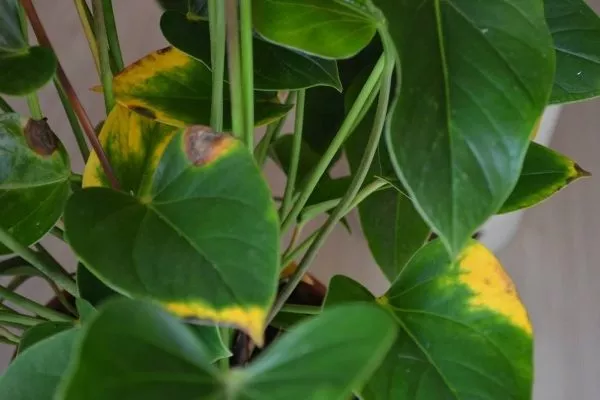
Leaf tips
If only the tips of the anthurium leaves have turned yellow, it is most likely a victim of unfavorable growing conditions.
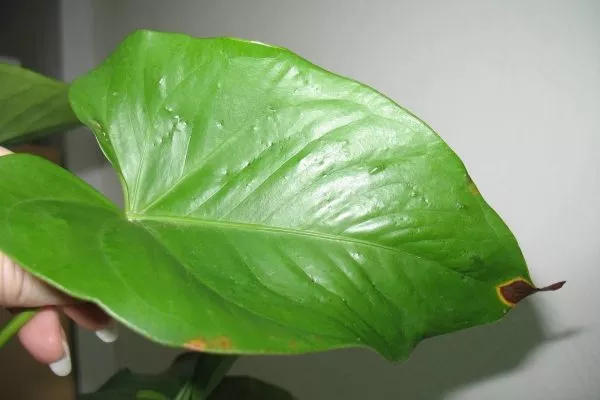
Causes of yellowing ends:
- drafts and excessively cool environment;
- cold water;
- dry air.
In spots
The appearance of spots—yellow, brownish, and blackish, of various shapes and sizes—shouldn't cause undue concern, provided two conditions are met. First, the spots should be dry, and second, they shouldn't grow in size.
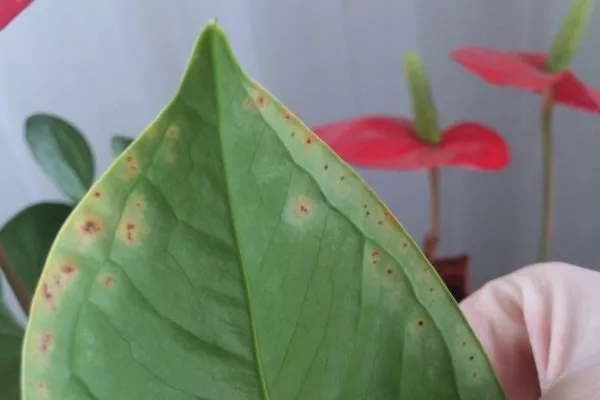
Reasons for the appearance of spots:
- moving a flower to another room;
- change in illumination - its lack or excess;
- sunburn;
- lack of microelements.
The problem is solved by eliminating the cause—the flower is moved to its original location or to a more favorable one. If a nutrient deficiency occurs, special liquid fertilizers are applied to the plant—these can be purchased at any flower shop.
Causes of yellowing
Yellowing leaves not only negatively impact the anthurium's appearance but also its health. If yellowing isn't a natural process, the plant will wither, become unhealthy, and eventually die. It's important to recognize the problem early, determine its root cause, and take corrective action.
Diseases and pests
Plant damage by pests or diseases almost always results in visible external changes. Yellowing leaves can be one of the signs of negative impacts from insect pests and diseases.
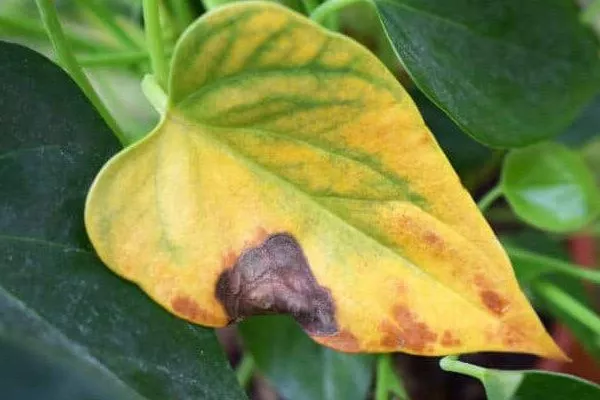
Diseases that cause yellowing of leaves:
- Gray rot. The cause is excessive humidity in the room. A yellow coating first appears, then turns white. If the disease is detected in the early stages, there is a good chance of cure.
- Septoria. This is a fungal disease that occurs when humidity is high and temperatures are low. The spots quickly spread, causing the leaves to wilt. The plant should be repotted in fresh soil and treated with Bordeaux mixture 2-3 times.
- Anthracnose. This fungal infection spreads through the soil. It spreads during extreme heat and high humidity. The spots are concentrated along the leaf edges. Black spots first appear, followed by a yellow border around them. Treatment involves spraying with Oxychom and Previkur.
- Chlorosis. This disease occurs due to a deficiency of magnesium and iron in the soil. The plant dries up, its leaves turn yellow, but the veins remain green. Treatment involves applying micro and macro fertilizers.
- Root rot. It develops with overwatering and high humidity. The leaves turn yellow, brown, and then wilt. The roots often become moldy. The plant needs to be repotted, removing all diseased roots. The cuts are sprinkled with crushed charcoal. The soil is replaced, and the pot is disinfected.
- ✓ Gray mold: the appearance of a gray fluffy coating on leaves and stems.
- ✓ Anthracnose: black spots on leaves surrounded by a yellow border.
Anthurium leaves can also turn yellow due to aphids or spider mites. Insect colonies can be destroyed with a soap solution. For severe infestations, spray the plant with Aktara, Confidor, or similar products.
Incorrect lighting
Anthuriums love warmth and light, but direct sunlight can cause scorch marks—large yellow spots—to appear on the leaves. These gradually dry out, turning dark brown or black.
All sunburned leaves are removed. To prevent a recurrence, provide the plant with diffused light. Anthuriums are best placed on west- and east-facing windowsills, rather than south-facing ones.
Yellowing, paleness, and stretching of leaves can also be caused by insufficient light. Move the plant pot closer to the sun and turn on additional lighting—a grow light.
Violation of the watering regime
Incorrect watering is the most common cause of yellowing anthurium leaves. Leaves can turn yellow due to overwatering, overwatering, or using hard or cold water.
Watering rules that will help prevent yellowing of leaves:
- Use rainwater, melted snow or filtered water for watering.
- Filter tap water and soften it with vinegar or citric acid. Add only a small amount. Taste the water—the acidity shouldn't be noticeable.
- Let tap water stand for at least 24 hours.

- Before watering, heat the water to +18…+24 °C.
- Water the flower only after the top layer of the substrate/soil has dried out.
- Half an hour after watering, drain excess water from the tray.
- ✓ The water temperature should be between +18…+24 °C.
- ✓ Water hardness should not exceed 8°dH.
Insufficient humidity in the room
When there's a lack of moisture in the air, leaves begin to turn yellow from the edges toward the center. Anthurium leaf blades are damaged en masse in dry air. The problem usually occurs in winter, when central heating is turned on.
When the yellowed edges of the leaves dry out, they turn black. Old leaves fall off, and young ones either fail to grow at all due to lack of moisture or grow deformed.
How to increase indoor humidity:
- A humidifier is installed in the room. This device helps maintain the humidity level required for anthurium—70-80%.
- Place a tray filled with moistened expanded clay or moss near the plant.
- Regularly - 2-3 times a day, spray the anthurium with a spray bottle and wipe its leaves with a damp sponge.
After transplantation
Anthuriums, like many other plants, don't like being repotted. This can damage the roots, which can cause the plant to take a long time to establish itself in its new location, and its leaves may turn yellow. When repotting, avoid touching the roots to avoid microcracks.
It's not recommended to repot purchased anthuriums by transshipping them and adding new soil. The plant will have to adapt to living in two different types of soil, which will negatively impact its leaves. It's best to repot purchased flowers immediately into fresh soil, removing the soil ball from the roots.
How to properly transplant anthurium:
- Pour a drainage layer (3 cm) into the pot.
- Sprinkle a thin layer of soil on top.
- Remove the plant from its store-bought pot with a wooden stick and shake the soil off the roots. Be careful not to damage the shoots.
- Place the plant in the center of the pot, straighten its roots and sprinkle with substrate.
Keep the repotted anthurium in indirect light. Water for the first time three days after repotting. Increase watering gradually, starting with very small amounts.
Excess fertilizers
To ensure the strength to grow and bloom for a long time, anthuriums need fertilizing. But it must be applied correctly—at the right times, with the right frequency and dosage. Overfertilizing, especially in dry soil, can damage the plant's roots, which immediately affects the leaves.
If yellowing leaves are due to overfertilization, it's necessary to temporarily suspend fertilization for about a month. At the same time, monitor the plant to see how the interruption in fertilization is affecting its health.
Draft
Anthuriums react extremely negatively to drafts. When exposed to a draft, the plant begins to turn yellow and wither. Temperature fluctuations also have a similar effect.
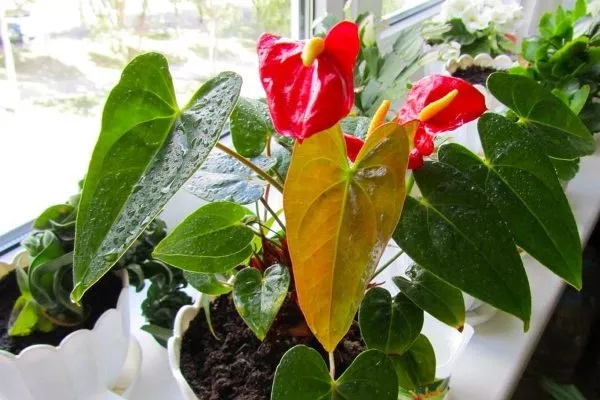
The problem is solved by moving the plant to another, warmer room. To avoid exposure to drafts, the pot should be moved to another room for ventilation.
Choosing a pot
Anthuriums grow poorly in both cramped and overly spacious pots. When planted in an unsuitable container, the plant often reacts with yellowing leaves.
Tips for choosing a pot:
- The height of the container should be 1-2 cm more than the length of the anthurium roots.
- If the pot is too deep, fill it one-third with drainage.
Anthuriums are grown in special pots that can accommodate their root system. If placed in a pot that's too small, the plant will slowly die.
Selecting soil
If the soil is dense and heavy, the anthurium will have difficulty absorbing the nutrients it needs. This immediately affects its appearance—the flower loses its decorative qualities, and its leaves turn yellow. The plant requires light, loose substrates specifically designed for anthuriums.
Natural cause
Yellowing leaves aren't necessarily caused by improper care, disease, or pests. They can also be caused by natural factors such as aging.
A leaf lives on average up to three years. After this period, it begins to turn yellow and eventually falls off. This usually happens to the lower leaves, so when they fall off, the anthurium stem is practically exposed.
How to treat anthurium?
Once the cause—either suspected or definitive—is established, treatment for the anthurium begins. Regardless of the cause of the yellowing, the procedure is carried out in a specific order, following the same protocol.
How to treat anthurium with yellowed leaves.
- Pluck off yellow leaves to help the flower recover faster.
- Eliminate the cause of the yellowing by adjusting your care, eliminating pests, or treating the disease. Care for the plant should be impeccable: adjust watering and fertilizing, provide proper lighting, and create the most favorable growing environment.
- If necessary, repot the plant, following the repotting guidelines. Select the appropriate soil and pot.
- If rot is the cause of the yellowing, be sure to rinse the roots with warm water and then disinfect them by soaking them in a solution of potassium permanganate or a fungicide for 20 minutes. Repot the plant in a new pot, water it, and wait—new leaves should grow.
Also watch a video on how to treat anthurium when its leaves turn yellow:
How to care for it properly?
Proper care can help prevent anthurium leaves from turning yellow. If done correctly, yellowing of this plant's leaves will only occur due to natural causes.
How to properly care for anthurium:
- Anthurium will never grow in the shade. It requires plenty of indirect light, with a minimum day length of 10-12 hours.
- Anthurium is a tropical plant that thrives in warm temperatures. Temperatures below 16°C (61°F) are not recommended.
- Do not place the flower in direct sunlight, drafts or near radiators.
- Please note that the normal humidity typical for living spaces is not enough for anthurium; it must be increased using spraying, fountains, humidifiers, and other means.
- Protect the plant from both drying out and overwatering. Keep in mind that the cooler the room, the less frequently you should water.
- Repot your plant regularly. Every year for up to 5 years, then every 2-3 years. When repotting, trim off any diseased roots, treating the cuts with crushed charcoal.
- Be sure to place a layer of drainage material at the bottom of the pot. It should have drainage holes in the bottom.
- Plant anthuriums only in light, well-drained soils - they must allow the oxygen needed by the roots to pass through well.
- Fertilize your anthurium generously in spring and summer. Use special formulas for araceae, but be sure to halve the concentration. Along with applying fertilizer to the soil, apply foliar feeding by spraying the foliage.
- Trim off the buds that have finished blooming. Do this very carefully. Use a sharp knife. Cut the flower at the base. Carefully remove the dried spathe, and the core will dry out and separate easily from the flower.
- Rejuvenate older plants promptly. Signs of aging include smaller leaves and flowers, or even a complete lack of flowers.
Prevention
When growing anthurium, it is recommended to take preventative measures aimed at preventing situations that provoke yellowing of the leaves.
Preventive measures:
- Maintain the specified growing conditions and follow the rules for caring for anthuriums.
- Feed regularly and repot the plant in time.
- Disinfect the soil before planting. Disinfection methods:
- freezing in the freezer;
- spilling with a solution of potassium permanganate;
- half-hour steam treatment.
- Inspect plants regularly for pests and diseases.
- Disinfect the planting pot before repotting, especially if reusing it.
Yellowing leaves are a warning sign, and it's crucial to determine the cause. If ignored, the plant will first lose its appeal and may even die. Proper care and regular inspections can help prevent this from happening.