
Anthuriums are typically repotted in the spring, but repotting this tropical plant is often done out of necessity. It's important to distinguish between repotting and propagation. The former is done to save the plant or improve its growing conditions, while the latter is done to produce new plants.
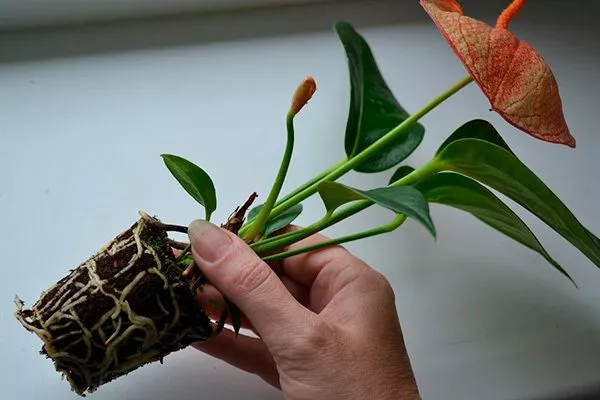
When is it time to replant a flower?
You can tell when it's time to repot your anthurium by a number of visual signs. By closely monitoring the plant, its condition, and its appearance, you can spot a problem early that requires drastic intervention—repotting it in a new pot and substrate.
The soil is depleted
The substrate, while providing nutrients to the flower, becomes depleted over time. Critical depletion occurs within 1-3 years. The more intensive the development anthurium, the faster the soil mixture is depleted.
How to determine if the soil is depleted:
- In soil that has completely depleted its nutrient reserves, the flower stops growing. It often retains the beauty of its leaves—they may still be green and glossy—but anthuriums do not form new stems, leaves, or flowers in depleted soil.
- Young anthurium leaves don't grow to the size of their predecessors. The plant lacks the resources needed for leaf growth. Moreover, it struggles to support both old and young leaves simultaneously.
The root ball has exceeded the substrate
Over time, anthurium roots grow and literally begin to stick out of the pot—they don't have enough space. If aerial roots grow above the substrate or protrude from the drainage holes, the plant needs immediate repotting.
Incorrect substrate
Anthurium is a tropical flower, so regular garden soil isn't suitable for it. It requires a special substrate suitable for its aerial roots. They absolutely cannot tolerate dense, heavy, and clayey soil, nor fertile garden soil, and even general-purpose potting soil for indoor plants is unsuitable.
If the anthurium begins to slowly fade, and its the leaves are turning yellow If the plant is drying out, it's quite possible that the substrate isn't right for it. Dense soil puts pressure on the roots, disrupts metabolism, and impedes all normal life processes. The plant becomes weak and often dies.
The symptoms described may also be associated with other causes - diseases or pests, lack of nutrition, but if the measures taken do not bring results, the flower should be replanted.
Diseases and pests
If an anthurium has been attacked by insect pests or has suffered a fungal or bacterial infection, it should be repotted regardless of the time of year. Even if the plant has been seriously damaged, prompt repotting can save it. Delaying the process can not only kill the anthurium but also infect neighboring plants.
The flower must be replanted if the following appears on the substrate:
- grayish and dirty yellow lumps;
- fluffy grayish-green coating;
- dark brown or black formations.
The pot that contained the contaminated soil mixture is thoroughly disinfected or replaced with a new one.
Preparing for transplantation
Before you begin replanting an anthurium, prepare for the procedure so that everything is at hand and you don't have to make any mistakes during the procedure.
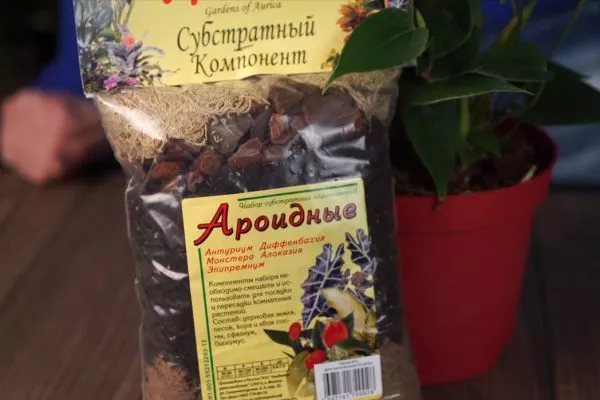
What you need to prepare for transplantation:
- substrate;
- pot;
- a container for soil - you can pour excess soil into it;
- oilcloth;
- tools - a small shovel, a wooden stick (to level the substrate);
- a watering can filled with warm, settled water;
- drainage material.
Recommendations for preparation:
- If the transplant is due to crowding, the plant must be replanted into a pot of a larger diameter and depth.
- If your anthurium isn't doing well in a large pot, it should be repotted into a smaller container. Otherwise, the plant will wither due to root rot—excess water, not absorbed by the plant, will begin to accumulate in the substrate.
- Before planting, be sure to disinfect the pot and check for drainage holes. If there aren't any, make some using a hot nail or a thin drill.
- The substrate must be ideal for anthurium. It must be loose, moisture- and air-permeable.
- Anthuriums are very demanding when it comes to substrate drainage—air and moisture circulation depend on it. Fine pebbles and gravel, expanded clay, or crushed brick can be used for drainage.
| Material | Fraction | Layer | pH |
|---|---|---|---|
| Expanded clay | 5-10 mm | 1/4 pot | 6.5-7.5 |
| Pebbles | 8-15 mm | 1/5 of a pot | 7.0-8.0 |
| Broken brick | 10-20 mm | 1/3 of a pot | 7.5-8.5 |
| Perlite | 3-6 mm | 1/6 pot | 6.0-7.0 |
Features of transplantation
Anthurium repotting is carried out taking into account the underlying reasons. The plant's condition is also taken into account. If repotting isn't urgent, wait until the most favorable time is reached.
Transplant timing
Anthuriums transplant best in the spring; summer is considered less favorable, and it's recommended not to disturb the plant at all in winter and fall. Anthuriums don't have a distinct dormant period, but winter is considered challenging for them, requiring more energy to adapt and establish themselves.
After purchase
Store-bought anthuriums should be repotted as soon as possible, no later than 3-5 days after purchase. Wear gloves when repotting, as the plant's sap is poisonous.
Transplantation procedure:
- Remove flower stalks.
- Carefully remove the anthurium from the pot.
- Remove the peat substrate in which the flower grew.
- Treat the roots with Fitolavin.
- Add a drainage layer to the pot. It should fill about a quarter of the pot's volume. Place sphagnum moss on top and place the plant on top.
- Place special soil around the roots so that the growth bud is at ground level.
If the room is warm and humid, you can water the plant immediately. If it's cool, postpone watering until the second day—you'll need to wait until the injured roots have time to heal.
Also watch a video about replanting anthurium after purchase:
During flowering
Although repotting anthuriums during flowering is not recommended, compared to other houseplants, they tolerate transplanting quite well while in bloom. While it's best not to repot anthuriums during this period, if the plant has serious problems that can be resolved by repotting, it's not a good idea to skip it.
It's done according to the standard procedure. As with repotting after purchase, the flower stalks are first removed, and then all the wilted leaves are trimmed—this speeds up the flower's establishment in its new location. The main thing is to carefully transfer the root ball so as not to damage the plant's roots.
Additionally, watch a video on how to transplant an anthurium during flowering:
How to transplant correctly?
Anthuriums can be repotted in one of two ways: with or without a root ball. The first option is suitable for healthy plants, while the second is for plants damaged by disease or pests.
Transfer by transhipment
Transplanting plants with a root ball is called the "transshipment" method. This method differs in that the plant is transplanted with the root ball intact. In this case, the soil is not shaken off the plant's roots.
The procedure for transplanting anthurium using the transshipment method:
- Water the potting soil generously. Carefully grasp the plant by the stems, near the roots, and remove it from the pot along with the root ball. Inspect the roots for damage, signs of rot, or pests.
- If the roots are healthy, move them to a new pot immediately. If not, take steps to correct the situation. Trim off any rotten roots and treat the remaining healthy ones with Fitolavin.
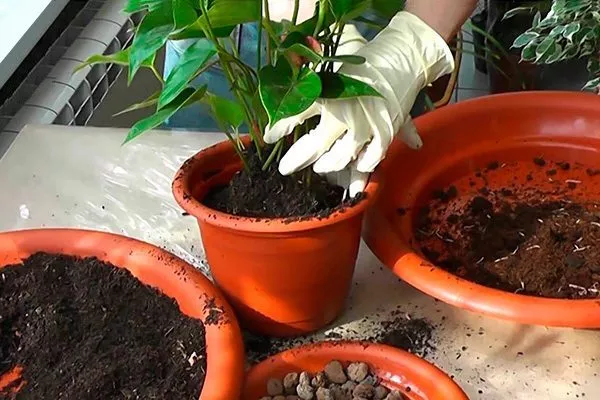
- Place the flower in a prepared pot filled about a third full with drainage material and potting soil. Position it so that the stems are in the center of the pot.
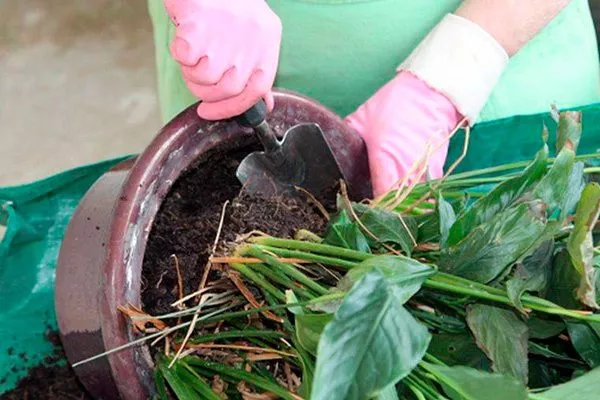
- Carefully fill the empty space in the pot with the substrate. If you come across any large pieces of peat, turf, or pine bark, push them through with a stick, but be careful not to touch the plant's roots. To ensure the substrate is evenly distributed throughout the pot, tap the sides periodically.
- Compact the soil with your fingers. Do this gently, without applying too much force. You can add sphagnum moss on top. Keep in mind that the soil in the pot should not be higher than the level it had before repotting.
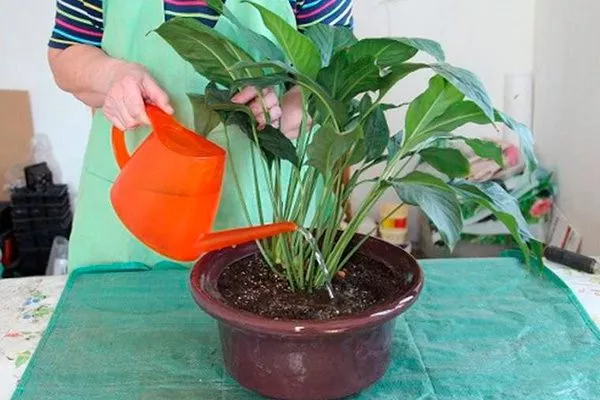
- Water the replanted flower. After the soil has settled, add more soil and return the pot to its original location—where the flower stood before repotting.
Bare-root transplant
How to transplant a flower with bare roots:
- Prepare the substrate and flat, wide containers for planting.
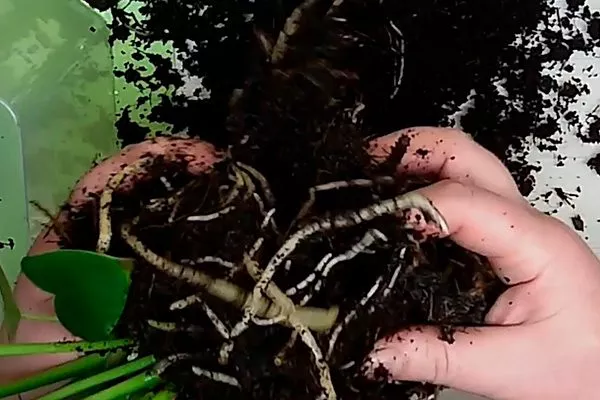
- Water the plant and carefully remove it from the pot.

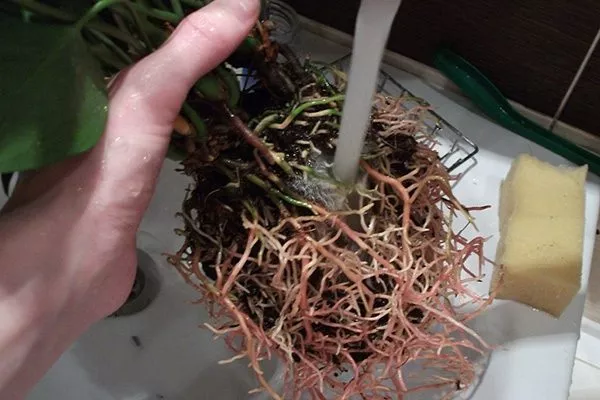
- Shake the soil off the roots.
If necessary, rinse with warm running water.
Handle the roots with extreme care - they are very fragile.
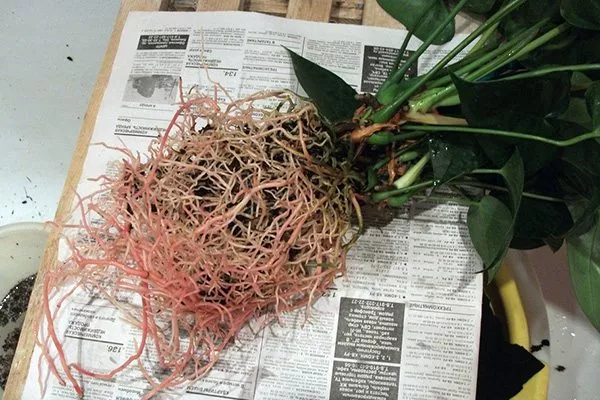
Pay attention to the color of the roots. A healthy anthurium will have pinkish, white, or yellowish roots. Remove any diseased, rotted, or damaged parts with a disinfected tool.
Also pick off all the yellow leaves, and if there are any affected shoots, remove them too. - Soak the plant roots in a solution of potassium permanganate or a fungicide for 15 minutes. Soak the over-dried roots in a solution of succinic acid (1 tablet per 1 liter of water) for 20 minutes. Sprinkle the cut surfaces with crushed charcoal.
- Place a layer of drainage material on the bottom of the pot, add the potting soil on top, and form a mound. Place the flower on top, spreading the roots along the slopes of the mound.
- Sprinkle the roots with the substrate and compact it slightly.
- The soil placed in the pot must be moist, so the flower should not be watered immediately after replanting; you need to wait until the top layer dries.
- Move the transplanted plant to a warm, draft-free room. Mist it and keep it out of direct sunlight.
How often should the procedure be done?
If the anthurium is healthy, it should be repotted once every three years. As it matures, repot less frequently—every five years. If the plant is overcrowded or sick, the procedure should be performed unscheduled.
Which pot should I transplant it into?
The pot for replanting is selected taking into account the reasons for which it is being carried out.
Recommendations for choosing a new pot:
- If the plant's roots have filled the pot and are cramped, the new container should be 2-4 cm larger than the previous one. This is enough for the anthurium to bloom beautifully.
- To obtain new plant shoots, use a pot twice as large. Anthuriums won't bloom until their roots have fully established themselves in the soil, but you can obtain cuttings for planting.
- The optimal pot material is ceramic or plastic. The pot material isn't particularly important, as long as it has drainage holes.
The downside of clay pots is the potential for roots to grow into the walls. This complicates subsequent repotting.
What kind of soil do you need?
The best option is to buy special anthurium soil at a flower shop. If you don't have any, you can make your own. It should be slightly acidic and have a specific composition.
How to prepare the substrate correctly:
- Prepare the mixture, removing any large particles as you stir. The simplest option is to mix equal parts leaf mold, peat, pine soil, and coarse sand. After thoroughly mixing, moisten the ingredients. There are other mixtures for anthuriums, such as:
- soil from under pine trees - 15%;
- turf soil from under deciduous trees - 15%;
- sphagnum moss - 30%;
- peat - 30%;
- mixture of bark, charcoal and sand - 10%.
- Place the potting mix in the freezer for 24 hours to disinfect the substrate. Or treat it with hot steam.
Post-transplant care
After transplantation, anthurium needs especially careful careThe transplanted flower is under stress, so its vitality is weakened.
How to care for a transplanted anthurium:
- Lighting. The flower should be placed in a location with soft, diffused light. Shade and bright sun are equally harmful to anthurium. Ideally, place it near a west- or east-facing window. If daylight hours are short, supplement the plant with a grow light.
- Temperature. This tropical flower thrives at temperatures of 25°C. In winter, temperatures can drop a few degrees lower. Sudden temperature fluctuations are undesirable.
- Humidity. In tropical and subtropical climates, where anthuriums originate, humidity is always high. To ensure the plant remains comfortable indoors, it's recommended to use a humidifier. Daily misting is also recommended in summer, while once every three days is sufficient in winter.
- Top dressing. During the first month, do not feed the transplanted plant, as fertilizers can harm the damaged roots. Later, you can use commercially available complex fertilizers.
- Watering. Use only warm and settled/filtered water. Watering a flowerwhen the top layer of soil dries out.
Post-transplant monitoring schedule
- Day 1-3: Daily inspection of leaf turgor
- Day 4-7: Checking the drainage holes
- Days 8-14: Monitoring new growth points
- Day 15-21: Assessing substrate drying rate
- Day 22-30: Checking the pH of irrigation water (5.5-6.5)
Transplantation problems
A transplant doesn't always produce the desired result; there are situations where it fails. In these cases, it's important to take appropriate measures promptly.
Problems and solutions:
- Anthurium does not take root. The plant takes a long time to adapt to a new location. It may not produce new leaves for 1-2 months, and this is not a cause for concern. However, make sure the growing conditions—temperature, humidity, etc.—are appropriate.
- The leaves of the shoots turn yellow. The cause is a lack of oxygen in the roots. This usually occurs due to overwatering or standing water. The solution is to reduce watering and loosen the soil.
Another cause of yellowing leaves is an excess of fertilizer. It isn't absorbed and begins to burn the plant's roots. For this reason, transplanted anthuriums aren't fertilized for 2-3 months after repotting. - The leaves are drying up. This is primarily due to low humidity. It's necessary to mist the plant and increase the humidity around it. You can even cover it with a plastic bag.
| Symptom | Cause | Solution |
|---|---|---|
| Losing 2+ leaves per week | Damage to the root collar | Treatment with Kornevin |
| Black dots on the petioles | Fungal infection | Spraying with Fitosporin |
| Slow growth | Low substrate temperature | Heating the tray up to 22°C |
| White coating on the soil | Root hypoxia | Loosening the top layer |
Repotting isn't stressful for anthuriums, but a normal process when growing indoors. If done correctly, the plant will suffer virtually no harm; in fact, in many situations, repotting is the only way to save the anthurium.