
In nature anthurium Native to tropical rainforests, it reacts extremely poorly to low air and soil humidity. To prevent the plant from wilting and losing its beauty, it's important to provide it with ideal growing conditions. One component of proper care is timely watering, tailored to the plant's needs.
How to determine when it’s time to water an anthurium?
Anthuriums, like many other houseplants, are recommended to be watered as needed rather than according to a strict schedule. It's important to consider the soil's condition and, based on that, decide whether it's time to water the plant.
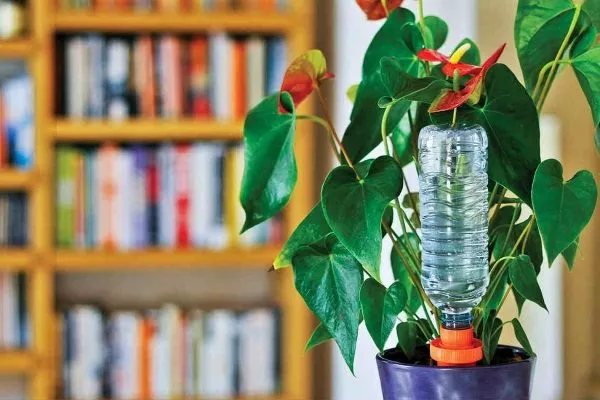
Symptoms of lack of water in anthurium:
- the bract loses its rich color, it becomes dull;
- leaves lose elasticity, color and shine;
- the edges of the leaves dry out, brown spots appear on the leaf blades;
- the normal tilt of the leaves changes - it becomes less than 45°;
- Due to moisture loss, the pot becomes light.
How to distinguish wet soil from dry soil?
If the pot is large enough, you can easily tell when it's time to water the plant by taking a handful of soil and squeezing it. If you squeeze out drops of moisture, the soil is still wet and there's no need to water the plant. In fact, overwatering in this case can actually cause harm, as the anthurium's roots may rot.
If the plant is growing in a substrate, remove a few large coconut particles and squeeze them between your fingers. If there are any drops, it's too early to water; if there aren't, it's time to water.
What influences the frequency and abundance of watering?
Watering anthurium requires a personalized approach, taking into account a wide range of factors. The more nuances you consider, the more accurately you can determine the timing and amount of watering.
The following factors influence the watering regime:
- Anthurium age. Mature anthuriums, aged 3 to 5 years, are recommended to be watered when the substrate is half-dry. Young plants, however, should be moistened before the substrate begins to dry out—it should always be slightly damp.
- Pot material. Anthuriums in clay pots always require more water than those in plastic ones. This is due to the clay's ability to permeate water, which then evaporates from the outer surface of the pot.
- Soil composition. Flowers planted in moss substrates are watered as they dry out. To determine the moisture content of the moss, rub it between your fingers. If the substrate "crackles," it's time to water the plant.
- Development period. The plant requires increased watering during flowering and when actively growing. During dormant periods, watering should be reduced by about half.
Watering frequency
Anthuriums naturally grow in humid tropical climates and therefore do not tolerate drought. However, overwatering can also negatively impact their health, particularly by promoting mold growth. Watering frequency depends on a number of factors and is determined individually for each plant.
The average frequency of watering a flowering anthurium is 2 or 3 times a week. The exact frequency is determined based on soil conditions and other factors, and is also influenced by seasonality—watering frequency is always reduced in winter.
Watering methods
You can water anthurium in different ways, the main thing is that the plant receives the required volume of water without being harmed.
The following irrigation methods are distinguished:
- Above. Water the substrate until it appears in the tray. After this point, stop watering, and drain the tray after half an hour. It's important not to let water drip onto the leaves or upper roots when watering, as this can cause disease.
- Through the pallet. This method allows for even distribution of liquid throughout the entire substrate. Water poured into the tray rises through the drainage holes, moistening the soil. The downside of this method is that the drainage layer can impede the water's upward movement, preventing the aerial roots from receiving the required amount of water.
- Spraying. Spraying with room-temperature water is recommended, especially during periods when the air becomes excessively dry and the room temperature rises. It's best to spray with a spray bottle. Spray once a week.
Most experienced gardeners opt for bottom watering, using a tray. The advantage of this approach is that no water droplets remain on the leaves, stems, or aerial roots. This reduces the risk of disease and preserves the plant's beauty. However, bottom watering also has a drawback: water may not reach the top layer of the substrate. In this case, the aerial roots suffer from lack of moisture.
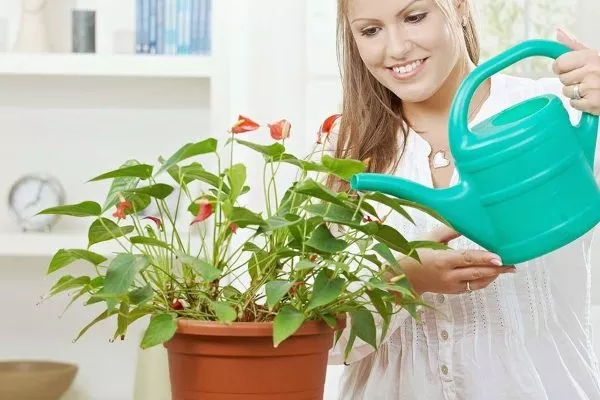
For overhead watering, use special watering cans with long spouts, without a spray nozzle. Water is poured strictly around the perimeter of the pot, simultaneously wetting the moss covering the aerial roots. The optimal solution is to alternate between different watering methods.
How does the type of anthurium affect watering?
| Name | Growth type | Flowering period | Humidity requirements |
|---|---|---|---|
| Climbing | Curly | All year round | High |
| Scherzer | Bushy | It decreases in winter | Moderate |
| Crystal | Bushy | All year round | Uniform |
| Andre | Bushy | During the growth period | High |
| Linden | Bushy | All year round | Moderate |
| Hooker | Bushy | Active growth | Abundant |
| Wendlinger | Bushy | All year round | High |
| Veicha | Bushy | All year round | High |
In addition to seasonal influences, watering is also influenced by the species characteristics of the anthurium. Some species require more frequent watering, while others are less demanding. The watering needs of indoor anthuriums largely depend on the natural habitat of their wild ancestors.
Watering depends on the type of anthurium:
- Climbing. They have no dormancy period, so watering is required year-round. Climbing varieties also require regular misting of the above-ground portions.
- Scherzer. Watering of this flower is reduced in winter and it is not sprayed until the onset of warm weather.
- Crystal. These anthuriums require uniform watering all year round.
- Andre. During the growing period, flowers require regular watering and daily spraying, which is reduced towards winter.
- Linden. Water only through the tray.
- Hooker. During active growth, water flowers frequently and thoroughly, avoiding overwatering and stagnant water. During the dormant period, reduce the amount and frequency of watering.
- Wendlinger. They are watered according to the standard schedule, but sprayed more frequently—twice a day in summer and every three days in winter. It's important to avoid getting the flowers wet.
- Veicha. Watering is done as usual. During the warm season, plants are sprayed daily, and in winter, every two days.
The nuances of watering after transplanting
After transplantation, anthurium spends a lot of energy on taking root, so the watering regimen must be adjusted.
- For the first week after repotting, keep the plant in partial shade to reduce stress.
- Start watering with small amounts of water, gradually increasing to the normal volume by the end of the second week.
- Use a root stimulator during the first watering after transplanting to speed up adaptation.
Features of watering anthurium after transplantation:
- Before moving the flower to a new pot, water it generously, and then, after planting, water it again.
- The first watering after repotting should be done 5-7 days later. Before watering, it is recommended to test the soil for dryness with a wooden stick or other means.
- If many roots were removed during replanting - damaged, dried out, rotting - the new soil is moistened minimally.
You can add a few drops of growth stimulant to the water—it will help the plant cope with the stress of transplantation and take root faster.
Watering considerations after purchase
The soil in which purchased anthuriums grow requires a special watering regimen—a regimen difficult to achieve at home. Therefore, anthuriums should be repotted immediately after purchase into a regular substrate. Watering should then be carried out according to the same schedule as after a standard repotting.
After replanting, the purchased flower is watered less often than usual, but sprayed as usual.
Watering at different times of the year
Anthuriums, like all plants, have their own life rhythms linked to the seasons. When watering these flowers, it's important to consider the season, as the nuances of the procedure vary depending on the season.
Features of watering at different times of the year:
- Winter. Anthuriums need to be watered moderately, about once a week. When the heating is turned on, it's especially important to monitor the humidity level, increasing it if necessary.
- Summer. During the hot season, this tropical plant grows and develops especially rapidly. At this time, the anthurium blooms and requires a lot of vital energy, more water and nutrition than usual. In summer, you can water the plant generously. It is recommended to mist the plant daily, and up to three times a day in hot weather.
- Autumn. During this period, it's important to monitor the plant's activity. If growth and flowering continue, maintain the summer watering schedule. If growth slows and new flower stalks are absent, reduce the amount and frequency of watering.
- Spring. When the anthurium begins to emerge from hibernation, it is initially watered according to the winter schedule. Once the plant is fully awake and begins to grow, the water volume is gradually increased.
Top dressing during watering
Anthuriums are recommended to be fertilized regularly. It's best to use ready-made formulas such as Kemira, Agricola, and others. Powders or granules are diluted in water and applied during watering at the dosage indicated on the packaging.
Mineral root fertilizers—along with watering—should be alternated with foliar feeding. Half the dose is diluted in water and sprayed onto the foliage. This treatment allows nutrients to quickly reach plant tissue.
Care after watering
After watering, the top layer of soil in the pots should be loosened. Do this carefully to avoid damaging the roots. Loosening should begin as soon as the soil has dried slightly, usually the next day. Loosen the soil to a depth of 1-1.5 cm. Loosen the soil with special hand tools, but a regular fork will also do.
What kind of water is needed for irrigation?
The quality and condition of the water used for watering anthuriums are important. Excessively hot, cold, or hard water (with a high concentration of salts) can be harmful to the plant. Young plants react sharply to unsuitable water, causing their leaves to turn yellow and fall off, and their overall condition to deteriorate. Anthuriums should not be watered with tap water.
For watering anthuriums, it is recommended to use water:
- room temperature;
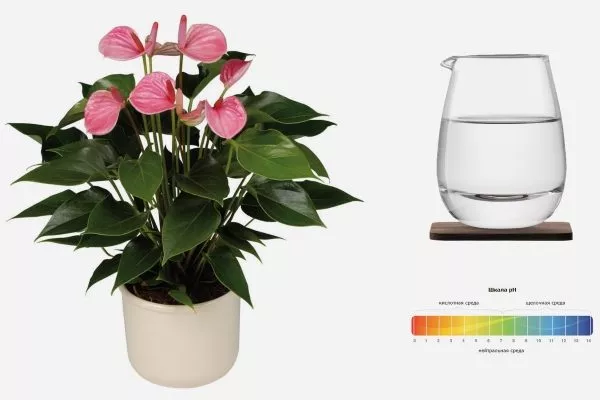
- with neutral pH;
- non-chlorinated;
- without heavy metals - they, settling on the roots, disrupt the normal growth and development of the flower.
- ✓ The water temperature should be strictly within 20-22°C to avoid stressing the plant.
- ✓ The pH level of the water should be in the range of 5.5-6.5 for optimal absorption of nutrients.
It is recommended to water anthuriums with rainwater collected in rain barrels after heavy rains. Short-term rainfalls are not suitable, as they contain harmful substances, especially in industrial regions.
The quality of tap water can be improved in a number of ways:
- Freezing. It's best done outdoors in winter. Water is poured into a metal container and placed in the freezer. When 50% of the liquid has frozen, the remaining water is drained. The remaining ice is melted for irrigation. Water can be similarly obtained by freezing it in the freezer and pouring it into plastic bottles.
- By defending. This is the simplest way to improve water for irrigation. It only takes a day to prepare—during this time, the water softens as the salts precipitate. Only the top and middle layers of the settled water are used for irrigation. The bottom layer, containing the precipitated salts, is discarded; it is not suitable for irrigation.
- By boiling. After boiling, the water becomes softer. After boiling, the water is cooled to room temperature. Boiling removes limescale deposits from the water, which settle on the walls of the kettle (scale).
Diseases due to improper watering
Incorrect watering of anthurium leads to diseasesOverwatering causes the most negative consequences: the plant's roots begin to rot, followed by other parts. Leaves are particularly affected: they turn yellow, wilt, and fall off.
Possible reactions to improper watering:
- The leaves have darkened and become covered with dark spots. The cause is excessive and frequent watering.
- The leaves are covered with white spots. The cause is watering with hard and cold water.
Diseases caused by improper watering:
- Sooty mold. It occurs as a consequence of aphid infestation—the fungus feeds on the aphids' waste products. The plant stops growing and developing. Treatment includes Bordeaux mixture, soap solution, and copper sulfate, as well as Fitosporin and Fitoverm.
- Powdery mildew. A common fungal disease that occurs with excessive moisture. The plant becomes covered with a whitish coating, and the leaves wilt. Antifungal fungicides such as Fundazol, Topaz, or similar products are used for treatment.
- Rust. This is accompanied by the appearance of dark brown spots on the leaves, which eventually fall off. Affected anthurium leaves should be removed, and the plant treated. Recommended products include Topaz, Abiga-Peak, Fitosporin, Baktofit, or a 1% Bordeaux mixture solution.
What are the dangers of improper watering?
Watering errors can lead to a variety of negative consequences, including plant death. An improperly chosen watering schedule, as well as watering the plant haphazardly and sporadically, can cause wilting and drying out.
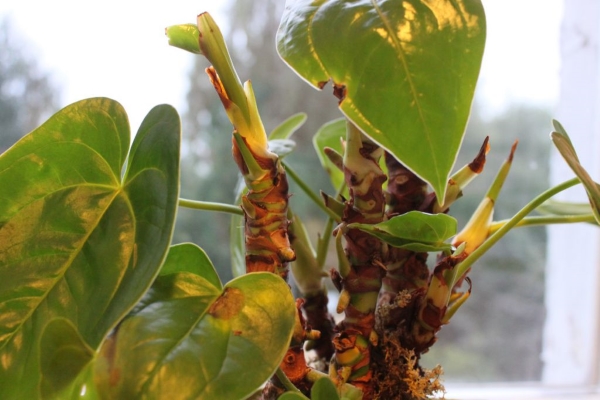
How to understand that anthurium is suffering from excess moisture:
- growth slows down;
- a greyish-white coating appears on the leaf during inflorescence;
- an unpleasant smell begins to come from the pot;
- brown, slimy spots appear on the roots;
- the leaves darken and become covered with dark spots.
Underwatering is no less harmful than overwatering. Anthuriums react to this by developing various diseases. Typically, the plant is affected by rust, which causes green leaves to turn dark brown. Affected leaves become soft and droop.
When there is a lack of moisture, the following symptoms appear:
- growth retardation;
- the leaves turn yellow, wither and curl into tubes.
Watering is the most important component anthurium careThis tropical plant is sensitive to any mistakes regarding its watering. Watering itself is not difficult; the main thing is to know the rules and strictly follow them.