
Anthurium is a spectacular tropical plant widely used in indoor gardening. Within its family, anthuriums are among the most numerous genus, comprising hundreds of species.
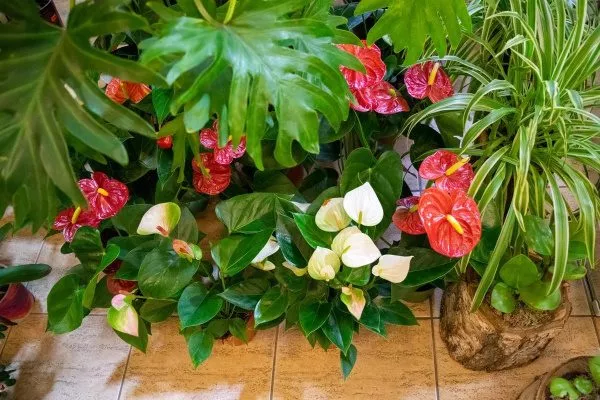
Description of Anthurium
Anthurium (Latin: Anthurium) — an evergreen herbaceous plant of the Araceae family. The plant gets its name from its distinctive inflorescences, which translates into Russian as "flower with a tail."
Most anthuriums are epiphytes and hemi-epiphytes, with short stems and aerial roots. The genus also includes vines and creeping herbs. Plant height, depending on the variety, ranges from 40 to 80 cm.
Description of Anthurium:
- Leaves — leathery, dense, glossy or semi-glossy, and can have a wide variety of shapes. Some anthurium species have entire leaves, incised, deeply dissected, lanceolate, and multipinnate leaves. Their length varies from a few centimeters to a meter. They can be plain green, iridescent, shimmering, or with silvered veins. Some anthuriums have large, patterned leaves. Anthurium leaf shapes:
- spatulate;
- heart-shaped;
- with blunt tops;
- rounded.
- Stems - thick, usually shortened, but sometimes elongated (up to 15-30 cm).
- Flowers — they are gathered in dense, long inflorescences, cylindrical or "tail-shaped." The spadix is surrounded by a spathe—a bract, the shape and color of which also depends on the anthurium species.
Flowers come with large and small spathes, matte and shiny, brightly colored and greenish. The scent varies—some species have a pleasant scent, others have an unpleasant one. - Roots — medium length, very fragile. Most species have aerial roots.
- Fruit - juicy and fleshy berries with many seeds, red or black.
With its evergreen, leathery leaves and striking inflorescences, this flower is very decorative and looks beautiful in modern interiors. Anthuriums are grown as ornamental foliage plants with beautiful blooms. They are also used for cut flowers and in bouquets and arrangements.
- ✓ The optimal air humidity for anthuriums should be 70-80%, which is critical for their epiphytic nature.
- ✓ Temperature conditions: 22-28°C during the day, not lower than 18°C at night to avoid stress on the plant.
Origin
Anthuriums are native to the tropical and subtropical regions of Central and South America. Their natural habitat extends from Mexico to Paraguay, from southern Brazil to the Greater Antilles. These flowers are widespread not only in tropical forests but also in the South American Andes.
Anthuriums grow at a wide range of altitudes, found in both savannas and highlands. Their maximum altitude is 3,400 m above sea level.
Varieties
Despite the large number of species—approximately 500—no more than 30 varieties of anthurium are cultivated. All can be divided into two broad groups: flowering and deciduous.
Ornamental flowering
Flowering anthuriums are used to decorate interiors, and their flowers and berries are used in bouquets and arrangements. Most flowering species have heart-shaped, patterned leaves and large inflorescences.
Some ornamental flowering anthuriums have a spathe diameter of 15-20 cm. The spadix length also approaches 15 cm. Berries and flowers can sometimes be present on the plant simultaneously. Flowering anthuriums usually have a delicate and pleasant fragrance.
Ornamental foliage
Ornamental foliage anthuriums typically have thin, oblong or oval leaves that are rich green. These climbers require support to grow. The foliage varieties have small flowers, but very beautiful leaves—up to 40 cm long. They can be leathery or velvety, with contrasting veins.
Types of Anthurium
Anthuriums are widely distributed and among the most popular in the Araceae family. They are prized not only as interior plants but also as cut flowers. About 30 species, represented by numerous cultivars and hybrids, are used commercially. Below are the most popular anthurium species for indoor gardening.
| Name | Plant height (cm) | Leaf shape | Color of the bedspread |
|---|---|---|---|
| Anthurium Andre | 40-80 | Oblong-cordate | White, pink, salmon, crimson |
| Anthurium scherzeriana | 15-50 | Lanceolate, subelliptical | Red-orange |
| Crystal Anthurium | 20-40 | Spectacular, dark green | Green or purple |
| Baker's Anthurium | 20-55 | Belt-shaped | Yellowish-green |
| Anthurium majesticum | Up to 60 | Heart-shaped | Not specified |
| Anthurium hookeri | 30-120 | Wide, bright green | Green |
| Climbing Anthurium | Up to 100 | Lanceolate, oval | Pale green |
| Anthurium multidissecta | 8-15 | Digitally dissected | Not specified |
Anthurium Andre
This epiphyte is native to southwestern Colombia and northwestern Ecuador. It prefers montane humid subtropical forests. It grows at altitudes up to 2,500 m above sea level. Latin name: Anthurium andraeanum.
Brief description:
- Anthurium andrae has short stems and aerial roots. The leaves are large, bright green, and glossy. They have long petioles and an oblong-heart-shaped form. The leaf blades are 30-40 cm long and 15-20 cm wide.
- The cob is cylindrical, white, cream, or pale yellow in color, and 8-15 cm long.
- The spathe is large, heart-shaped, and leathery, with a bubbly surface and a metallic sheen. Colors include white, soft pink, salmon, and crimson.
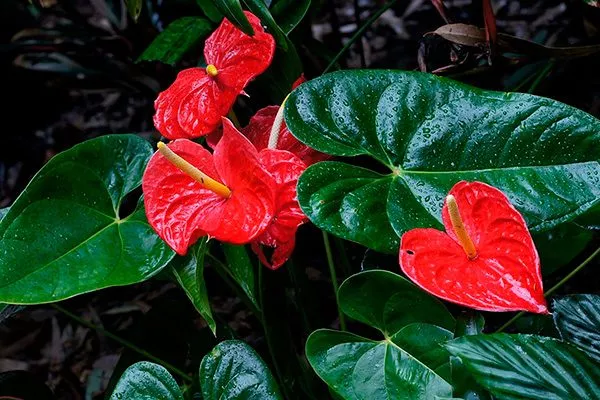
The blooming period is long, lasting over a month. After cutting, the flowers can remain fresh for up to four weeks. After flowering, the spathe does not wilt, but becomes rough and green.
Garden hybrids are predominantly grown in cultivation. Anthurium Andrei varieties are respectable, fashionable, and quite profitable for commercial gardening.
Anthurium scherzeriana
Native to Costa Rica, it is found in forested mountainous areas. This epiphyte prefers to grow at altitudes of 1,300–2,100 meters above sea level. It is considered the most suitable species for indoor conditions. It can also grow as a terrestrial plant. Latin name: Anthurium scherzerianum.
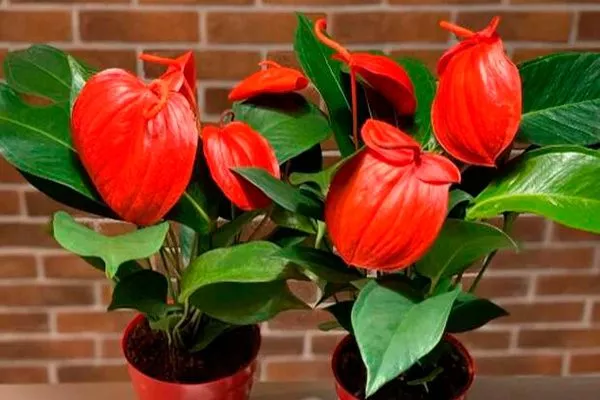
Brief description:
- The stems are extremely shortened, often underground.
- The leaves are dark green, dense, leathery, and matte. The shape is lanceolate, almost elliptical. The leaves are covered with black speckles on both sides.
- The petioles are 4-20 cm long, and the peduncles are 15-50 cm long. The spathe is dense, red-orange in color. The shape is elliptical or ovoid. The spathe is 3-12 cm long and 3-6 cm wide.
- The cob is yellow or orange. Length is 2-8 cm. The fruits are red-orange.
A very popular species, grown as a houseplant and for cut flowers. It has many garden forms and hybrids.
Crystal Anthurium
This epiphyte is native to Peru and Panama. It is found in mountain tropical forests. Its Latin name is Anthurium crystallinum.
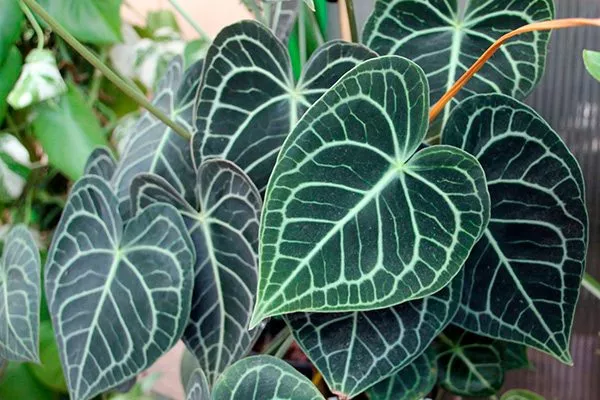
Brief description:
- The leaves are striking, dark green, and velvety to the touch. They are 20-40 cm long and 15-20 cm wide. The veins are silvery and shiny.
- The petioles are smooth and rounded in cross-section. The peduncle length is up to 40 cm.
- The spathe is green or purple. It is 7-10 cm long and 1.5-2 cm wide. The cob is 15-25 cm long. The fruits are purple.
Baker's Anthurium
This spectacular plant is native to the South American rainforests. It is found across a vast area, from Colombia to Guatemala. It is an epiphyte. Its Latin name is Anthurium bakeri.
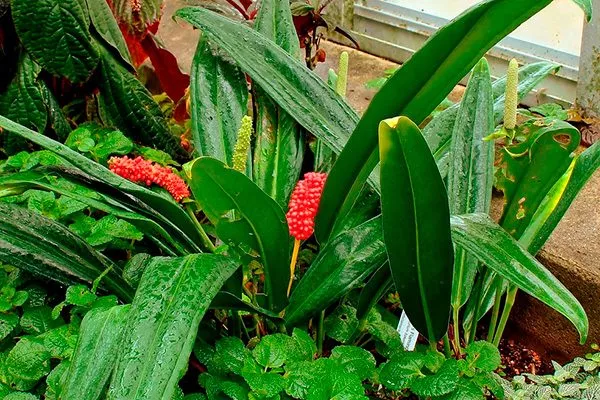
Brief description:
- The leaves are dense, strap-shaped, 20-55 cm long and 3-10 cm wide. Their reverse side is covered with reddish-brown dots.
- The inflorescences are not as large as the leaves. The peduncle is 5-30 cm long, with a leathery, yellowish-green spathe. It is 2.5-5 cm long and 2.5 cm wide. The spadix is creamy or white, reaching 10 cm in length. The fruits are red.
Anthurium majesticum
This evergreen flower is native to Colombia, where it can be found in mountain rainforests. This species thrives indoors. In the wild, it occurs as an epiphyte or as a terrestrial plant. Its appearance is very similar to that of the crystal anthurium. Its Latin name is Anthurium magnificum.
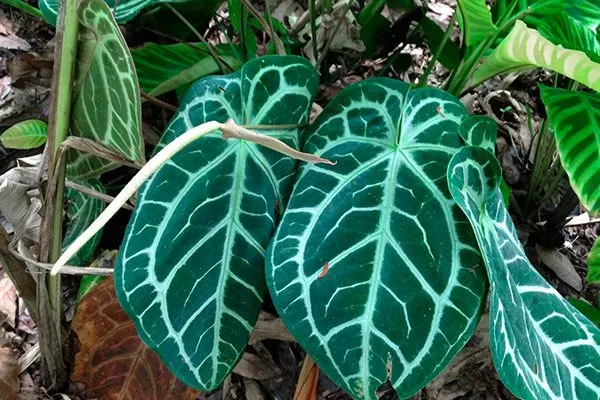
Brief description:
- The leaves are deep green, large, and smooth, and the flowers are glossy. The leaves are heart-shaped and have silvery veins, creating unique patterns.
- The length of the leaves is up to 60 cm, the width is up to 50 cm. A distinctive feature of the species is the tetrahedral leaf petiole.
Anthurium hookeri
In the wild, this anthurium is found in the Lesser Antilles, Trinidad, and Suriname. It grows in tropical monsoon forests. The plant form is an epiphyte with large leaves or a rosette epiphyte. Latin name: Anthurium hookeri.
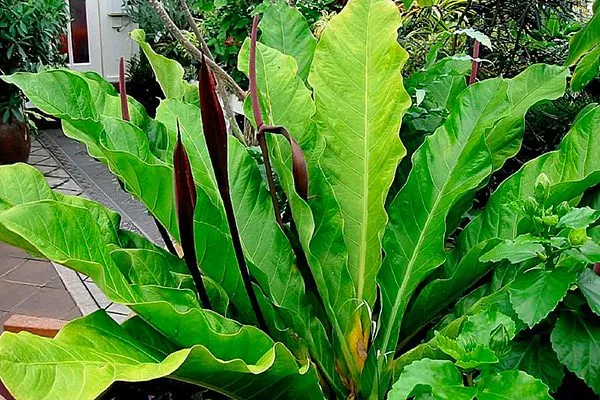
Brief description:
- The leaves are large, wide, and bright green. They are covered with black speckles on both sides. The leaves are 30-120 cm long and 10-45 cm wide. The peduncle is 40-90 cm long.
- The petioles have a triangular or flat-convex cross-section and are 2–15 cm long.
- The spathe is green, oblong, reaching 25 cm in length and 3 cm in width. The cob is pale purple, up to 30 cm in length. The fruits are white, and their tops are red.
Climbing Anthurium
This species grows from the southern border of Mexico and throughout Brazil. It is an epiphyte. It tolerates shade well and is one of the easily flowering and fruiting anthuriums. Latin name: Anthurium scandens.
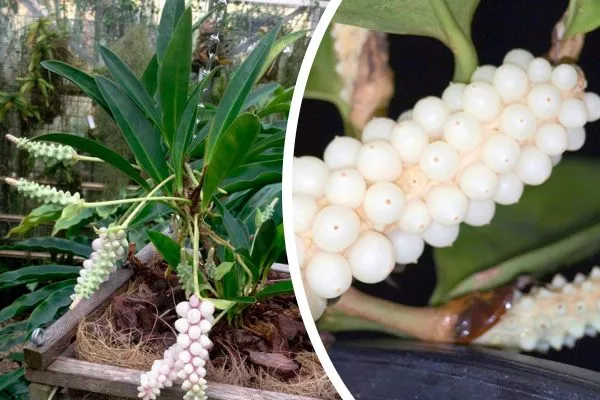
Brief description:
- The roots are thick, and the stems reach 1 m in length. The petioles reach 2-9 cm in length.
- The leaves are thick and leathery, ranging in shape from lanceolate to oval. The underside is covered with black speckles.
- The peduncle is shorter than the leaves, its length is 2-6.5 cm.
- The spathe is pale green. It's 8-15 cm long and 0.5 cm wide. The cobs are yellow-green, 2 cm long and only 2-3 mm thick. The fruits are white or pale purple.
Anthurium multidissecta
This anthurium vine grows in humid tropical forests. It is found in Colombia and Peru, and in the Amazon River valley. It is an excellent indoor vine. Latin name: Anthurium polyschistum.
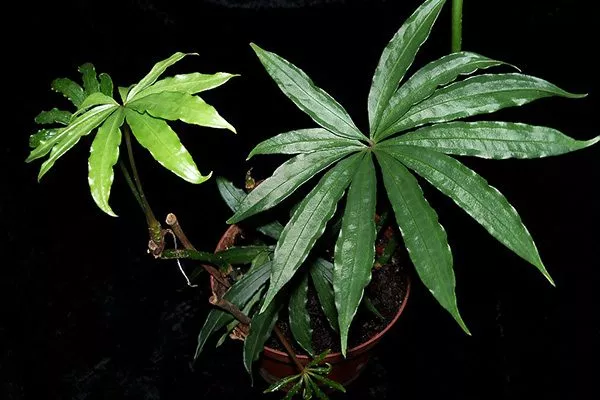
Brief description:
- The leaves are palmately dissected. There are 10-15 segments at the base. The edges are wavy, and the shape is linear-lanceolate. Length is 8-15 cm, width is 0.5-1.5 cm.
- The peduncle reaches 10-30 cm in length. The spathe and the spathe are the same length—6-10 cm. When the plant blooms, the spathe curls back. The berries are juicy, reddish-purple in color.
What colors are there?
There is an opinion that anthuriums are always red, but in fact, this plant's inflorescences can be of a wide variety of colors and shades.
Color of anthuriums (inflorescences):
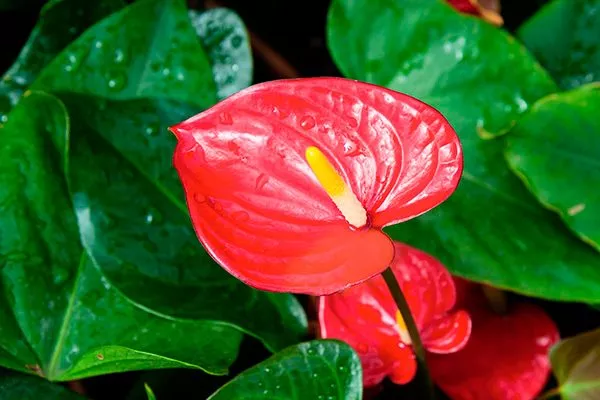
- Red. These are the most popular indoor anthuriums. Bright and striking, they look wonderful in interiors. With proper care, they can bloom almost year-round. This is the most numerous group of anthuriums.

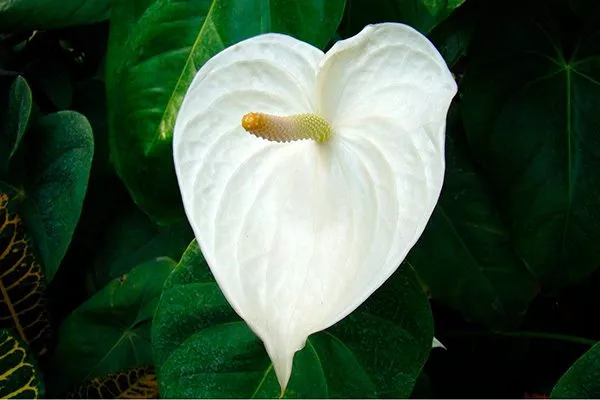
- White. Anthuriums with white spathes have a remarkable ability to remain fresh for up to two weeks after cutting. White anthuriums look beautiful in flower arrangements and bouquets.
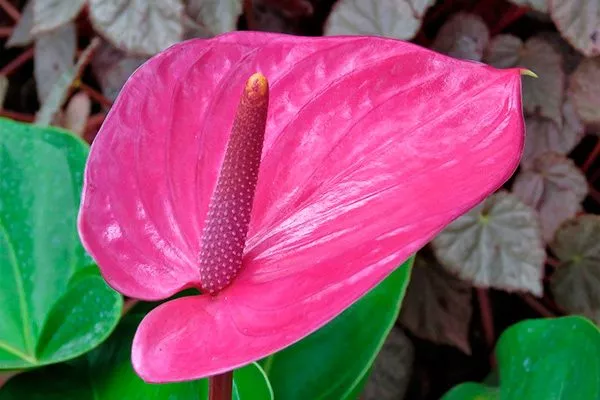
- Pink. Pastel-colored anthuriums are highly prized by experienced gardeners. These flowers include some very interesting specimens; for example, some varieties can develop changes in color of their spathes and spadix with age.
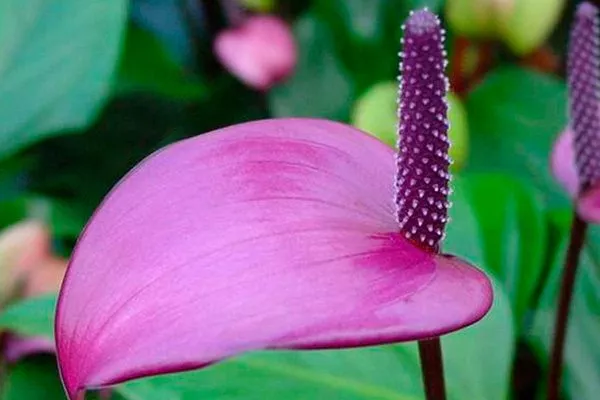
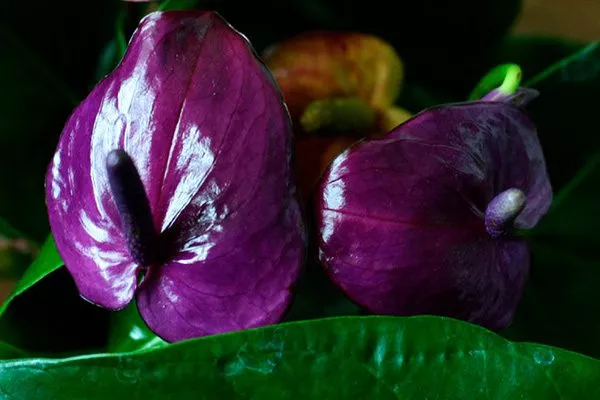
- Purple and lilac. They are rarely found in indoor gardening. These anthuriums are often called tulip anthuriums due to their coloring and small spadix.
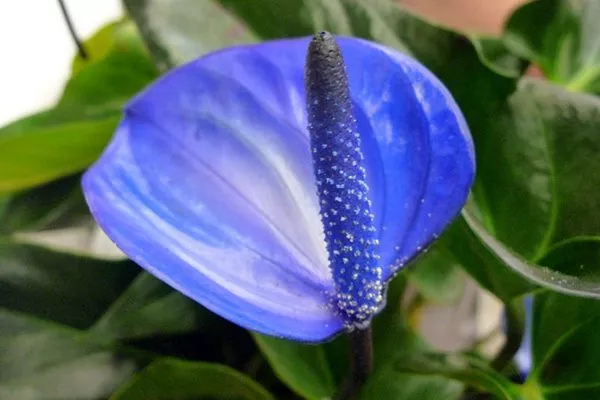
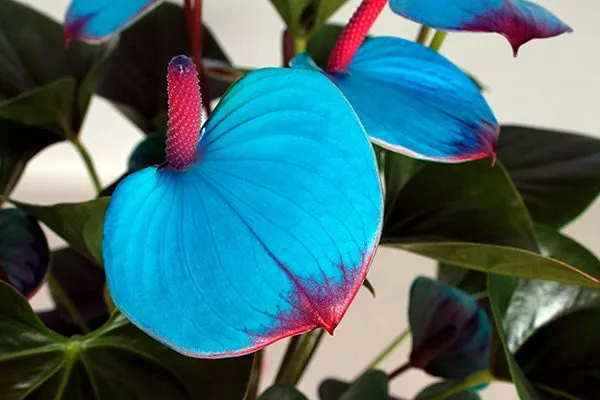
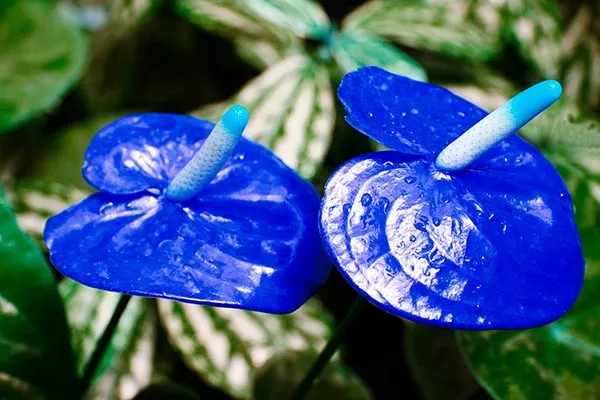
- Blue, light blue, ultramarine. This color can only be found in artificially bred anthuriums. Often, sellers simply tint white varieties, passing them off as more expensive blue/light blue varieties.
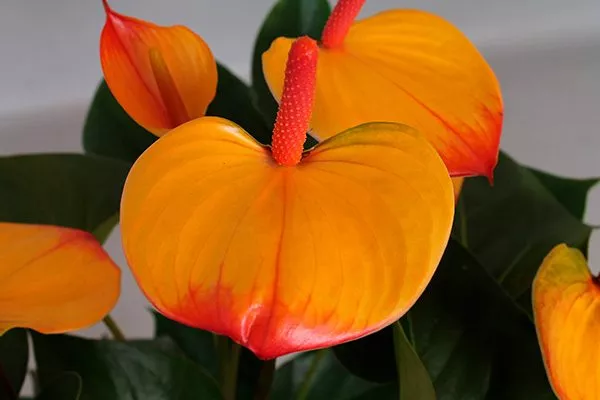
- Yellow and orange. These anthuriums look extremely original and vibrant. The bracts often match the color of the spadix.
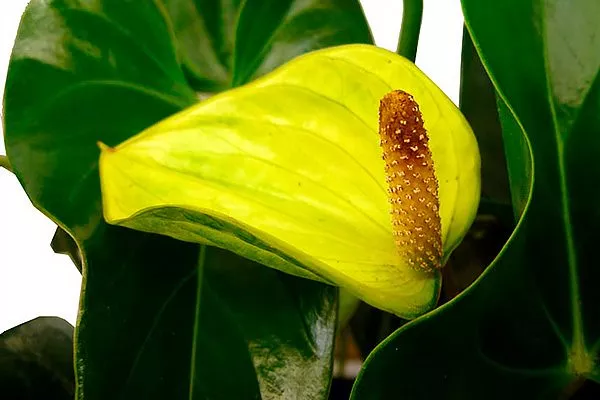
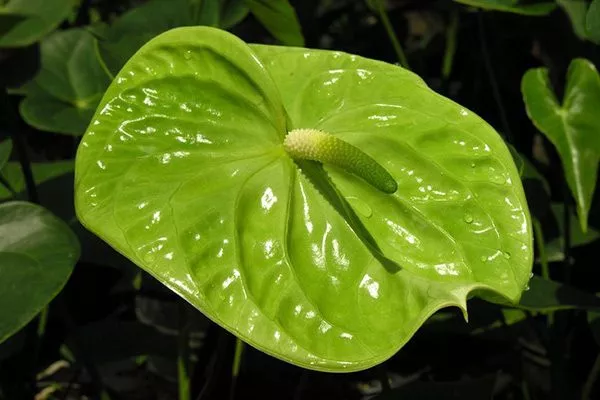
- Green. These anthuriums look especially beautiful in floral arrangements. Plants with yellow cobs are especially beautiful.
How to choose?
When choosing an anthurium for indoor growing, it's important to consider the plant's characteristics and the conditions it will be growing in. Many anthurium species cannot be grown in regular homes and apartments due to their strict growing conditions; they are grown only in greenhouses.
What to look for when choosing an anthurium:
- State. If there are grey or black spots on the back of the leaves, the plant is either affected by pests or is unhealthy.
- External features. A good flower has all its parts in proportion. It should be free of any defects, such as spots, pruning marks, or damage.
- Number of buds. The more unopened buds a plant has, the longer it will bloom.
- Substrate condition. It should be moderately moist. Neither excessive dryness nor excessive humidity are acceptable. The substrate should not emit a rotten, damp, or musty odor. All these signs indicate poor care; such anthuriums have a weak immune system and will often become ill.
- Roots. If roots are sticking out of the drainage holes, the plant is too small for its pot. It will soon need to be repotted.
Anthurium is considered the most common exotic flower for indoor cultivation for good reason. It's hard to find a more suitable exotic plant for interior decoration—beautiful, easy to care for, with a long flowering period and easy propagation. If you don't have an anthurium yet, hurry to rectify this omission—with so many varieties, you're sure to find a flower to suit your taste.