
Anthurium, or flamingo flower, is a striking houseplant that blends harmoniously into modern interiors. In nature, this plant grows in tropical rainforests, so when growing it, it's important to create the right conditions and provide proper care.
Botanical description and structure of anthurium
Anthurium (Latin: Anthurium) is an evergreen herbaceous plant, predominantly climbing, rarely woody. The plant occurs in various forms. It belongs to the Araceae (or Araceae) family and is the most numerous member of this family. The genus contains up to 900 species.
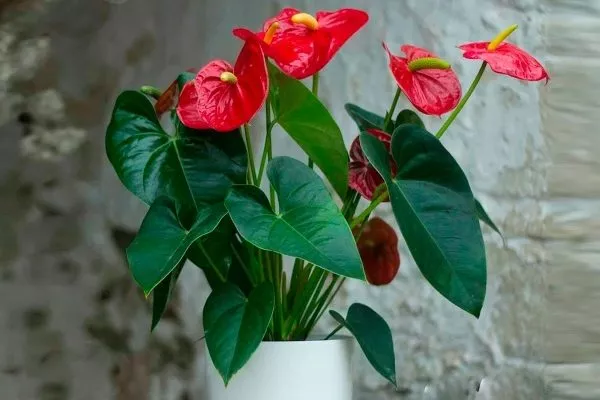
Anthuriums are represented by the following life forms:
- epiphytes - they grow on trees and have aerial roots that go down to the ground;
- hemiepiphytes - they begin to grow in the upper tiers of the forest and, descending to the ground, begin the life of terrestrial plants;
- lithophytes - They are adapted to life in rocky and stony environments.
Among anthuriums, there are also species that enter into symbiosis with ant colonies.
Roots
| Name | Life form type | Leaf shape | Inflorescence color |
|---|---|---|---|
| Epiphytes | Aerial roots | Heart-shaped | Diverse |
| Hemi-epiphytes | Ground and aerial roots | Heart-shaped | Diverse |
| Lithophytes | Ground roots | Lanceolate | Diverse |
Anthuriums don't have very long roots, so they don't need large pots. Most indoor varieties have aerial roots, which they inherited from wild tropical epiphytes. Anthurium roots are particularly fragile and easily damaged during repotting.
Stems and leaves
| Name | Leaf shape | Surface of leaves | Leaf structure |
|---|---|---|---|
| Spatulate | Spatulate | Matte | Fragile |
| Rounded | Rounded | Glossy | Leathery |
| With blunt tops | With blunt tops | Semi-gloss | Leathery |
Anthuriums have thick stems, often shortened, rarely elongated (15-30 cm). The shape of the leaves varies by species, and they are usually located at the ends of the stems (this does not apply to terrestrial species). The leaves are vertical or gathered in a rosette. In some species, the leaves reach 1 m or more in length.
Anthurium leaf shape:
- spatulate;
- rounded;
- with blunt tops.
Terrestrial species and epiphytes often have heart-shaped leaves, which look particularly striking indoors. There are also species with lanceolate and multipinnate leaves.
The leaves of this flower can be either entire or complexly dissected. The leaf surface depends on the anthurium species and can be matte, glossy, or semi-glossy. Leaf texture varies widely, from fragile to leathery.
Species that grow in relatively dry environments have a rosette of leaves folded like a bird's nest. This collects water and plant debris, which later turns into organic fertilizer.
Flowers
| Name | Inflorescence shape | Color of the cob | Smell |
|---|---|---|---|
| Club-shaped | Club-shaped | White | Nice |
| Cone-shaped | Cone-shaped | Green | Nice |
| Spiral | Spiral | Red | Unpleasant |
| Spherical | Spherical | Pink | Nice |
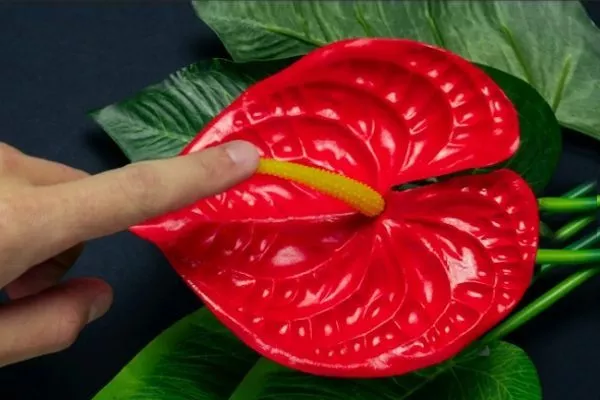
The inflorescence is a spadix, the color and shape of which depends on the type of anthurium.
Possible inflorescence shapes:
- club-shaped;
- conical;
- spiral;
- spherical.
The cobs can be white, green, red, pink, purple, or a combination of these. The flowers are densely packed on the cobs. The flowers are exclusively bisexual, have a four-membered perianth, and four stamens.
The spathe of the inflorescence is usually white or green, but can also be brightly colored—red, pink, purple, and even multicolored. The scent also depends on the species and ranges widely, from pleasant to unpleasant.
Fruit
Anthurium fruits are fleshy, juicy berries containing numerous seeds. The berries range in color from red to black, and can also be bicolored or striped. The seeds are flat-convex in shape.
As the berries ripen, they emerge from the perianths, hanging by two stripes. They are eaten by animals and birds, dispersing the seeds.
Origin
Anthuriums grow in tropical and subtropical regions of Central and South America, from Mexico to northern Argentina. These flowers are especially common in the South American Andes and the Central American Cordillera.
Anthuriums are found across a wide range of altitudes—from sea level to 3,400 meters above sea level. In the highlands, epiphytes predominate, while lower elevations, at 100-300 meters above sea level, are home to specialized anthuriums called savannah anthuriums.
Legends about the plant
In their South American homeland, anthuriums are widely used in folklore. Legend has it that the flower was once a beautiful maiden who chose to perish in a fire rather than marry a cruel Native American chief.
The gods, appreciating the girl's selflessness, transformed her into a beautiful red flower. Colombian Indians ascribe magical properties to the anthurium—it is believed to bring prosperity and well-being to the home. Here, bouquets of anthurium are always placed in the homes of newlyweds.
Types
There are many species of anthuriums: an estimated 900 varieties. Breeders have divided indoor varieties of this "male joy" into several main groups to make it easier for gardeners to navigate the vast number of varieties of this flower.
All anthuriums are divided into three large groups, differing not only in external characteristics, but also in their uses:
- Beautifully flowering. These plants are used not only for interior decoration but also for creating floral arrangements and bouquets. Their leaves are typically heart-shaped and patterned, and their inflorescences are small.
- Deciduous. These are climbing plants resembling vines. When grown indoors, they require support. The leaves of these varieties are oval or oblong, rich green. The flowers are typically muted, pastel colors.
- Ornamental foliage. These anthuriums have long, drooping stems and rich green leaves.
Each species and even cultivar of anthurium requires its own unique care requirements. Furthermore, they can differ significantly in certain characteristics. For example, some anthuriums have an extremely pleasant aroma. However, there are cultivars with a downright repulsive odor—this should be taken into account when choosing a flower.
Features of flowering
In nature, anthuriums can bloom year-round. However, to realize this potential indoors, it's necessary to create a special microclimate, maintaining a specific temperature and humidity level.
How indoor anthuriums bloom:
- Duration. At home, flowering lasts from several hours to a month.
- Deadlines. Flowering time usually occurs in July-August - anthurium blooms in the hottest weather.
- Features of flowering. During the female phase, only the stigmas are visible, while the stamens are hidden in the recesses of the perianth. Then, a sweet, sticky fluid appears on the stigmas, attracting insects. When this fluid dries and the stigma no longer accepts pollen, the stamens emerge from beneath the perianth.
- Care during flowering. During this period, loosening the soil, repotting, and treating the plant with chemicals is prohibited. Watering should be increased, even as frequently as once a day.
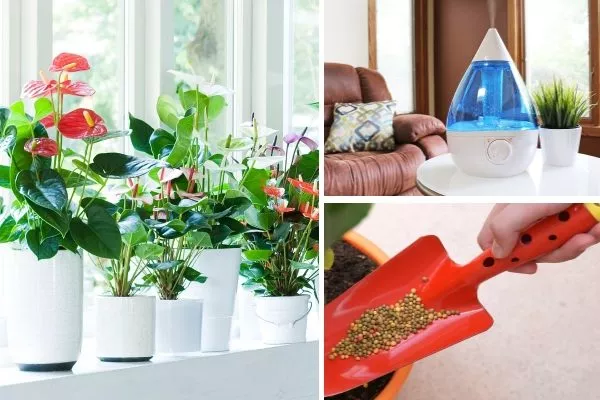
If your anthurium refuses to bloom, increase the humidity by running a humidifier. Complex mineral fertilizers and adjusting the lighting to bright but diffused levels can also help.
Flowering conditions
Young anthuriums begin blooming at two years of age. However, the duration of their blooming period directly depends on growing conditions and care. Sometimes, the plant fails to bloom at all because the environment is unfavorable. In this case, it is necessary to adjust the care and growing conditions.
Rules for anthurium flowering:
- Water the plant with room-temperature water. When letting the water settle, be careful that it doesn't spoil, causing blooms or rot.
- Cover the soil with moss to prevent it from drying out.
- Avoid placing the pot in direct sunlight. If necessary, shade the window or move the plant to partial shade.
- In winter, turn on additional lighting.
- Do not move the flower from place to place too often - this will negatively affect flowering.
- Move the flowering plant from a brightly lit area to diffused light.
- Feed the flowering plant once every 2 weeks - this will increase the duration of flowering.
- Remove the spathes from fading flowers to prevent the plant from wasting energy on them. Deadhead faded flowers promptly.
What color can flowers be?
Indoor anthuriums don't come in a wide variety of colors, but there are enough to choose from to suit your taste. In addition to red, white, pink, and yellow anthuriums, there are also variegated and bicolor varieties.
Popular Anthurium colors:
- Red. The bright spathe looks picturesque against the dark green leaves. The bracts are red, either lighter or darker than the spathe. Popular red varieties include Sierra Magic, Turenza, and Dakota.
- White. If the flower has a white spathe, the bracts are most often red, beige, or pinkish. These are typically long-blooming varieties. The most popular are Scherzera, White Heart, and Princess Amalia Elegance.
- Pink. These varieties are usually short. Popular pink varieties include Jolie, Pink Champion, and Lady Love. Most pink anthuriums are hybrids. They are known for their ease of care.
- Yellow. Anthuriums come in a variety of yellow shades, from soft lemon to canary yellow. The most popular varieties are Princess Alexia and Picasso.
- Orange. The most popular varieties are Rainbow Champion and Vanilla. These anthuriums are especially popular due to the beautiful contrast of their orange flowers with their dark green leaves.
- Violet. Popular varieties include Cavalli Purple, Picasso Purple, Utah, and Fiorino. All varieties were developed through selective breeding. They not only boast a striking appearance but also strong immunity. Spathe color ranges from light pink to deep purple.
- Green. Popular varieties include Picasso Green, Midori, and Baby Green. These are typically medium-sized plants with green or brown bracts.
What is the difference between anthurium and spathiphyllum?
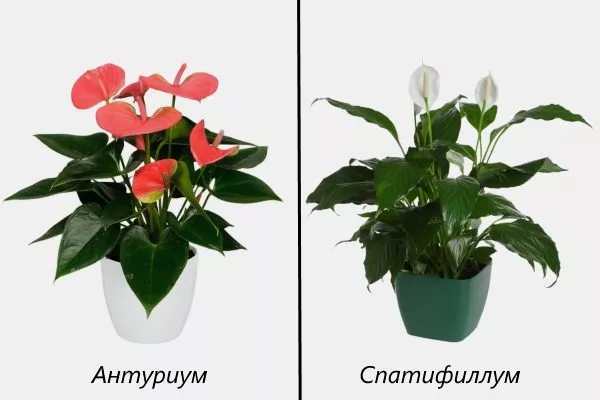
Spathiphyllum is a perennial evergreen plant that resembles anthurium in appearance. They even share similar names: while anthurium is popularly known as "male happiness," spathiphyllum is known as "female happiness." In nature, spathiphyllum occurs in both terrestrial and epiphytic forms.
What are the differences:
- Unlike anthurium, spathiphyllum does not have a stem - long petioles grow vertically directly from the ground.
- Anthuriums have larger flowers, which come in a wide variety of colors. Spathiphyllums have white flowers, and the spadix is yellow or greenish.
Growing conditions
The quality of anthurium flowering, its growth, and development directly depend on growing conditions. The closer these are to the ideals for a particular species/variety, the longer the flowering period and the healthier the plant.
When growing anthuriums, it's important to remember that they all thrive in warmth and humidity, but they absolutely cannot tolerate shade. The indoor climate should be as close to tropical as possible.
General recommended growing conditions for anthuriums:
- Temperature. In summer, the thermometer should not drop below 24°C. The ideal temperature is 26°C. In winter, the temperature is maintained at 16…18°C. At lower temperatures, the plant goes into dormancy—it does not grow or bloom.
- Lighting. Anthurium requires plenty of light. It's not recommended to place other plants near it. The best locations are south- and east-facing windows.
- Air humidity. For normal flower development, humidity levels of 75% are necessary. In dry air, when the heating is on, a humidifier should be used.
- Priming. Anthuriums aren't picky about soil composition, so any soil or commercially available growing medium will do. It's best to use special potting mixes for indoor plants. They prefer soils with a neutral pH.
- Pot. Regular ceramic pots with drainage holes in the bottom are preferable. The main requirement for a pot is sufficient depth, as anthuriums have a fairly extensive root system.
- ✓ The optimal temperature for anthurium should be maintained within the range of +24°C to +26°C in summer and not lower than +16°C in winter.
- ✓ Air humidity must be at least 75%, which requires the use of a humidifier during the heating season.
Care conditions
Anthuriums look like strong plants, but they require certain care to grow and develop successfully.
Main events:
- Watering. Watering should be moderate but regular. In summer, water the plant every two days; in winter, water it every three days. If the soil dries out quickly, water the plant daily. It is recommended to supplement watering by misting the leaves. It is best to apply water using a spray bottle.
- Top dressing. The plant is fed every three months with complex mineral fertilizers (formulated for indoor plants). Wood ash, which is rich in potassium, crushed eggshells, and used tea leaves are added monthly.
- Trimming. This is done when the anthurium is not blooming. The stems are cut at an angle, from top to bottom. If the plant is heavily branched, it needs to be shaped; for smaller bushes, trimming dry leaves is sufficient.
- Transfer. This is done once every three years. It's important to repot the plant without damaging its extensive roots. The repotted plant is watered generously, and the soil is covered with a layer of moss to retain moisture.
- Rejuvenation. Old plants can be rejuvenated by pruning the top and side shoots. It's best to remove all above-ground growth, leaving the roots in place.
Reproduction
Anthuriums are easy to propagate vegetatively—it's simple, quick, and effective. The key is to create the right conditions for rooting—water the young plant properly and maintain an optimal room temperature.
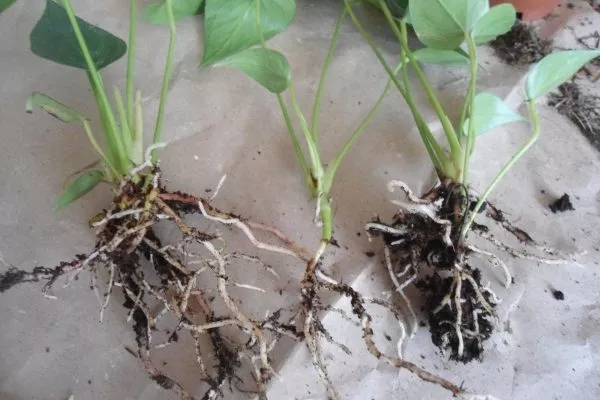
Vegetative propagation methods of anthurium:
- Cuttings. A small shoot is cut from the green part and replanted in a separate pot. Leaves and aerial roots can also be used as cuttings.
- By dividing the bush. Water the parent plant before the procedure to make it easier to remove from the pot. When dividing the roots, it's important to ensure each section has at least one growing point and one leaf. Replant at the same depth as the plant was originally planted.
- Leaves. They are taken from mature plants. The leaf is cut so that the cutting is no more than 4 cm long. It is rolled into a tube and planted in a pre-prepared pot. Only 1/3 of the leaf should remain above ground.
- Offshoots. A small offshoot is separated from the parent plant and planted in a prepared pot. Offshoots usually take root well.
| Method | Rooting time | Success rate |
|---|---|---|
| Cuttings | 2-4 weeks | 80% |
| By dividing the bush | 1-2 weeks | 90% |
| Leaves | 3-5 weeks | 60% |
| shoots | 1-3 weeks | 85% |
Anthurium can also be propagated by seed. However, this process is long and labor-intensive. It is typically used by breeders developing new varieties. This method is rarely used by gardeners, and anthurium seeds germinate extremely poorly indoors.
Diseases and pests
Anthuriums are often affected by fungi, viruses, and various insect pests. Both folk remedies and various commercially produced products can help combat these diseases. Some anthurium diseases can be cured without the use of special treatments, by adjusting the growing conditions.
Common diseases:
- Septoria. This fungal infection is accompanied by the appearance of yellow and brown spots. Spraying with Bordeaux mixture and a soap/salt solution is recommended.
- Anthracnose. The fungus causes leaves to dry out and brown spots to appear. It only takes a month for this disease to kill the plant. The solution is to spray with copper sulfate and reduce watering.
- Fusarium. This disease is caused by a fungus. It is accompanied by wilting and yellowing of the leaves. The solution is spraying with fungicides, such as Previkur and Fitosporin-M.
Insect pests pose just as much of a threat to anthuriums as diseases. They can quickly and catastrophically worsen the plant's condition and even lead to its death.
Pests parasitizing on anthurium:
- Aphid. These tiny insects live in colonies and suck nutrients from plants. When they appear, anthurium leaves curl, the plant dries up, and growth slows. The solution is to spray with insecticides, such as Actellic or Fufanon.
- Spider mite. When infected, a web appears on the underside of the leaves. In addition to the chemical treatments mentioned above, biological treatments such as Fitoverm and Akarin can be used. Washing the leaves with soapy water and using specialized mite control products (acaricides) are also recommended.
- Scale insects. These are brown bugs that feed on plant sap. When infected, dark, sticky spots appear on the leaves, and brown bumps appear on the undersides. The plant stops growing and dies. Regular insecticides are ineffective; special systemic agents are needed, followed by treatment with mineral oil.
- Thrips. These small insects are dangerous because they can infect plants with viruses. Their excretions also promote fungal diseases. When thrips infest the leaves, they turn yellowish-white. The solution is to spray with Omite or Vertimek.
If a plant is infested with pests, action must be taken as soon as possible. Otherwise, the plant will die and infect neighboring plants.
How to resuscitate?
If your anthurium is dying, you need to try to save it. There are several signs that indicate the plant needs resuscitation.
Warning signs:
- the plant does not bloom for a long time;
- bare stem;
- shrinking of leaves and flowers;
- trunk elongation and leaf fall.
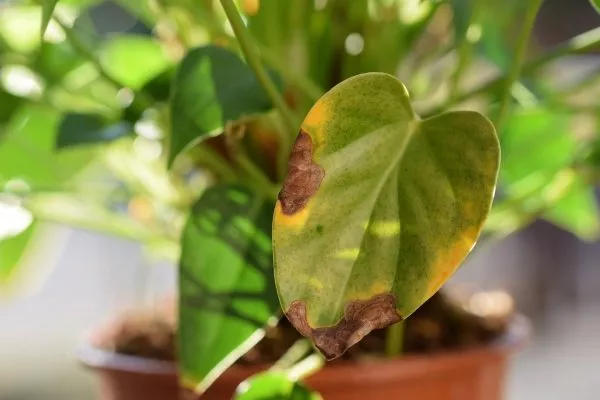
How to resuscitate anthurium:
- If a plant's leaves are curling, it means the light levels are off and the air humidity is inadequate. At the same time, the tips of the leaves are starting to turn yellow. To correct the situation and save the plant, move it to a warmer location or remove it from a draft.
- Using hard water can cause the plant to wilt. Freezing the water or filtering it helps achieve the desired softness. Hard water also causes the tips of the anthurium leaves to turn black.
- If a plant is actively shedding leaves, inspect the stems. They may have thickened areas where roots are growing. These can be used to revive a dying plant.
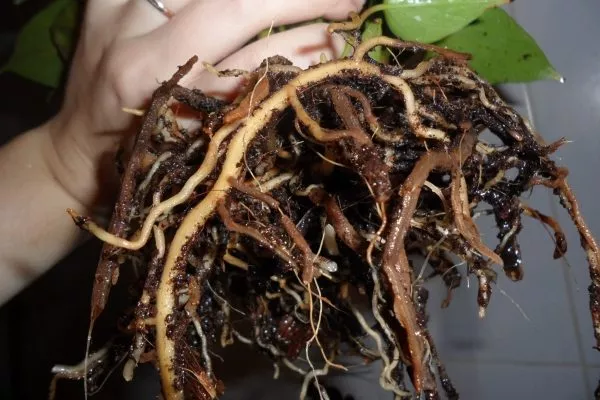
- If your anthurium's roots have turned black or yellow, they're infected or rotting. These roots should be removed, and a new plant can be grown from the living roots.
Precautionary measures
Anthurium can be safely grown indoors—it doesn't produce any poisons. However, its sap can burn skin and mucous membranes, and if ingested, it can cause poisoning.
Toxicity of leaves is common among members of the Araceae family. Ingestion can cause diarrhea, vomiting, and contact dermatitis. If you have small children in the house, be careful not to let them ingest anthurium leaves or stems.
Possible problems
Most often, problems when growing anthurium arise due to a lack of nutrients and poor care.
What problems can anthurium have?
- The leaves turned yellow. The plant is experiencing a potassium deficiency. The solution is to add ash or a complex fertilizer. Loosening the soil is essential. Read more about all the causes of yellowing leaves and how to correct the condition. here.
- The ends of the leaves have dried out. Increase watering and apply fertilizer. Inspect the plant for pests and take action if necessary.
- The leaves are curling. The cause is insufficient heat. This problem is often observed in winter. The solution is to turn on a heater (in winter) or move the plant closer to the sun (in summer). You can also turn on a lamp for additional heat.
- Spotted leaves. Yellow or brown spots are a symptom of rust. They can appear not only on leaves but also on buds. The leaves first darken and dry out, then the spots turn black, and the rust spreads from the leaves to the roots. The cause is overwatering. The solution is to reduce watering and humidity.
- The leaves and stems turn pale. This phenomenon indicates a nutrient deficiency. The solution is regular fertilizing with a complete fertilizer. Repotting into a larger pot is also recommended.
- The stem became bare. This symptom indicates iron and light deficiency. The solution is to use a complex fertilizer and move the plant to a south-facing window.
- The stem stretched out. This situation occurs due to a calcium and potassium deficiency. To compensate, it is recommended to feed the plant with a complex fertilizer.
- The stem withers. This occurs with fungal and viral infections. The solution is spraying with fungicides or antiviral agents for indoor plants, such as Inta-vir.
- The flower is "crying". If the leaves become damp, it means the plant is trying to get rid of excess moisture. This condition is caused by overwatering and requires no treatment.
- Aerial roots have appeared. If they're peeking out from under the leaves, it's time to repot the plant. The upper part of the stem with the aerial roots needs to be rooted. It's cut off and moved to a separate pot. Then, water the plant generously.
- The roots are rotting. This is caused by fungal infections. The solution is to spray with fungicides and repot, removing the rotten parts of the roots.
Frequently Asked Questions about Anthurium
Beginning gardeners often have questions about growing anthuriums. These flowers are relatively easy to care for, but if the growing conditions and guidelines aren't met, they can become diseased and wither. A particularly common reaction to poor conditions is a failure to bloom.
What do beginning gardeners ask:
- How to properly divide anthurium? When dividing a plant, the roots are first carefully untangled, then cut with a disinfected tool - a knife or pruning shears.
- Why do anthurium flowers turn green at the edges? This phenomenon may be caused by a lack of light or the natural aging of the plant. Furthermore, some anthuriums have green flowers as a varietal characteristic.
- Why doesn't the anthurium bloom? Most often, a plant fails to bloom due to insufficient light. This problem can be solved by moving the plant to a south-facing location and providing additional fertilizer.
- Why do yellow spots appear on a flower? To determine the cause of your anthurium's yellowing, look closely at the size of the spots. If they're large, it could be a reaction to overfeeding; if they're small, the plant is likely infested with spider mites.
Anthurium is a stunning flower, striking in its beauty and diversity. To ensure this tropical plant thrives and beautifies your home, it's important to provide it with a favorable microclimate and loving care.